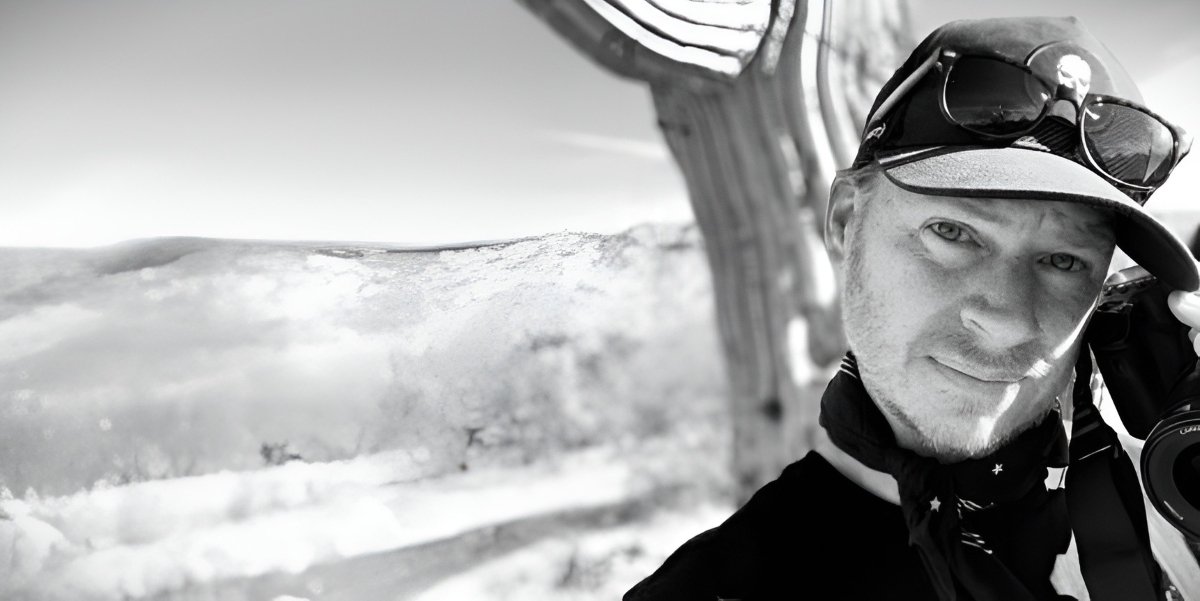

In many parts of rural America, photography has long been used to capture both the quiet rhythms of the landscape and the evolving faces of communities. Landscapes have remained a favorite at exhibitions that bring steady crowds. A 2023 report from the U.S. Bureau of Economic Analysis estimated that arts and cultural production contributed significantly to the U.S. economy, with visual arts accounting for a notable share of that total. While big city projects tend to make headlines, small-town endeavors and freelance photographers offer a different vision, one that presents life within communities not generally found on front pages.
Nathan Larson grew up within these diverse surroundings. He was born in 1973 in Tooele, Utah, and grew up in Utah, Arizona, Wyoming, Connecticut, and Vermont. He was constantly moving, which exposed him to various landscapes and groups before he graduated from Woodstock Union High School in Vermont. At the age of twelve, he had already enrolled in darkroom classes, having been encouraged by a sixth-grade teacher to explore photography. Early life experimentation with film and printing served as a precursor to a career combining observation and storytelling.
Following high school, Larson attended Brigham Young University and graduated from the University of Chicago with a bachelor’s degree in anthropology. Throughout college, he wrote music reviews for the Chicago Maroon and worked in college marketing for Atlantic Records. He further acquired an interest in natural conservation, making research contributions to Round River Conservation Studies’ efforts to reintroduce the Mexican wolf to Arizona. These experiences blended academic research with creative vision, a combination that would re-emerge in his future projects.
Larson’s career in photography began after college, when he began selling prints. His subjects ranged from wildlife to rural townscapes, often mixing traditional film techniques with digital methods. He has described his process as one that gathers fragments of text, field notes, and poetry alongside photographs. The result is a body of work that functions as both documentation and narrative. In 2012, he edited and photographed 250 Years / 250 People: Windsor, Vermont, a community portrait celebrating the town’s long history. Two years later, he co-created Why We Stay: Royalton, Vermont, a photo essay and oral history project developed with his sister, photographer Chris Cammock. Vermont Public Radio showcased the project in April of 2014, drawing broader attention to the portraits and interviews series that explored why residents decide to stay in rural areas.
The influence of Larson’s photography is not just local. Since 2021, a significant portion of his body of work has been licensed through Wild Apple Graphics, an international fine art licensing agency. Licensing enables artists to place their work in global galleries, design companies, and commercial customers. Wild Apple, with its Vermont headquarters but global distribution, makes print and digital copies available to a wide range of retailers and art consultants, presenting Larson’s work to eyes far beyond the small towns where most of his photographs are from.
Larson’s methodology tends to involve integrating text and images into hybrid journals. He incorporates field notes, personal essays, poetry, and discovered natural matter, seeking to offer photography not as a single image statement but as one link in a continuum. This process was evident in shows like the 45th Annual Carriage Barn Arts Center Photography Show, where his photograph “Cook Inlet Brown Bear/Bear in the Wind” was chosen by Brett Abbott, the New Britain Museum of American Art Executive Director. Juried exhibitions like this one remain competitive; the Carriage Barn Arts Center usually receives hundreds of works each year from across the United States.
Aside from exhibitions and licensing, Larson still publishes books that combine images with words. His forthcoming collection, Field Notes on Avoidance, due for publication in 2025, combines photography and poetry collected on long journeys around North America. Previous publications are Cloud Hunter (2012) and Avian (2017), both of which incorporated sparse text with photographs of wildlife and landscape. These books add to an increasing market for photography books. Art and photography titles have had consistent sales in recent years, exhibiting stability even as other print categories are falling, according to the Association of American Publishers.
Larson’s work tends to focus on the lives of residents in small towns, but his photographs also exhibit a steady concern with natural environments. Broad valleys in Vermont, forests in the American West, and coastal areas of Alaska recur in his portfolio. He photographs in both color and black-and-white, with film and digital cameras and alternative printing processes.
Media coverage has followed this reconciliation of nature and society. Vermont Public Radio covered Why We Stay, and local newspapers, such as the Valley News, reported on his projects in Windsor. Websites like Fine Art America offer his licensed pieces, and streaming sites like Apple Podcasts and Spotify feature his highly rated podcast, WonderBuzz. Though his professional experience involves some forays into healthcare innovation and hospitality, these pursuits are distinct from the subject of his photography and do not dominate the visual art with which he is primarily associated.
Larson works throughout North America, frequently covering great distances for photographs and for his podcast WonderBuzz with Nate Larson, which started in 2025. The podcast combines travel narrative, poetry, and cultural critique and has a 4.9 out of 5-star ranking on Apple Podcasts, indicating a broad fanbase. Nevertheless, photography is still at the forefront of his public identity. From the first darkroom sessions to international licensing agreements, his path shows how local projects become global in scope while remaining tethered to particular sites and individual pasts.
Nathan Larson’s career shows how a childhood interest in cameras can lead to a long-term career of visual exploration. His photographs of rural landscapes and townspeople, his books that blend image and poem, and his participation in juried shows constitute a document of both natural and human landscapes. As he prepares Field Notes on Avoidance for publication and continues to license work through Wild Apple Graphics, Larson engages in a practice that bridges personal observation with broader cultural concerns.