
By: Lindsay Jeffords
What gives something value? Is it the material, the lifespan, or the story behind it? Many people define value by appearances: what shines, what lasts, what can be sold. Gerhard Petzl questions this instinct.
For Gerhard, worth emerges from the act of creation itself. His works in chocolate, bronze, and repurposed materials form a dialogue with those who encounter them, prompting viewers to reconsider how importance and meaning are assigned.
The Foundation of Creative Freedom
From his early days in Graz, Gerhard understood that mastery is rooted in reverence for materials, for process, and for patience. Discipline and careful attention did not confine him; they gave him the freedom to shape ideas into form and imagination into tangible expression. “My professional culinary background, paired with private travels, different cultures, languages, art styles, chocolate projects, and chocolate installations around the globe, formed me. I am always striving for a masterpiece in the end,” he reflects. The artwork should be worth showing in public or shared at all.
These early foundations shaped not only his skill but his mindset. Discipline, for Gerhard, was never restrictive. It became a framework that allowed imagination to remain grounded, intentional, and precise.
Becoming a Master and Choosing More
At just 21, Gerhard became Austria’s youngest Master Pastry Chef. Many would have rested on such a milestone, but for him, it was only the beginning of a journey. He spent the next decade working in the kitchens of the world’s finest hotels, earning his entrepreneurial and teaching credentials along the way.
“I never thought about being a brand; it evolved into something. Being authentic to myself is my brand. No fake, just real qualities as a human being, on ethical and moral standards, and most importantly on the quality of the works provided,” he says. For Gerhard, identity and artistry grew organically, not from strategy or expectation.
Expanding Possibility at Thirty
After nearly a decade of refining pastry, Gerhard returned to school at 30 to study Art and Design, focusing on sculpture at the Ortweinschule in Graz, Austria. The decision was unconventional, yet it allowed him to translate the precision of the kitchen into sculptural form, chocolate installations, bronze works, and multidimensional creations. Food art had shaped him, but it no longer defined the boundaries of his work.
This period reinforced his belief in continual growth. “The constant challenge and re-invention of myself is the key and secret. As I age and develop every day, my views, techniques, interests, and media also change. Exploration and discovery are my constants in life.” For Gerhard, learning remains an ongoing process rather than a completed phase.
Recognition Through Excellence
Gerhard’s work has been tested in environments where standards are uncompromising. Gold at the Culinary Olympics in Berlin in 2000, awarded for Best Chocolate Showpiece while representing the Singaporean National Team, remains one of the industry’s rare distinctions. This was followed by WACS Global Master Chef certification, national recognition in the United States as one of its five leading chocolatiers, and the Master Chocolatier of the Year Award in New York in 2017, markers of a career shaped by consistency rather than spectacle. He loves to explore and share scientific discoveries and visual beauty, as he did with one of his published books: “Chocolate Crystals: The Soul of Chocolate. He found something new that all the Chocolatiers before him may have noticed but did not explore further, because chocolate bloom was considered the enemy.
For Gerhard, it opened the door to a new universe, which he studied privately for years, drawing on over 100 different origins and samples from all over the world. It was then finally shared after this phase with his renowned ‘Planet Series,’ where chocolate bloom resembles real planets in space. Yet Gerhard measures success differently. Rather than pursuing recognition, he remains focused on the work itself. Achievements acknowledge skill, but they do not define his direction. Recognition, he believes, emerges naturally when curiosity and discipline remain in balance.
Global Influences, Personal Vision
Gerhard draws inspiration from every corner of the world. Time spent across four continents exposed him to rituals, histories, and artistic traditions that continue to inform his work. Each year in Japan, he steps away from the controlled environment of his studio to confront raw wood, carving large-scale sculptures with a chainsaw. The physical intensity of this process challenges him in ways that contrast with the measured precision of his refined studio practice.
For Gerhard, curiosity is constant rather than occasional. “Trash for you could mean gold for me. Materials I find in daily life, such as peels, husks, discarded cables, moss, or even paper pulp, become elements in my art. The boundary between doing art and living as an artist is the same for me,” he says, illustrating how observation and awareness guide his creative decisions.
Structure That Supports Freedom
Gerhard spent nearly a decade immersed in food- and product-innovation, a field defined by tight timelines and high expectations. The experience sharpened his ability to think clearly under pressure and translate concepts into outcomes efficiently. That discipline now supports his artistic practice, where careful planning coexists with experimentation.
“I have worked for almost a decade in R&D for food products and the innovation team. That means I am built to deliver on time and deliver ideas and concepts ad hoc if necessary. Precision and structure are part of my creative process,” he explains. Reliability and clarity sit alongside imagination as core elements of his work.
Seeing Beauty Everywhere
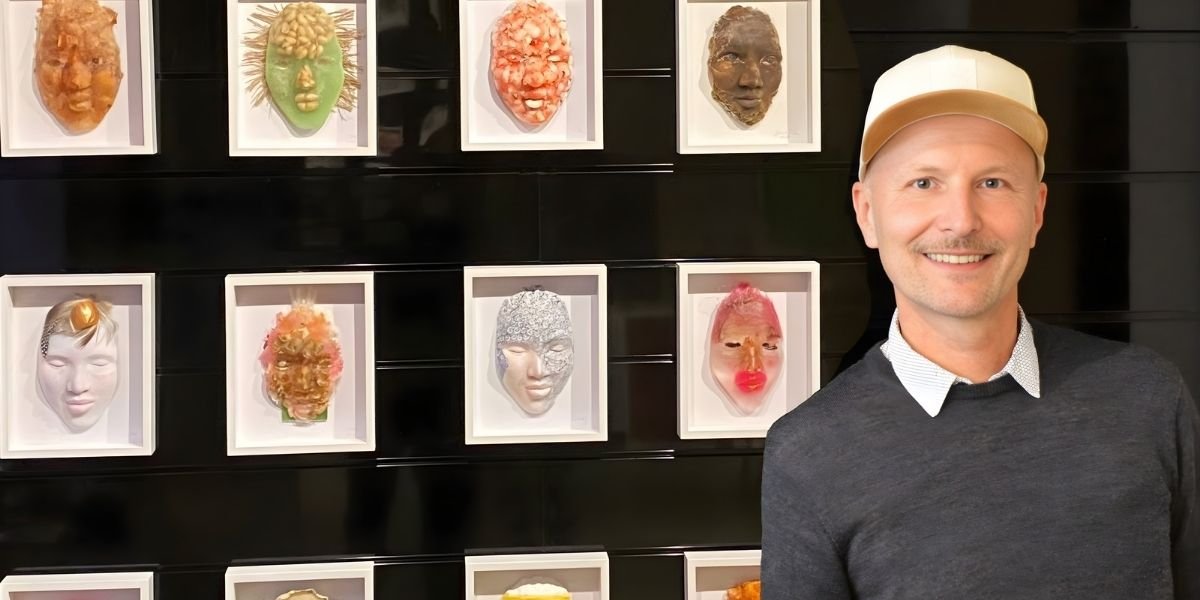
In Gerhard’s hands, overlooked materials are reimagined in his masks series. Peels, shells, husks, wires, moss, and lichen are woven into sculptures, masks, and installations, each shaped with intent. Even a paper pulp egg carton, designed for single use, can be transformed into a spiraling shell, a sculpted spine, or a bronze object meant to endure, encouraging a reassessment of what is considered disposable and the value of objects in general.
He also navigates the balance between fleeting and enduring value. “I love stable value like gold coins or bronze sculptures, and I also value chocolate sculptures, which are just for the moment to enjoy. One is ephemeral, the other lasts for generations—it’s about balancing presence and permanence.” For Gerhard, every material carries meaning, regardless of lifespan.
Creating with Intention
Each collaboration becomes an opportunity for exploration. Working with cultural institutions, exhibition spaces, and private collectors, Gerhard shapes materials into expressions that carry layered narratives. Chocolate serves as a temporary experience, meant to be fully engaged in the moment. At the same time, his bronze and metal works continue that conversation over time, remaining as physical records of intention and craft.
Sustainability remains central to his practice. Materials are reconsidered rather than discarded, and waste is deliberately minimized. In his bronze and metal works, human and natural forms intertwine, resulting in compositions that are visually intricate and conceptually grounded. These works function not simply as objects, but as lasting expressions of presence and thought.
A Practice Still Unfolding
Following a recent pop-up gallery in Switzerland that presented more than one hundred works, Gerhard continues forward without a fixed endpoint. For him, the practice remains open-ended. Over time, his focus increasingly shifts toward bronze and metal, materials that resist ephemerality and allow ideas to persist beyond the moment of creation.
In Gerhard Petzl’s work, value emerges through intention and care. Impermanence becomes a strength, overlooked materials gain relevance, and the act of creation itself moves to the foreground, inviting viewers to engage more deliberately with meaning, material, and time.