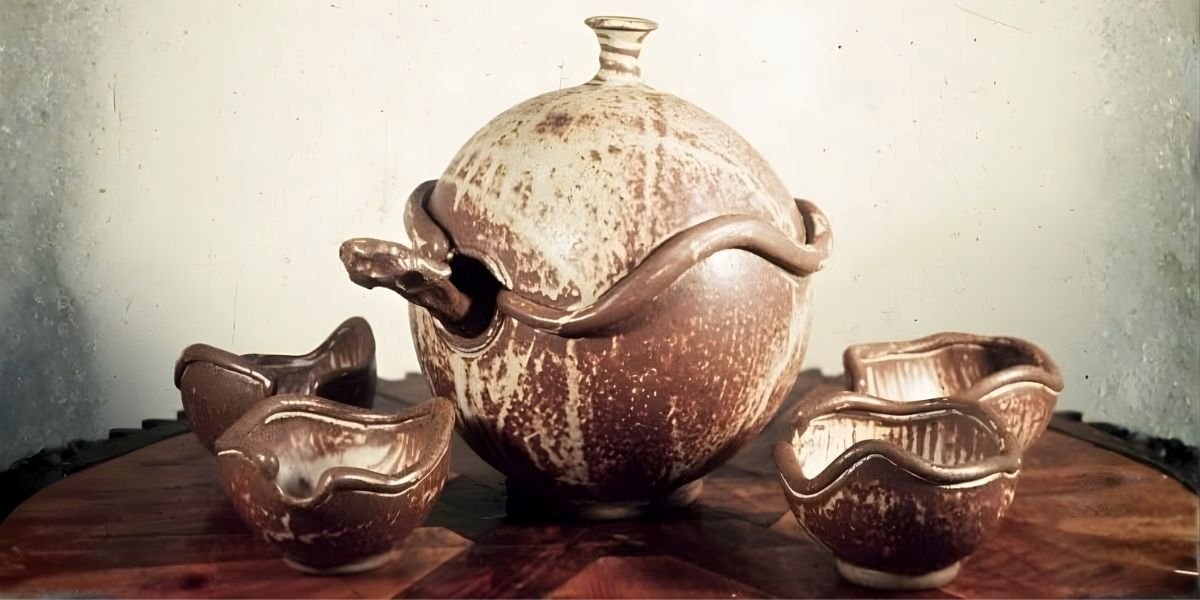

The emergence of ceramic art in the United States during the latter part of the twentieth century involved notable influences from artist communities in various regions that intermingled live/work practices with studio practices. During this time, small groups of artists connected to develop shared communities to both research similar technical experiments and processes of artistic expression, as well as develop ecosystems for locally made ceramics. These communities expressed the concepts and values of sustainability, and handcrafted methods, and sought to create mutual support, which paralleled cultural movements toward artisanal practices and collective art making. Thus, Louisiana and Arkansas became centers for new studio pottery, attracting artists who hoped to achieve both professional development and community in ceramics.
Jeff Robinson was born in 1949 in New York. He became involved in the field of ceramics after studying business at Florida Atlantic University (FAU) in the late 1960s. With a strong desire to learn ceramics, Robinson transitioned away from the business track and began studying ceramics. At FAU, he eventually became an apprentice of David Tell, a ceramic artist, from 1969 to 1973, who was a faculty member of FAU during those years. Through this apprenticeship process, Robinson learned all of the basic skills needed to sit behind a wheel, glaze ceramics, and run a productive studio. His training provided him with knowledge in technical execution as well as in arranging functional systems for the purpose of expressing design. These early experiences significantly influenced Robinson’s practice in co-existing in a communal studio and developing multiple collaborative art projects with colleagues later on.
In 1970, Robinson moved to Thibodaux, Louisiana, and helped start Good Earth Pottery with a number of other artists. Good Earth Pottery functioned as both a studio and a community, and eventually sat on approximately 120 acres of land. The idea of the group was to combine creative practice with daily living by building individual houses, roads, and necessities for the people living there and their families. Good Earth quickly received attention in the Southeastern United States for its role in studio pottery production, particularly in terms of its innovative forms and surface decorations. Between 1970 and 1975, the studio received several awards and was featured in local print and public media as it became a notable entity in the artisanal community.
The move of Good Earth Pottery to Evening Shade, Arkansas, in 1976 initiated a new phase of career for Robinson as an artist and for the studio as an organization producing ceramics. The Arkansas site allowed for increased space for production, exhibition, and residency, and provided the artists an opportunity to explore more daring technical and conceptual pieces. Robinson continued to prioritize his full-time studio practice, developing ceramics that were designed to have colorful, flowing patterns. During this period, Good Earth Pottery maintained a presence in national galleries and fine art exhibitions, demonstrating both the commercial viability and cultural significance of the collective’s work. The studio’s exhibitions contributed to the visibility of Southeastern American ceramics within broader national networks.
Between 1970 and 1981, Good Earth Pottery’s recognition extended beyond regional awards to a range of exhibitions and critical attention. Robinson and his collaborators participated in gallery shows that highlighted experimental techniques and creative compositions, situating their work within the evolving discourse of American studio pottery. The community model also underscored a broader trend in the arts during the period, in which shared living arrangements, co-created infrastructure, and collaborative production facilitated both artistic exploration and practical sustainability. The integration of residential and studio space allowed residents to maintain consistent engagement with their craft while fostering an environment of peer learning and mentorship.
The work of Robinson during this time became a harmony of professional skill and design sensibility. The ceramics output and other products of Good Earth Pottery possessed large, powerful patterning and subtle glazing techniques that made full use of their understanding of material properties and aesthetic principles. The ceramics stabilized a group style where local creatives again built on the aesthetic character of other Southern artists and collaboratives throughout the Southeast region, spanning the next forty to fifty years. The favorable press coverage Good Earth Pottery began to receive in the 1970s was due not only to the formal artistic dimensions of the work, but also because of the community values established by their cooperative studio and understanding of creative production.
Good Earth Pottery also assisted its members in allowing the community to be a structure that offered ways to experiment with being artists over a sustained period. Members of this collaborative structured the decision-making regarding the studio space, exhibition planning, and building systems that better supported the collaborative. The community reflects part artistic progression and part plans to build systems that better support the practical needs of housing and some utilities. Formally, Robinson and his collaborators understood that integrating professional practice and communal residence gave insight into how artist communities can better understand how to exist as a social and creative enterprise.
Ultimately, Robinson’s work in ceramics was the basis of his later explorations into additional media in woodworking and sculpture. However, his work in the 1970s and early 1980s holds an important place in the historical record of Southeastern American studio pottery. The merger of Robinson’s skillful making, Good Earth Pottery’s group-based logistics, and the Southeastern cultural context established a distinct prototype of studio pottery. Robinson’s apprenticeship to David Tell and the practice of the studio signified a joint effort for creative development in the visual arts with formal education and current studio practices. A significant attention to his early artistic endeavors is evidenced by his many awards, national exhibitions, and media publications, highlighting the professional reach of Robinson’s practice within the community of ceramics.
Jeff Robinson’s early years at Good Earth Pottery, as a microcosm of craft, community, and professional practice, exemplify the broader precepts of and the intertwined relationships in American ceramics. His career trajectory in the 1970s and early 1980s demonstrated the significance of small cooperative studios in defining regional art movements and creating pathways for viable technique and relocation for artists. These legacies continue to contribute to the understanding of collectives of artists and to build the ongoing development of contemporary craft networks with understandings shaped by the practices of studio communities in the Southeastern United States.