
At The Glory of Christ Art Heritage, artists from around the globe bring a distinct visual perception of Christ to a shared sacred tradition.
Few subjects place as much history on a painter’s shoulders as the figure of Jesus Christ. An artist approaching Christ is entering a visual tradition shaped by nearly two millennia of icons, frescoes, illuminated manuscripts, altarpieces, oil paintings, sculptures, and monumental church commissions.
Yet that inheritance has never produced only one image of Christ.
Across periods and cultures, artists have emphasized different dimensions of the same figure. Christ has appeared as teacher, healer, suffering servant, king, judge, sacrificial figure, and resurrected presence. His face has been rendered with serenity, anguish, compassion, authority, vulnerability, and triumph.
Every new painting therefore begins with a difficult artistic question: how can a subject already depicted countless times be seen with renewed clarity?
At The Glory of Christ Art Heritage, the answer is not to impose one standardized image. Founded by Nir Ziso, the contemporary Christian Fine Art initiative commissions artists from around the globe, each of whom approaches Christ through an individual visual sensibility.
The artists do not form a single school and are not required to adopt a common house style. What connects their work is a shared subject, a commitment to theological seriousness, and the use of classical Fine Art painting techniques. The commissioned originals are executed exclusively in oil or acrylic, while their contemporary character emerges through composition, atmosphere, color, scale, and psychological presence.
The face of Christ is never a neutral decision
When an artist paints Christ, even the smallest decision carries meaning.
The direction of the eyes can suggest compassion, confrontation, sorrow, or transcendence. The position of the head can communicate humility or authority. The treatment of the hands can emphasize blessing, suffering, invitation, or sacrifice. Light can describe the physical setting while also functioning as a sign of revelation.
A painter must also decide how close Christ appears to the viewer. A distant, formally composed figure may create reverence and solemnity. A closely cropped face may produce intimacy and psychological immediacy. A monumental figure may dominate the canvas, while a smaller figure surrounded by witnesses may shift attention toward the human response to his presence.
These are not secondary stylistic details. Together, they form the artist’s visual perception of Christ.
That perception is shaped by more than technique. It can reflect the artist’s cultural surroundings, spiritual understanding, emotional temperament, and personal way of seeing the human figure. The subject remains Christ, but the visual encounter changes from one artist to another.
A world of experience enters the painting
The Glory of Christ Art Heritage works with artists from different countries and cultural environments, with company materials describing commissioned artists across six continents.
Geography does not automatically produce a recognizable regional style, and it should not be reduced to superficial ideas of cultural difference. Its influence can be much more subtle.
An artist’s environment may shape the quality of light that feels natural, the emotional restraint or expressiveness of the figures, the relationship between foreground and landscape, or the way physical suffering is represented. Cultural memory may influence the rhythm of a composition, the use of color, or the balance between realism and symbolism.
One artist may see Christ primarily through stillness. Another may approach him through physical presence and human vulnerability. Another may emphasize radiance, movement, or the responses of those surrounding him.
The result is not a collection of unrelated religious images. It is a series of individual artistic encounters with a shared sacred figure.
The company’s official Instagram archive provides a view of the range of visual approaches associated with its developing collection.
Classical materials and a contemporary eye
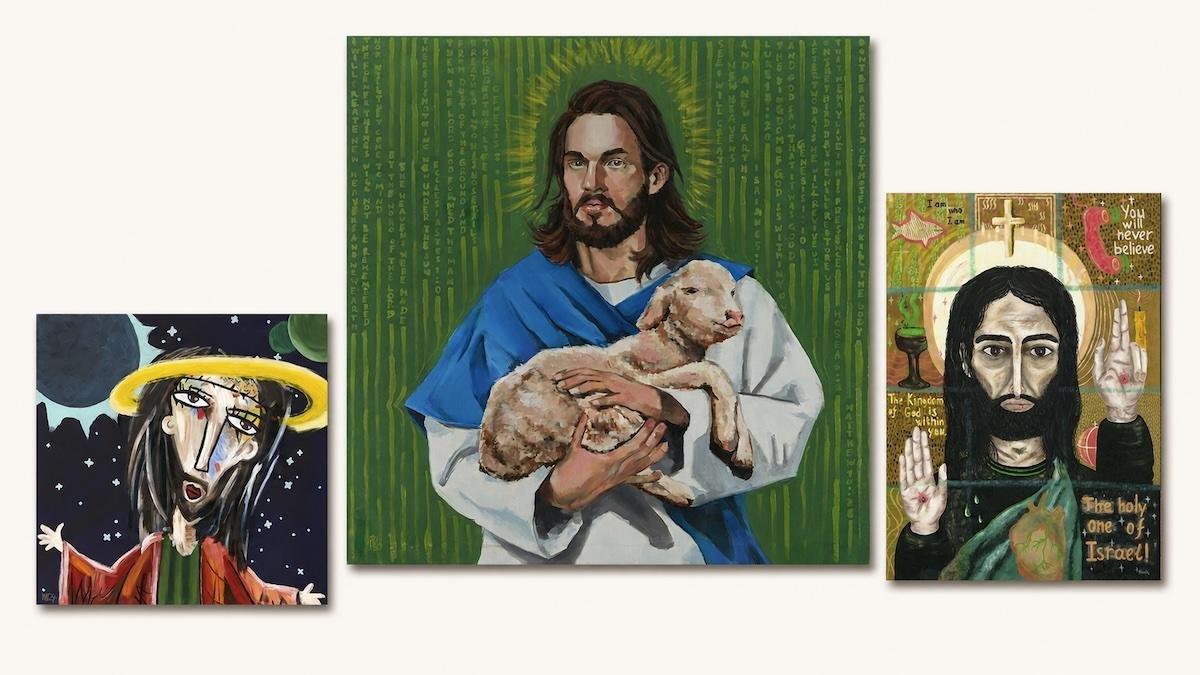
Photo Courtesy: The Glory of Christ Art Heritage (Paintings commissioned by The Glory of Christ Art Heritage demonstrate how artists from different parts of the world bring individual visual perceptions to the figure of Christ.)
The word “contemporary” is often associated with new technology, unconventional materials, or the rejection of established artistic methods. That is not the model used here.
The original paintings commissioned by The Glory of Christ Art Heritage are created only in oil or acrylic. The artists rely on the enduring disciplines of painting, including tonal construction, layered color, glazing, modeling, controlled brushwork, and the physical development of a painted surface.
The contemporary quality of the work comes from the artist’s vision rather than from technological novelty.
A painting can feel unmistakably current through an unexpected crop, an intensified palette, a compressed setting, or a more immediate psychological relationship between Christ and the viewer. Contemporary scale, negative space, dramatic contrast, and unusual compositional balance can alter how a familiar narrative is experienced without abandoning the traditional medium of painting.
This distinction is essential to the project. Classical technique does not require historical imitation. Oil and acrylic remain capable of expressing the visual and emotional concerns of the present.
Theology provides the center, not the finished image
The artists are given room to develop their own visual perception of Christ, but that freedom does not mean the subject is treated as entirely open-ended.
According to the company’s commissioning framework, each work begins with a subject rooted in Scripture and Christian tradition. The theological meaning is established before the visual language is fully developed.
“The theological content governs the work; the aesthetics serve it,” Ziso has said.
This principle gives the commission a center without prescribing one predetermined image. The artist still makes the central pictorial decisions: how Christ occupies the space, how the surrounding figures respond, where the light originates, and what emotional tone governs the scene.
Ziso describes this as freedom within the tradition. The phrase recognizes that sacred art contains boundaries, but also that those boundaries can produce artistic concentration rather than uniformity.
The aim is not to give every painter an identical template for Christ. It is to ensure that each artist’s interpretation remains connected to the meaning of the sacred subject.
Many visions do not mean many different messages
The idea of multiple artistic perceptions requires a careful distinction.
The project is not suggesting that Christ can be made to mean anything an artist chooses. Its position is that a consistent theological subject can generate many legitimate visual interpretations.
A painter may focus on Christ’s compassion without denying his authority. Another may emphasize suffering without reducing him to suffering alone. A Resurrection painting may concentrate on divine radiance, while another may focus on the astonishment of the witnesses.
The theological event remains recognizable, but the emotional and pictorial center can shift.
This is where individual perception becomes artistically valuable. A painter does not need to repeat every dimension of the Christian understanding of Christ in one canvas. The artist can enter one moment, one gesture, or one psychological tension and develop it with enough depth to reveal something that a broader, more generalized image might miss.
Authentic variety therefore comes from emphasis, not contradiction.
The difficulty of avoiding a house style
Any initiative working with multiple artists faces two opposing risks.
The first is visual incoherence. Without a clear standard, the collection can become a loose accumulation of paintings connected only by subject matter.
The second is excessive control. When a commissioner attempts to make every work look consistent, the individual artist’s intelligence can disappear. The collection may become recognizable, but only because every painting repeats the same formula.
The Glory of Christ Art Heritage is attempting to occupy the space between those two outcomes.
Its common framework is theological and qualitative rather than stylistically uniform. The company says it looks for mastery, reverence, originality, and a visual language capable of carrying the sacred subject. Its approved artist statement describes the task as entering Christian tradition deeply and rendering eternal truths through a living visual language.
That approach places significant responsibility on the curatorial process. The commissioner must recognize when an artist’s interpretation is original and meaningful, and when novelty has begun to overpower the subject.
It must also know when to intervene and when to allow the painting to remain unmistakably the artist’s own.
The painting must carry its own authority
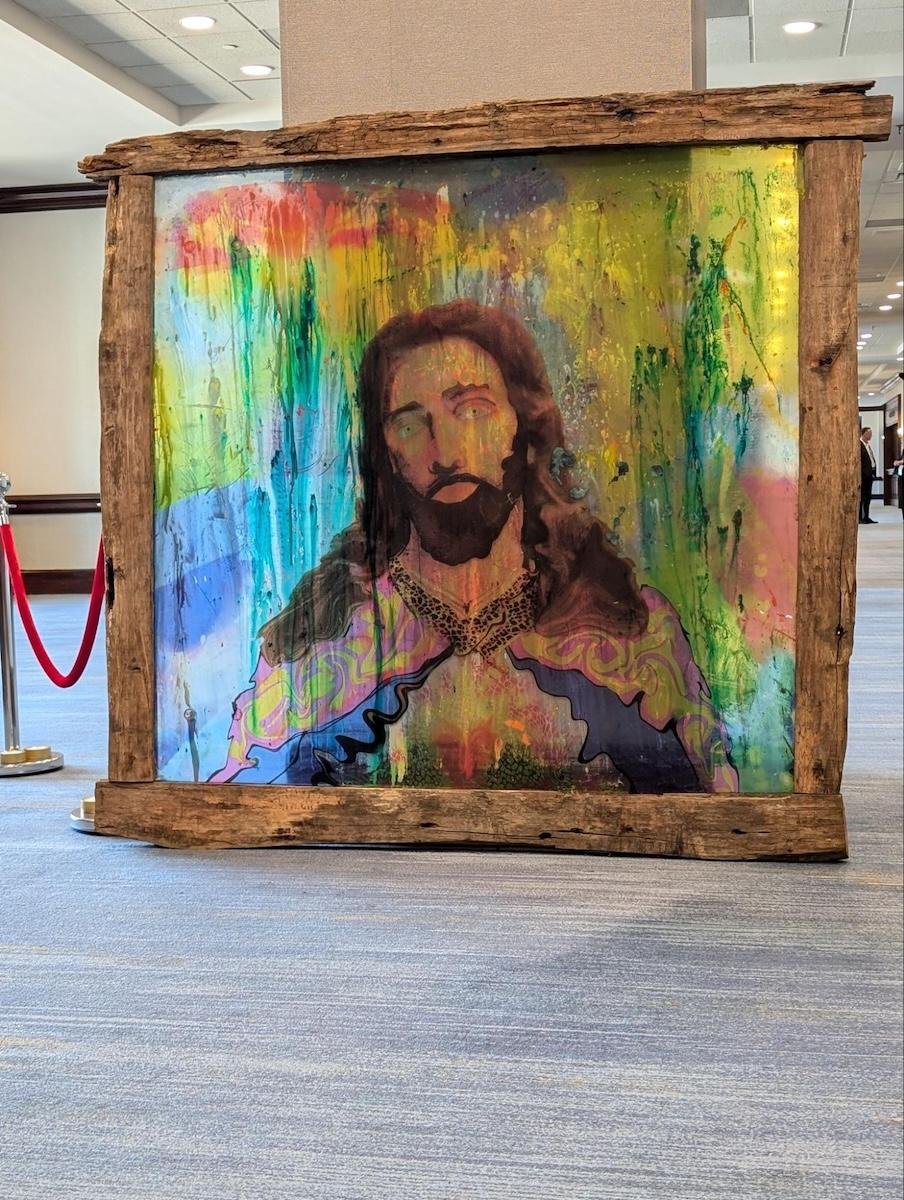 Photo Courtesy: The Glory of Christ Art Heritage (Illumination of Sacred Heart, Oil and Acrylic on glass, 150 x 150 cm / 59 x 59 in., Brandon Fisher, Brazil.)
A Christian subject cannot compensate for a weak painting.
The seriousness of the message makes artistic judgment more important, not less. Composition, anatomy, light, spatial structure, color, and brushwork must still withstand examination. The figures must possess emotional and physical presence. The image must hold together before an accompanying explanation tells the viewer what it is meant to signify.
This is particularly important when sacred art is presented outside a strictly devotional setting.
A believer may initially respond to the biblical subject, but a broader Fine Art audience will also examine how the painting functions as an object. Does the composition lead the eye with purpose? Does the surface reward close attention? Does the contemporary treatment arise from a genuine artistic need, or has it been added merely to signal relevance?
The strongest works will not ask the viewer to choose between theological meaning and artistic quality. Each will reinforce the other.
One figure and many encounters
The diversity of artistic perception can also change how viewers encounter the collection.
A person who feels distant from one formal or historical representation of Christ may respond to another interpretation with greater immediacy. One viewer may be drawn to quiet realism, another to expressive color, and another to a composition built around dramatic light or emotional restraint.
This does not make the meaning dependent entirely on personal preference. It recognizes that different visual languages can open different points of entry into the same subject.
For The Glory of Christ Art Heritage, the original painting remains the source of that encounter. Authenticated limited editions may allow selected images to circulate more widely, but the artistic process begins with the physical oil or acrylic work and the individual perception that shaped it.
The company presents its wider exhibitions and institutional activity through its official LinkedIn page.
The central proposition of the initiative is therefore not that one painter can provide the definitive contemporary image of Christ. It is that artists from around the globe can approach the same sacred figure with different eyes, while working within a shared theological and artistic discipline.
One Christ can be seen through many artistic perceptions.
The question is whether each painter can make that perception sufficiently honest, skillful, and visually powerful to allow the familiar subject to be encountered again.