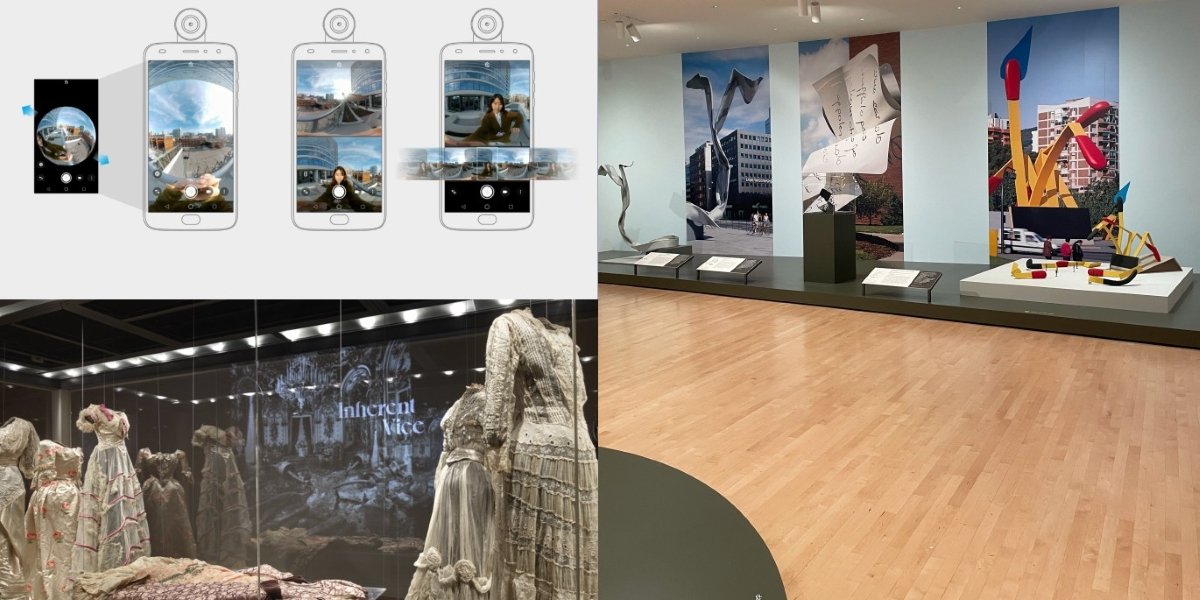


For designer Mina Kim, every project is part of a larger orchestrated system where visual identity moves fluidly between digital and physical forms. Her work spans from Motorola’s award-winning camera design to exhibition identities at the RISD Museum and the San Francisco Museum of Modern Art (SFMOMA)—each demonstrating how design can organize perception across materials, scales, and contexts.
At the RISD Museum, Kim designed the visual identity for Inherent Vice (Jan 29–Jul 10, 2022), an exhibition exploring the fragility of historic textiles. The system referenced the show’s themes of deterioration and material memory through restrained typography and subtle motion elements that suggested disintegration. The identity lived across gallery graphics, publications, and digital screens—maintaining a cohesive tone without flattening the complexity of the subject.
Kim’s ability to adapt design systems to the specific needs of each project has been a key factor in her success. Whether working on a museum exhibition or a consumer product, she brings a deep understanding of the cultural context and audience. For example, her work on the Inherent Vice exhibition at the RISD Museum required her to engage with the material history of textiles, interpreting fragile objects through design. She didn’t just create an aesthetic; she communicated the essence of the exhibit—one that highlights the vulnerability of history—through visual elements that evoked fragility. The same thoughtful approach is applied in her work for commercial products, ensuring that the identity feels both timely and timeless, bridging the gap between immediate consumer appeal and lasting brand relevance.
She also designed the identity for Variance, another RISD Museum exhibition examining ideas of shifting form and interpretation. The work translated curatorial concepts into visual rhythm—creating continuity between wall graphics, labels, and digital applications.
“In a museum, design has to move through multiple channels,” Kim explains. “You encounter it on walls, in print, on screen—it has to hold together as one system.”
Alongside her work in museums and technology, Kim has applied this systems-driven approach within commercial environments as well, including visual merchandising and launch campaigns at Stila Cosmetics, where she translated brand strategy into spatial and graphic systems across retail and digital touchpoints.
In Kim’s work, the ability to blend form with function is crucial. She believes that design should be intuitive, allowing users to experience seamless transitions between different interfaces. At Stila Cosmetics, for instance, her ability to create harmonized spatial and graphic systems was instrumental in enhancing the customer experience both in-store and online. By unifying the brand’s messaging across multiple touchpoints, from the physical shelves to digital ads, Kim helped strengthen the brand’s presence, making it instantly recognizable and fostering deeper connections with consumers. Each element—whether a product display or an Instagram post—felt like part of a larger narrative, making the overall experience more immersive and memorable for shoppers.
Before her museum work, Kim contributed to Motorola’s Moto 360 Camera Mod, part of the company’s 2018 Red Dot Award recognition. Her focus was on making a new 360-degree imaging technology approachable through visual clarity and system logic. Reviewers described the Mod as “easy to use and compact enough to bring along,” noting its thoughtful balance of simplicity and depth.
Now at SFMOMA, Kim applies the same orchestral approach to exhibition and institutional design—developing visual systems that connect environmental graphics, printed matter, and digital activations. Her work at the museum spans major exhibitions, including the international collaboration RM × SFMOMA and Big Thinking: Oldenburg & van Bruggen exhibition, each requiring distinct visual strategies while maintaining institutional coherence. Rather than treating these as separate disciplines, she designs them as interdependent parts of a single language.
Across her work, Kim positions design as more than surface or style—it is the architecture of connection. By orchestrating relationships between media, scale, and context, she creates systems that shape how people read, move, and understand the world around them.