

By: Valentina Shaeva
In her visual practices, Qishan Li is particularly drawn to the human body, which is under constant pressure and tension. Undoubtedly, every day we experience pressure from the system, space, and even the gaze of an onlooker. Artist’s previous work piece, Y3, currently on view at 1215 Gallery in Canada, makes this tension visible and almost physically palpable. However, Li’s approach is not through the spectacle inherent in video art, but through the restrained rhythm of repeated images. Y3 does not explain itself. Instead, it conceals its obvious meaning. Digital art compels viewers to slow down, look closely, and perceive the image as a coded form rather than a narrative.
In Y3, Li employs segmented and repeated frames and rhythm to convey a sense of control born of the anxiety associated with a constant need for attention. The work reflects the artist’s interest in how the environment shapes human behavior. She is particularly interested in public spaces associated with productivity and self-improvement, such as the gym. This issue directly resonates with her current work, SELF IN THE MIRROR, completed in 2025. However, in this work, the artist’s focus becomes more specific and focused.

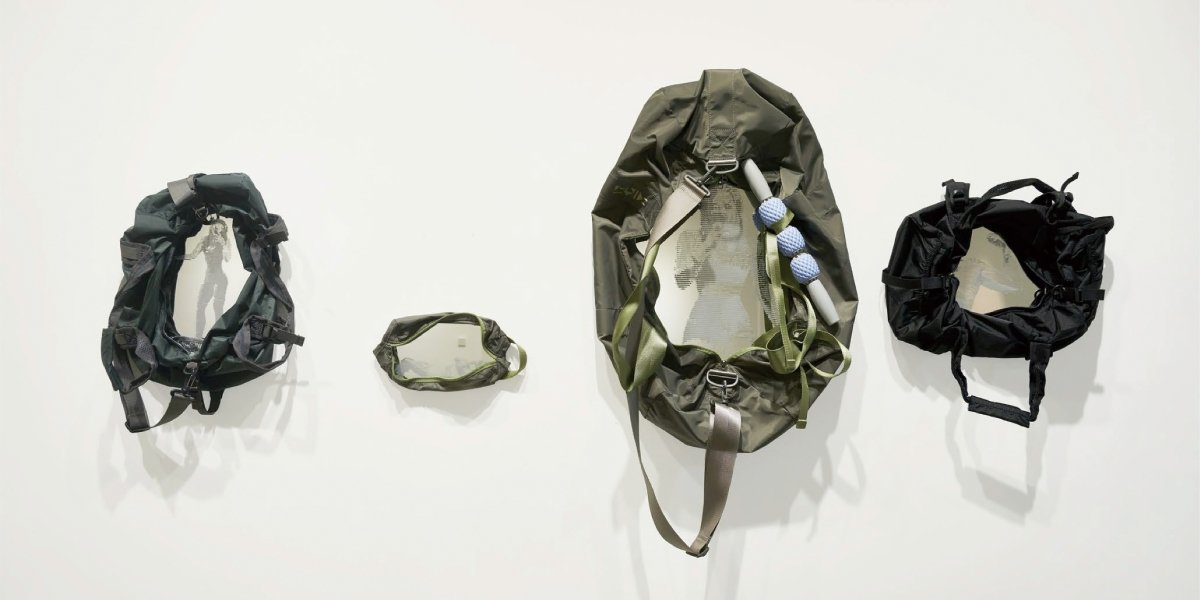
Photo Courtesy: Qishan Li (Y3, Qishan Li, 2024. Installation view of ‘When Everything Slows Down’, 1215 Gallery, Montreal, Canada.)
The exhibit SELF IN THE MIRROR presents the gym as a gendered, rather than neutral area. The artist sees the gym as a place where contemplation of the beautiful body and the praise of strength play a dominant part. The mirror plays a key role in the exposition. Li’s artistic approach is based on transforming the mirror by digitally transferring images from gym selfies onto it. These images are hidden within the bag and coded. In this way, Li complicates the viewer’s work, as they cannot easily discern the depicted female body within the gym bag without some effort and imagination.
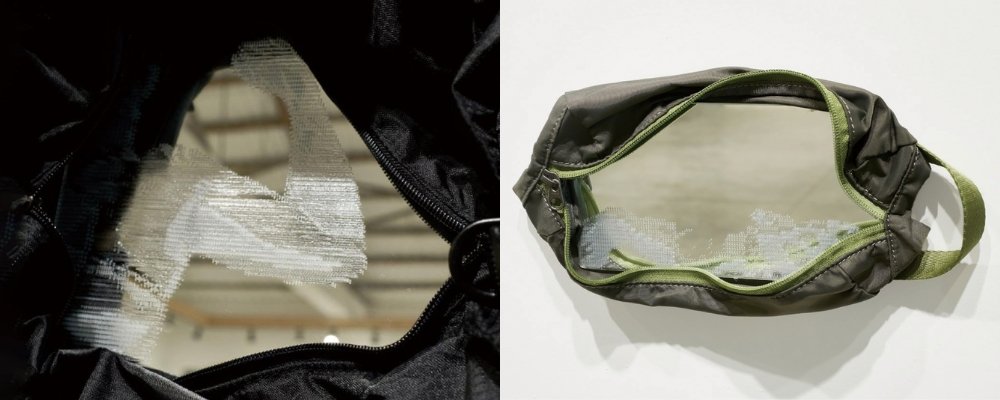
Photo Courtesy: Qishan Li (SELF IN THE MIRROR, Qishan Li, 2025 / SELF IN THE MIRROR, Qishan Li, 2025)
Speaking about the characteristic features of visual practice, there is a certain intimacy in it. Nevertheless, the materials from which the work is created are quite simple: a mirror, sports bags, UV stickers, and a sports vibrator, arranged without irony. Li does not aestheticize them, but presents them as established facts. The artist demonstrates the illusion of control over identity and challenges traditional gender roles, often imposed on women through athletic training. Instead, the visual language demonstrates a desire for bodily autonomy and self-identification. At the core of Li’s artistic practice is the conversion of images intended for self-presentation using digital tools that strip them of their clarity. The mirror no longer confirms identity, but rather questions it. The reflected female body is unstable and blurred, and it is precisely this instability, declarative in nature, that confronts established notions of femininity, strength, and beauty.
In Y3 and SELF IN THE MIRROR, Li creates her unique language that explores issues of identity, gender roles, and imposed beauty standards. Her works convey a precise, concentrated tension through their choice of subject matter, materials, and perceptual space. SELF IN THE MIRROR compels the viewer to reflect again and again on their own strength and self-determination – profound and important questions for everyone, yet often ignored in our everyday lives.
About the author:
Valentina Shaeva is an Art Critic, International Art Curator, and Art Project Manager working with contemporary art. As the Founder of Russian Art Center, she delivers art project solutions for international cultural projects, from curatorial concept and artist selection to project management, advisory, and implementation.
Her practice focuses on advising private and corporate collectors; she combines curatorial strategy, critical expertise, and hands-on art project management to create structured, concept-driven projects that enhance spatial identity and cultural value.