

By: Tabish Khan
Everyone alive today is more surveilled than any generation that has come before us, and it’s likely future generations will never know an age when they aren’t being recorded. What does this do to our behaviour? Are we better behaved? Are we never allowed to be our true selves? Is it a mixture of the two?
These are the questions Renwei Liu is asking us to ponder in their digital workpiece ‘Delay Zone’. The concept of Jeremy Bentham’s panopticon, a prison where the prisoners never know when they are being observed and therefore behave as if they are always being observed, is a reality today. Through a mixture of closed-circuit television cameras and the cameras on everyone’s smartphones, and even through some smart glasses, we never know when we’re being recorded.
Jon Rafman’s work ‘The nine eyes of Google street view’ highlighted how many moments were caught on camera by Google’s cars as they mapped streets, catching illegal and candid moments unexpectedly. The work was only made fifteen years ago, but it feels rather quaint compared to the level of data that now passes through cameras and that data is sold to others. As the author Shoshana Zuboff states, we are living in a state of surveillance capitalism, and Liu’s work reflects that.
In Liu’s work, we see the protagonist being photographed and stared at by disembodied eyeballs. He wears a mask, but is it meant to represent the social mask we all wear when we appear on social media, or to hide his identity from everyone trying to establish who he is? My interpretation is it’s both. Given how present some individuals are on social platforms, it calls into question which identity is an accurate representation: the online avatar or the offline person of flesh and blood?
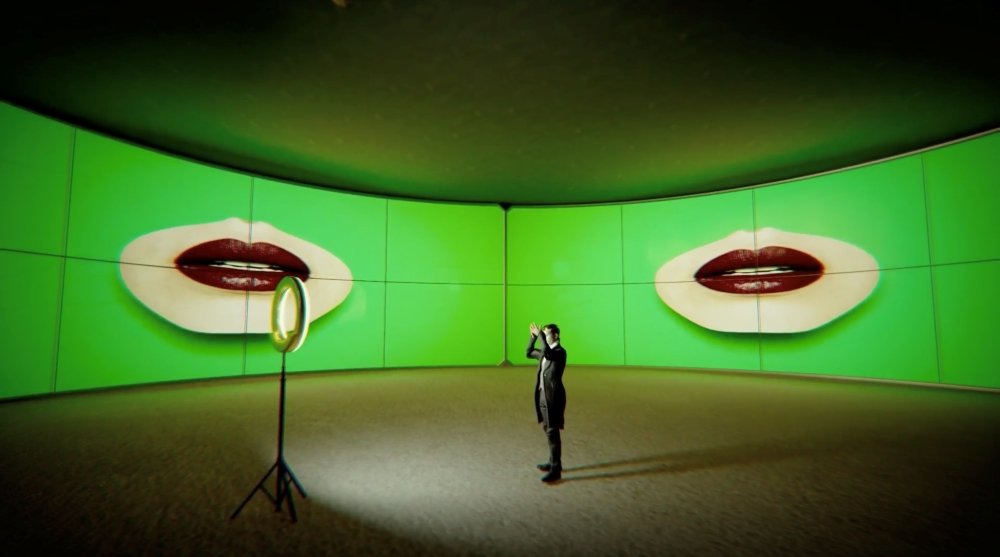
Photo Courtesy: Renwei Liu (Still Image of Delay Zone)
The crown on the protagonist’s head suggests the concept of main character energy, where people behave in public as if they are a main character in a movie or video game, and so deem it acceptable to disrupt the days of others because, in their worldview, strangers’ wants and needs are inconsequential. These individuals care more about likes and shares online than the shame of blocking traffic or a pedestrian’s path. We see this mimicked in the film as our character dances in front of a ring light.
The lack of clarity and blurred lines between truth and fiction remind me of Amalia Ulman’s ‘Excellences and Perfections’, a four-month-long performance on Instagram in which an individual drew engagement and sympathy from the public, who had no idea she was Ulman’s construction. Once it was revealed, many of the account’s followers felt betrayed.
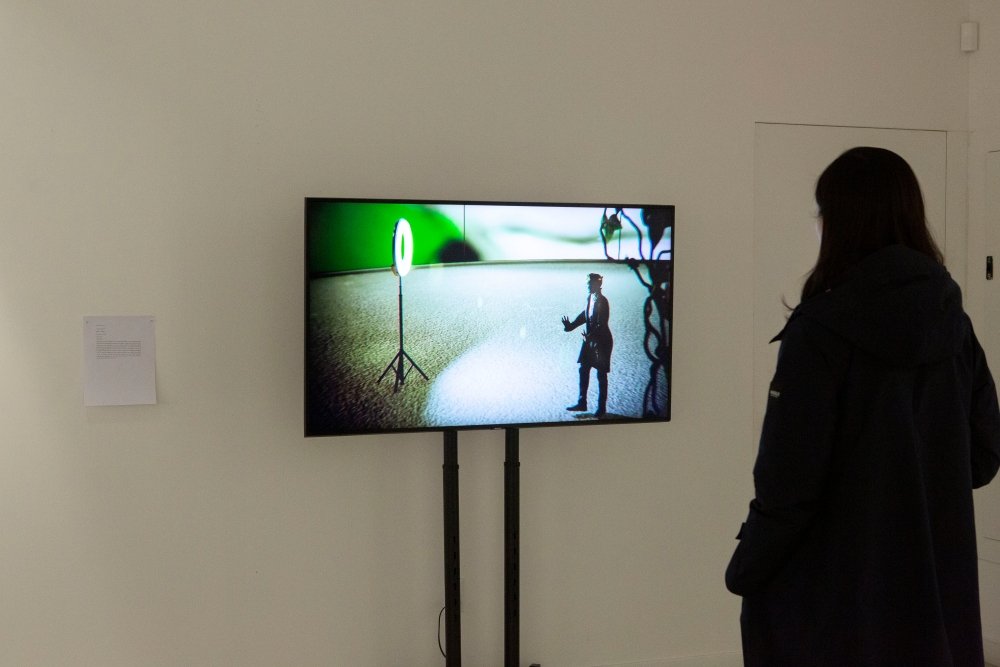
Photo Courtesy: Shaoyu Ba (Delay Zone, Renwei Liu, 2025. Installation view of ‘When Everything Slows Down’, 1215 Gallery, Montreal, Canada.)
Whispering sets of lips speak to our main character, but the words are intelligible, much like how the information overload online is often too much for people to make sense of, what’s real, what’s fake? The tone of green around these lips is the same as the green screens used for computer-generated sets in movies. In an age of deepfakes, when anything can feasibly be rendered, is misinformation going to spiral out of control to the point that none of us will know who or what to trust?
Rapid technological advances suggest we’re entering an unknown and uncertain future. Renwei Liu’s work highlights these concerns and asks us to contemplate what it may look like and whether we want it to come to pass.