
By: Jim Manley
Onstage, a family prepares for a Bat Mitzvah. There is planning to be done, food to be discussed, and jokes to be lobbed across the room. What lingers underneath, however, is not anticipation but unease. Something has happened. Everyone knows it. No one wants to be the first to say it aloud.
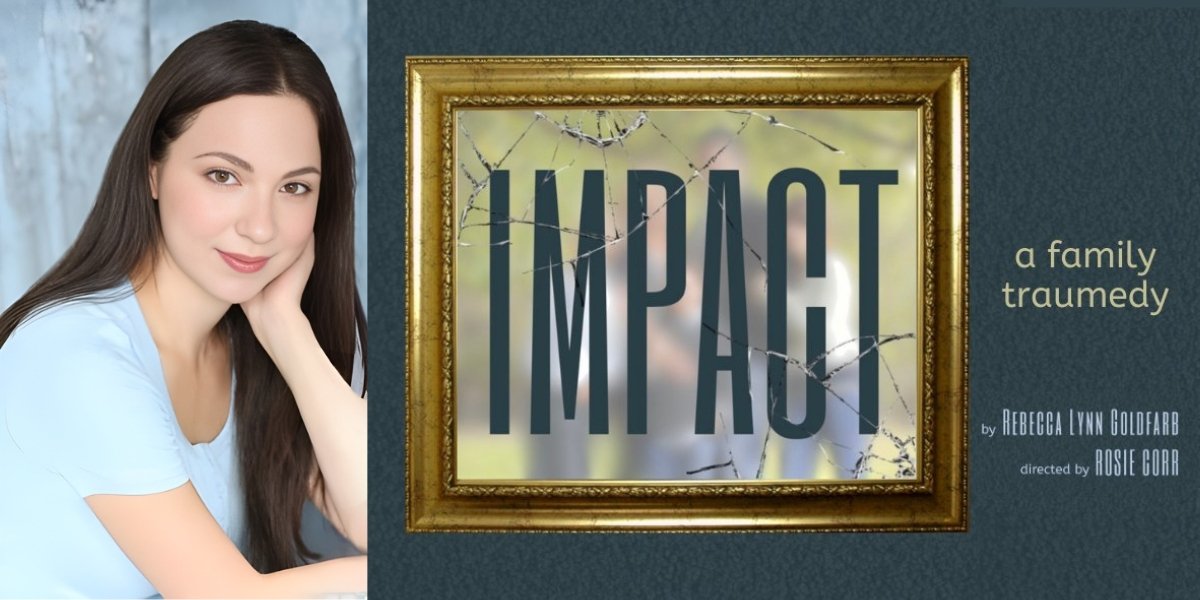
That uneasy calm is the terrain of IMPACT, a new play by Rebecca Lynn Goldfarb, running February 2 through 8 at The Tank. Directed by Rosie Corr, the production arrives after a long period of development and a sold-out industry presentation, carrying with it the quiet confidence of a work that seems to have a clear sense of what it is and what it intends to explore.
IMPACT is not a trauma drama in the traditional sense. It does not build toward a single revelation or cathartic release. Instead, it tracks how families process rupture over time. Jokes transform into defenses. Rituals continue even when belief feels fragile. Love persists alongside anger without necessarily resolving it.
Humor is not simply a tonal choice but is positioned as a survival strategy. “Humor has always been my lifeline,” Goldfarb said. “It’s helped me survive the moments that felt messy or impossible to process.” In the play, laughter often arrives just before discomfort or just after it, reflecting the way real families navigate pain without always naming it outright.
The story unfolds in the shadow of an upcoming Bat Mitzvah, a moment meant to mark transition and joy. That choice is central. In Jewish tradition, a Bat Mitzvah is both communal and deeply personal, celebratory yet demanding. For Goldfarb, it was also critical to the play’s integrity. “If I were going to write a story inspired by my family, I couldn’t erase our culture,” she said. While culturally specific, the moment becomes a lens for something broader: the universal experience of growing up in a family that is doing its best with imperfect tools.
Though IMPACT draws from lived experience, Goldfarb resists turning the play inward. The writing avoids self-explanation in favor of observation, allowing dynamics to speak louder than backstory. Conversations overlap. Tension slips out sideways. Laughter lands, then catches in the throat.
Director Rosie Corr leans into that instability. Known for her actor-centered process and emphasis on consent and agency, Corr has shaped the production with a light but deliberate hand. Scenes end without punctuation. Emotional beats are allowed to pass unannounced. “IMPACT doesn’t offer easy answers,” Corr has said. “It offers something better, recognition.”
That trust in the audience is reinforced by a cast that prioritizes intimacy over performance. Shauna Bloom, Sophie Knapp, Andrew Shapiro, and Doug Shapiro play a family that feels lived-in rather than staged. Their interactions suggest years of shared history, old arguments barely concealed, affection expressed through irritation, moments of tenderness that arrive unexpectedly and disappear just as quickly.
What gives IMPACT its staying power is its refusal to flatten experience. Trauma is present, but it is not the story’s sole engine. Joy is not framed as triumph. Instead, the play examines how families continue forward, planning celebrations, showing up for one another, arguing about nothing, even when resolution remains elusive.
Goldfarb hopes audiences can recognize something familiar in that ambiguity. “One of the most meaningful responses I’ve received is, ‘This reminds me of my family,’” she said. “I love that sense of recognition.” The play, she added, is less about answers than about opening space. “If people leave the theater with a deeper understanding, curiosity, and empathy for one another, then the play has served its purpose.”
By the end, no grand reconciliation has occurred. The Bat Mitzvah remains ahead. The family is still imperfect, still negotiating what can be said and what must be lived with. What has shifted is not the past, but the present, a willingness to remain in the room together.
In IMPACT, that choice to stay, to speak imperfectly, to continue, is the closest thing to resolution the play offers. It is also the reason the work lingers after the lights go down, quietly asking what conversations audiences might carry home with them.
IMPACT plays February 2 through 8, 2026, at The Tank in New York City.
For tickets and additional information, visit TheTankNYC.org.