
By Nathaniel Cross
The Book of Revelation has probably inspired more fear than any other chapter of Scripture. It is the biblical book people turn to when the world feels as though it is spinning off its axis, and its visions have fueled centuries of end-times predictions, theological arguments, apocalyptic movies, and more than a few heavy-metal albums.
Eddy Mann hears something different.
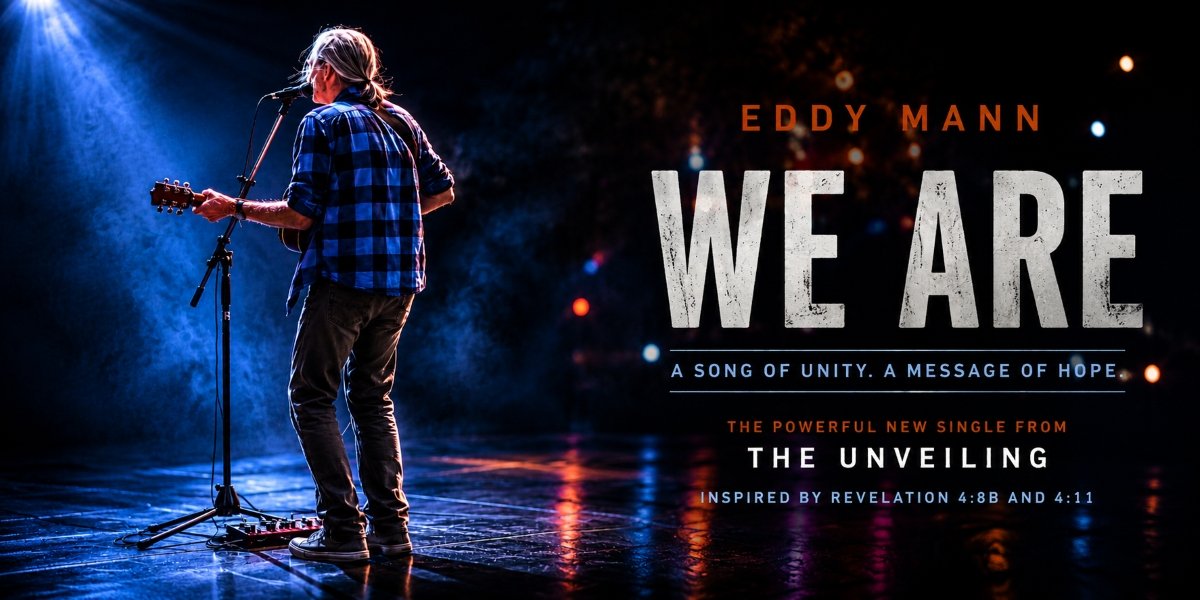
On his single “We Are,” from the album The Unveiling, the veteran Christian singer-songwriter and minister approaches Revelation not as a warning siren but as an invitation to worship. Inspired by Revelation 4:8b and 4:11, the song finds its foundation in the heavenly scene where creation gathers around the throne and declares the holiness and worthiness of God.
Mann takes that enormous vision and makes it intimate.
“Holy, holy, holy,” he sings, invoking words that have echoed through Christian worship for generations. But the most revealing moment arrives with the song’s central declaration: “We are Your will / We are Your desire / We are Your pleasure.”
Those lines are uncomplicated. Their implications aren’t.
At the center of “We Are” is an idea about human identity: existence isn’t accidental. Humanity has purpose, and that purpose is collective. The operative word isn’t “I.”
It’s we.
That distinction feels particularly significant in a culture increasingly organized around division. Politics, social media, religion, and everyday public discourse regularly encourage people to identify the opposing tribe before recognizing the human being standing inside it.
Mann plants his flag elsewhere.
He has long championed what he calls brotherhood and sisterhood, arguing that divisive rhetoric “nourishes separation.” “We Are” becomes his musical response—not so much a political statement as a theological one. If humanity shares a Creator, Mann suggests, then whatever divides us cannot erase what fundamentally connects us.
The song becomes even more interesting when you turn from its message to its musical construction.
“We Are” is written in 5/4 time.
That sounds like the kind of decision a musician might make specifically to demonstrate sophistication, but Mann says it happened almost accidentally. The song emerged during a quiet period of worship and simply settled into that meter.
That organic beginning matters because “We Are” never sounds like an odd-time-signature exercise. The extra beat creates a subtle instability, giving the music a sense of movement without disrupting its contemplative character.
Instead of calling attention to itself, the rhythm serves the song.
That’s an important distinction.
Jazz has always understood the tension between individuality and community. A musician needs an identifiable voice while remaining sensitive to every other player in the room. Too much individuality and the ensemble becomes chaos. Too much conformity and the music loses its personality.
“We Are” works from essentially the same proposition.
Unity doesn’t require sameness.
The jazz influence gives Mann room to explore that idea musically. Rather than relying upon the familiar architecture of contemporary worship—quiet verse, building pre-chorus, enormous chorus, repeat until transcendence—the song takes a more restrained route.
Its spirituality isn’t manufactured through volume.
Instead, Mann allows space to become part of the arrangement.
That restraint also suits his voice. After more than three decades of music and ministry, Mann doesn’t sound like an artist auditioning for anyone’s approval. His vocal possesses the lived-in character of somebody who has spent years wrestling with the subjects he’s singing about.
There’s no need to oversell the conviction.
It’s already there.
That quality has become increasingly important throughout Mann’s work. He describes God as his “audience of One,” and there is something refreshingly independent about that philosophy in an industry governed by streams, playlists, algorithms, trends, and increasingly short attention spans.
“We Are” isn’t desperately trying to grab you.
It invites you to listen.
The song also makes more sense within the larger context of The Unveiling, Mann’s ambitious project inspired by Revelation. Where many interpretations emphasize catastrophe and judgment, Mann repeatedly discovers hope, restoration, and compassion.
That doesn’t mean he ignores darkness.
It means he refuses to believe darkness gets the final word.
On “I Will Never Know the Desert Again,” another standout from the project, Mann considers the possibility of suffering finally ending. “We Are” approaches the same larger spiritual vision from another direction, asking what happens when human beings recognize themselves as part of something greater.
Its final declaration—“Worthy, You are worthy / Our Lord / Our God”—returns everything to worship.
No theological fireworks are required.
No apocalypse arrives.
Instead, an unusual five-beat groove carries a remarkably straightforward message.
In a fractured age, Eddy Mann has made a song about belonging. In a genre often dominated by familiar formulas, he has allowed the music to find its own rhythm. And in a biblical book famous for inspiring fear, he has discovered another reason to hope.
Maybe that’s the most interesting thing about “We Are.”
For all its musical sophistication and scriptural foundation, its argument eventually comes down to one tiny word.
We.
Sometimes the smallest words carry the biggest ideas.