
The former punk-rock trailblazer bridges electronic dance music, spiritual awakening and a lifetime of searching for connection on a single that reimagines rebellion as an act of compassion.
By John Parker
There is a moment in nearly every great dance-floor experience when the distinction between the individual and the collective begins to dissolve. The beat continues, the crowd moves together, and the ordinary boundaries of identity momentarily lose their significance. For Ananda Xenia Shakti, that sensation is more than a temporary escape. It is evidence of something fundamental about human existence: an innate longing for connection that music can reveal but cannot entirely explain.
Her new single, “A Revolution in Love,” arriving November 6th on MTS Records, approaches that realization through an unusual combination of Deep House production, spoken-word poetry and spiritual philosophy. Rather than using electronic music to suspend thought, Shakti employs its rhythmic foundation to encourage contemplation. The result is an ambitious meditation on suffering, freedom and the transformative possibilities of unconditional love.
The song also represents a reconciliation with her own past.
Before embracing Eastern spirituality and becoming a member of Love Power the Band, Shakti belonged to Toronto’s late-1970s punk underground as a member of The B-Girls, a pioneering all-female group that toured with The Clash. Her musical history also includes contributing to Blondie’s Autoamerican. Those experiences placed her within a culture that valued disruption, confrontation and the rejection of established expectations.
Decades later, her vocabulary has changed considerably. The impulse to challenge conventional thinking has not.
Where punk attacked social structures through musical aggression, “A Revolution in Love” questions the emotional structures that keep people isolated from one another. Its central proposition is that compassion, rather than confrontation, might represent a more profound form of rebellion.
“This is a revolution in love,” Shakti declares, returning repeatedly to a phrase that becomes the composition’s organizing principle.
The repetition serves a purpose beyond conventional songwriting. In Deep House, recurring rhythmic patterns create continuity while small variations gradually transform the listener’s perception. Shakti adopts a similar approach to language, allowing her central declaration to accumulate meaning through persistence.
She describes love as an eternal circle, without beginning, ending or sides. The image suggests something larger than individual relationships: a form of interconnectedness that exists beyond ordinary distinctions and divisions.
That philosophical ambition could easily become sentimental. What gives the song its emotional foundation, however, is Shakti’s willingness to acknowledge the darker experiences that preceded her spiritual understanding.
She recalls moments when suffering appeared pointless, when kindness seemed absent and when the possibility of belonging felt remote. These admissions interrupt the composition’s optimism with an important recognition: awakening is not necessarily born from serenity.
Sometimes it emerges from despair.
For Shakti, suffering becomes a passage toward understanding rather than proof that existence lacks meaning. The transition is central to the song’s narrative, moving from alienation toward an increasingly expansive declaration of acceptance.
The production, credited to Kabumi, Kudos Lokey and Shakti, provides an electronic setting for this philosophical progression. Its instrumental soundtrack draws upon a remix of Keinemusik’s “The Day I Met You,” connecting the recording to contemporary house music’s emphasis on hypnotic repetition and communal release.
The contrast between its electronic framework and Shakti’s explicitly spiritual language is the single’s defining artistic tension. Dance music often communicates transcendence without naming it. Shakti insists on articulating precisely what she believes that experience represents.
Her approach is closer to spoken-word performance than conventional pop singing. The lyrics unfold as a sustained address to the listener, alternating between personal testimony, philosophical reflection and direct encouragement.
“Your freedom lies, in how you embrace the other,” she proposes.
The statement moves the composition beyond individual self-improvement toward a broader ethical argument. Freedom, in Shakti’s understanding, is inseparable from the ability to recognize another person’s humanity.
Yet her expansive message also creates certain musical challenges. The repeated declarations occasionally leave little room for ambiguity, and listeners accustomed to the suggestive emotional economy of electronic music may find her spiritual certainty unusually insistent.
But that insistence is integral to the project. Shakti is not interested in allowing her message to disappear beneath the rhythm. She wants listeners to consider what the rhythm has meant to them.
The recording’s unusual creation story makes that intention especially resonant.
It began in the cloud jungle of Costa Rica, where Shakti recorded her spoken-word vocals in a single take. The performance reportedly moved both her and her collaborator to tears. Subsequent development took the recording to India before its completion in Toronto, where she decided to retain the original vocal take rather than substitute a more polished performance.
That decision preserves the immediacy of the song’s initial emotional expression.
Toronto, meanwhile, represents more than a convenient production location. As a teenager, Shakti entered the city’s clubs searching for freedom, belonging and an experience she could not yet fully identify. Her eventual movement into punk rock reflected that same desire for transformation.
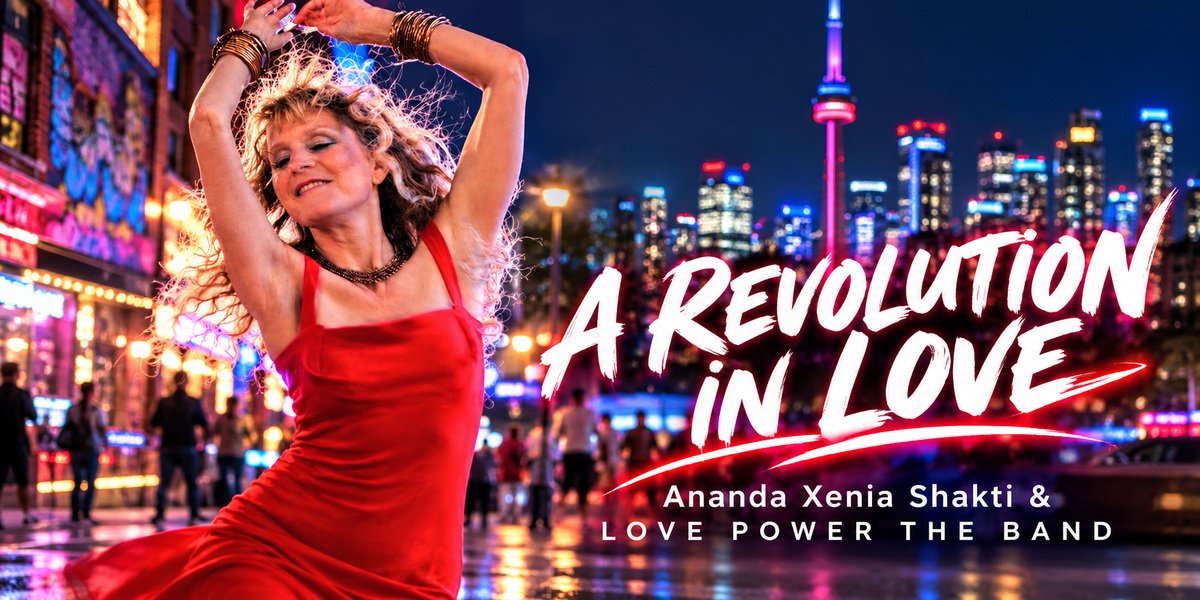
The accompanying music video returns her to those familiar streets, now dancing in a red dress rather than confronting convention through punk fashion and attitude.
The symbolism is direct but effective. She has returned to the places where her search began, carrying a different understanding of what she was seeking.
“A Revolution in Love” is ultimately less about discovering an entirely new identity than about extending compassion toward an earlier one. Shakti does not reject the rebellious teenager who found liberation in underground clubs. She recognizes that girl’s longing as an authentic expression of the spiritual quest that followed.
That reconciliation provides the single with a depth its more abstract declarations cannot always achieve.
Electronic dance music has repeatedly offered temporary communities built around rhythm, movement and shared physical experience. Shakti’s contribution is to ask whether the emotional openness found in those spaces might extend beyond the club itself.
Her answer is emphatic, idealistic and unmistakably personal.
The most intriguing revolution in “A Revolution in Love” is not the transformation of punk rebellion into spiritual affirmation. It is the suggestion that the two were never fundamentally opposed.
For Shakti, the desire to challenge the world and the desire to embrace it have finally become the same impulse.
And the dance continues.
“A Revolution in Love” by Ananda Xenia Shakti will be released November 6, 2026, via MTS Records. Produced by Kabumi, Kudos Lokey and Ananda Xenia Shakti.