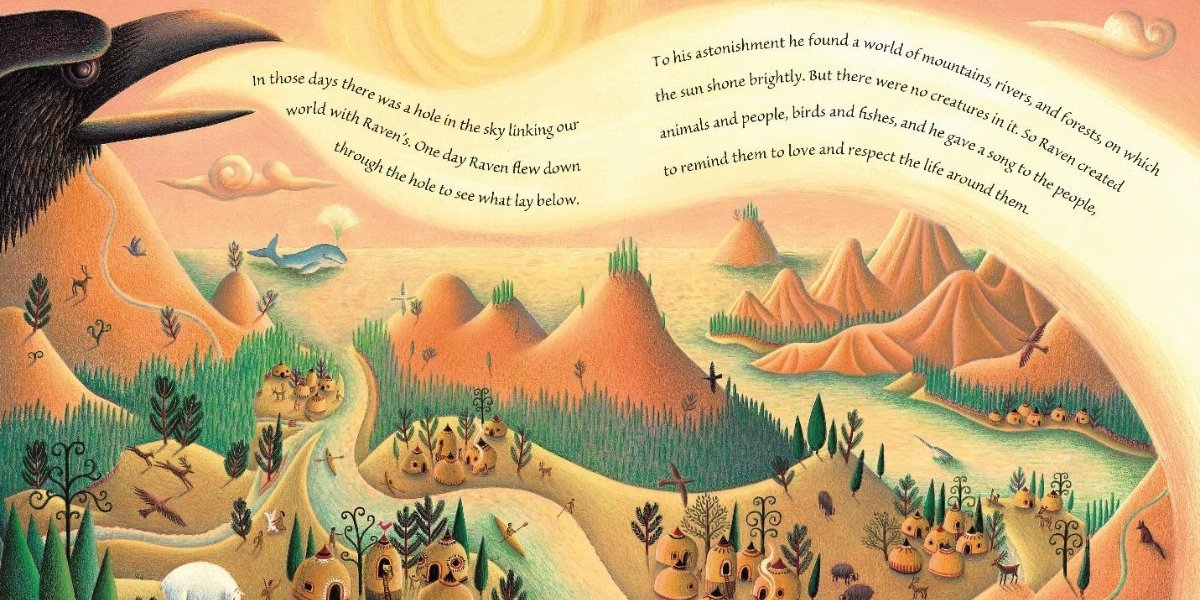

Illustration © Amanda Hall. From Song of the Raven, written by Amanda Hall. Published by Wisdom Tales.
Children’s picture books have traditionally straddled the two forms of storytelling: the visual and the written. In recent times, children’s picture books have changed the modes of production, authorship, and collaboration, in which the illustrator has been involved in a more comprehensive capacity than merely illustrating the text; this includes writing, design, and even conceptual work. In the United Kingdom and the United States, this change has had a considerable impact on the production of children’s picture books. In this regard, the work of the British illustrator and writer Amanda Hall can be seen as an exploration of the traditional and the autonomous.
Hall’s professional career began in the late 1970s following her training at the Cambridge School of Art, where she completed a diploma in graphic art. From the outset, her work diverged from strict observational drawing, favoring a more interpretive approach rooted in the “mind’s eye.” Over time, this approach developed into a visual language marked by layered compositions, defined outlines, and tonal variation. Her images often contain dense visual information, with forms that appear to project forward, creating an almost three-dimensional effect on the flat page. This method became a consistent feature across her illustration work in both early and later publications.
During the early decades of her career, Hall worked primarily through commissioned projects, a common model in children’s publishing. In this structure, a publisher acquires a manuscript and then appoints an illustrator. One example is The Fantastic Jungles of Henri Rousseau, published in 2012 by Eerdmans Books for Young Readers. The text by Michelle Markel had already been written when Hall was invited to illustrate it. This distinction is central to understanding her practice, as it separates commissioned illustration from projects where she is involved at an earlier conceptual stage.
Alongside commissioned work, Hall has also engaged in collaborations in which the illustrator and writer develop a project together before submitting it to a publisher. This approach involves shared authorship at the formative stage and differs from the more common publishing model, where editors typically match a completed manuscript with an illustrator. Pre-submission collaboration can therefore be seen as a less orthodox and more independent route within picture book publishing. It carries risks, including the possibility that a project may not be accepted. Hall has described the process as both demanding and creatively stimulating, requiring agreement on structure, content, and ownership through a working arrangement before any external contract is secured, and often involving extended periods of unpaid development.
This can be seen in her collaboration with Markel on Out of This World: The Surreal Art of Leonora Carrington, in which the author and illustrator contributed from the very beginning. This can also be observed in her collaborations with Jamila Gavin on Tales from India and with Dawn Casey on Babushka and Little Bear. In these works, the collaboration began before a publisher was involved, enabling a closer relationship between the text and the illustration.
Another aspect of Hall’s work can be seen in her role as an author-illustrator, where she is responsible for both text and imagery. One example is The Stolen Sun, first published in 2002 by Frances Lincoln. The same work was later acquired and republished in 2024 by Wisdom Tales under the title Song of the Raven, with a redesigned format. Prince of the Birds, also published in 2005 by Frances Lincoln, provides a further example of this dual role. In these works, a self-contained relationship is established between text and illustration, shaped within a single conceptual framework, with Hall assuming full responsibility for both narrative and visual development.
Throughout her career, Hall has built long-term relationships with publishers in both the United Kingdom and the United States. In the United Kingdom, her work has been published by companies including Lion Children’s Books, Frances Lincoln, Dorling Kindersley, Barefoot Books, Pavilion Books, Templar Publishing, and Little Tiger Press. In the United States, her work has been published by Eerdmans Books for Young Readers, Wisdom Tales, Balzer and Bray, and Sleeping Bear Press.
The distribution of Hall’s work has been international, with her books published in 24 additional countries beyond the United Kingdom and the United States through co-edition agreements. These include Australia, Brazil, Canada, China, Czechoslovakia, Denmark, Finland, France, Germany, Greece, Holland, Italy, Israel, Japan, Korea, Mexico, New Zealand, Norway, Poland, Portugal, Spain, Catalonia, South Africa, Sweden, and Taiwan. Co-edition publishing is a common model in children’s illustration, allowing the same visual material to be adapted for multiple languages and markets while maintaining production consistency. This form of distribution has extended the reach of Hall’s illustrated work across a wide international readership.
The scope of Hall’s work reflects a broader shift within children’s publishing in the late twentieth century, when illustration was often expected to directly depict the text rather than expand on it. In Hall’s work, images frequently introduce visual elements not explicitly described in the text, creating an additional layer of narrative. This approach aligns with interpretive illustration, in which the visual content can complement, extend, or subtly comment on the written story.
Throughout the more than four decades of her professional work, Hall has worked under various modes of production, including commissioned work, speculative collaborations, and the role of the author/illustrator. These modes of production interact with a range of factors, including publisher expectations, market context, and the author-illustrator’s approach, all of which contribute to shaping the final form of the book.
Amanda Hall’s work remains current in both the British and American publishing industries, with ongoing interest in her illustrated work and collaborative projects. Her work demonstrates the various roles the illustrator may undertake in the current field of children’s literature, ranging from responding to a completed work to contributing to the narrative from its inception.