
By: Dr. Lukas Gabric
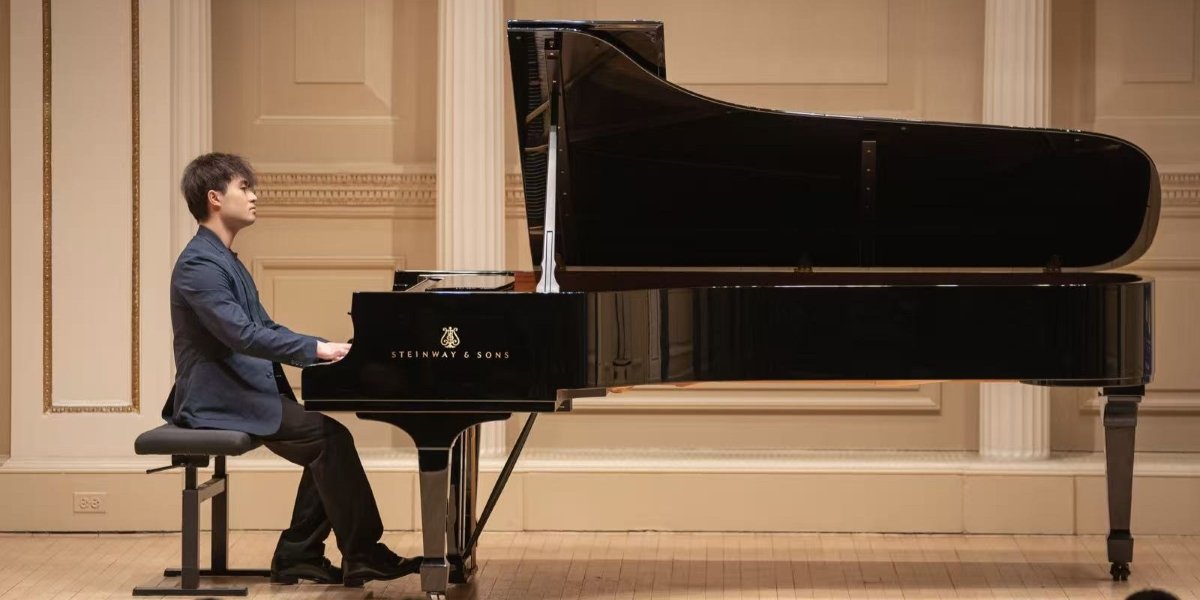
In an age where pianistic achievement is too often measured by velocity, volume, or surface brilliance, Guhan Peng represents something far more enduring: a synthesis of absolute technical command, intellectual depth, and genuine musical imagination. His artistry resists easy categorization, not because it is obscure, but because it is complete. One is struck, above all, by the sense that nothing stands between his musical intention and its realization at the keyboard. His technique is, in every meaningful sense, flawless, not as an end in itself, but as a vehicle for expressive freedom of the highest order.
It is this technical sovereignty that allows Guhan to transcend the instrument. Passagework unfolds with natural ease, chords resonate with fullness yet never harshness, and even the most intricate textures retain transparency. Yet what is most remarkable is not the absence of limitation, but the presence of possibility: he is able to draw from the piano precisely the sound he imagines, shaping phrases with a suppleness that feels at once spontaneous and inevitable. There is no sense of effort, no trace of compromise, only the music, realized with clarity and conviction.
Beyond this command lies a deeply cultivated musical intelligence. Guhan’s performances reveal not only a knowledge of style, but an internalization of it. His interpretations are informed by a profound engagement with the historical and aesthetic contexts of the repertoire, as well as with its literary and philosophical underpinnings. This is especially evident in his approach to German repertoire, where his playing carries an unmistakable sense of structural integrity and stylistic authenticity. These are not imposed qualities, but lived ones, suggesting a lineage of thought that can be traced to the great pedagogical traditions associated with figures such as Leon Fleisher and Menahem Pressler. In Guhan’s hands, this heritage is not imitated, but reimagined, absorbed into a personal voice that is both respectful and distinct.
Equally compelling is his affinity for the virtuosic repertoire, where a different aspect of his artistry comes to the fore. Here, one encounters a boldness of gesture, a rhythmic vitality, and a commanding presence that evoke the great Russian school of pianism. Yet even at moments of greatest brilliance, there is never a descent into mere display. The architecture of the music remains intact; clarity is never sacrificed for excitement. Instead, virtuosity becomes a means of expression, integrated seamlessly into a larger interpretive vision.
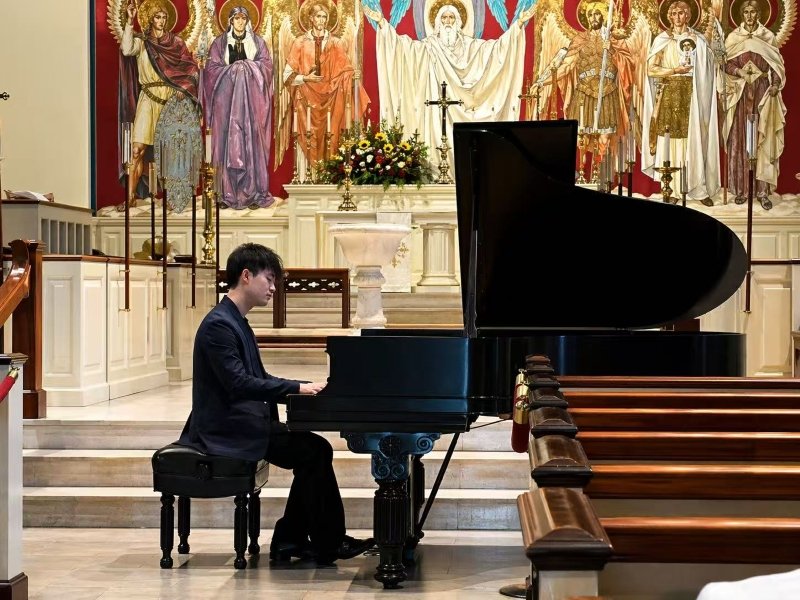
Perhaps the most distinctive element of Guhan’s artistry, however, lies in the profound influence of his experience as an opera pianist. This background has shaped not only how he hears music, but how he projects it. Guhan listens at the piano in a way that is fundamentally different from many of his contemporaries: not as a soloist isolated from the musical world, but as a collaborator attuned to multiple voices, lines, and dramatic trajectories. The result is a sound that is orchestral in conception. His playing is rich with color, each register carefully differentiated, each voice imbued with character and intention. One hears not simply melody and accompaniment, but a dialogue of forceswinds, strings, brasscoexisting within the single instrument.
This orchestral sensibility also informs his approach to musical time. Where many pianists are tempted to linger in moments of heightened beauty, stretching phrases to the point of indulgence, Guhan maintains a sense of forward motion that feels entirely organic. His interpretations are governed by an internal logic that renders every decision inevitable. Tempi breathe, but they do not waver; climaxes emerge naturally, without exaggeration. There is an underlying discipline at work, but it is never rigid. Rather, it is the discipline of understanding, of knowing precisely how much space a phrase requires, and no more.
To experience Guhan Peng in performance is, ultimately, to encounter a redefinition of what it means to play the piano. He does not treat the instrument as an object to be mastered, but as a medium through which a vast musical landscape can be realized. In this sense, he is less a pianist in the traditional mold than a conductor at the keyboard, shaping an invisible orchestra with remarkable control and imagination. Every line is voiced, every texture balanced, every gesture imbued with purpose.
Such artistry does not call attention to itself, yet it leaves a lasting impression. It invites the listener not merely to admire, but to engage to hear familiar works anew, illuminated by insight and brought to life with uncommon vitality. In Guhan Peng, one finds an artist who embodies the highest ideals of musicianship: technical excellence in the service of expression, intellectual rigor balanced by emotional depth, and above all, a commitment to the integrity of the music itself.
Authored by Dr. Lukas Gabric
Austrian tenor saxophonist, composer, musicologist, and critic Dr. Lukas Gabric is an internationally active, award-winning recording artist, scholar, and educator. A Thelonious Monk Competition semifinalist and ASCAP Herb Alpert Award recipient, he holds a PhD in Musicology and serves as Associate Professor at the Xinghai Conservatory of Music. His work appears with publishing houses including Mel Bay and Sher Music, and in peer-reviewed journals such as Journal of Jazz Studies and Jazz Perspectives.