


By: Ruonan Du
Illusion: Impermeable Ground as a Healthy Rule
In the late nineteenth and early twentieth centuries, urban health was frequently articulated as a problem of order, visibility, and control. Otto Wagner’s vision of the “Great City,” developed from a transformed agrarian territory, exemplifies this ethic of modernization. In The Development of a Great City (1912), Wagner describes the future city as a technical and administrative organism that must meet the expanding demands of governance, commerce, hygiene, and art. His proposal organizes the city through a gridded framework and a hierarchical distribution of programs: administrative and governmental functions are emphasized along a principal axis, while commercial corridors structure the lateral fabric, producing a legible and regulated urban field.
Crucially, hygiene is not treated as an external policy but as an aesthetic and material rule. Wagner links neatness and cleanliness to an ideal of artistic modernity through smooth surfaces—extending from paved ground to exterior envelopes and interior finishes—while removing what is deemed redundant, excessive, or unruly, including exposed land and soil. In this framework, impermeability becomes a spatial shorthand for health: sealing, flattening, and sanitizing the ground are understood as necessary conditions for a modern civic life.
This equation between health and impermeable order cannot be separated from its historical context. At the time, public life was shaped by the fear of bacterial contagion and by the urgency to manage invisible microbes through spatial discipline. The emergence of the sanatorium as a modern architectural type makes this logic explicit: highly controlled planning, stripped ornamentation, and intensified sanitary apparatus transform architecture into a therapeutic instrument—an operational extension of medicine rather than a neutral shelter, as demonstrated by Alvar and Aino Aalto’s Paimio Sanatorium (1929–33).
In this paradigm, health converges with hygiene, and hygiene demands smooth, impervious, and carefully regulated urban surfaces. The question that follows today is not whether this rule once responded to real threats, but what “health” may signify under contemporary ecological knowledge and social conditions. If the modern city secured autonomy through separation, a different health framework could be constructed through negotiated proximity—where living with soil becomes a deliberate spatial choice rather than a condition to be eliminated.
Human With Soil: Symbiosis on the Ground
Permeable City serves as the central case study for this essay’s second movement, where symbiosis is tested not as a metaphor but as an urban ground protocol. Developed at Columbia GSAPP as a research-driven urban proposal, the project has received recognition with Best of Best Student ArchitectureMasterPrize2025 LANDSCAPE ARCHITECTURE – Urban Design, and was later featured by GSAPP’s official Instagram and GSAPP Abstract 2023. The work begins from a simple suspicion: the modern city’s promise of health has been historically tied to separation, and that separation was materialized most clearly through the ground—paved, sealed, and made “safe” by removing soil from daily life.
In Vienna, this logic produces a recognizable urban image: a city of smooth surfaces, standardized spaces, and citizens who move anonymously across a continuous field of hard ground. In our readings of Otto Wagner’s planning legacy, impermeability is not only a technical decision but also a social aesthetic that minimizes difference. On the project site and its surrounding districts, permeable ground is reduced to a thin remainder; the figure that stayed with us during early research was that only a small fraction of land remains permeable, while most of the city is covered by artificial surfaces. The result is an urban condition where soil is treated as an outside—either rural, infrastructural, or ornamental—rather than an everyday interface.
Permeable City reopens this interface by reversing a basic ratio: if a city significantly increases its soft, permeable ground while reducing hard surfaces, what new programs, behaviors, and forms of civic health could become possible? This question guided our formal and methodological experiments. We tested combinations of smoothness versus roughness, rigid planning versus open-ended occupation, and building massing strategies that either stack volumes to free ground or remove pavements to return land to water, plants, and microbes. These were not stylistic choices; they were attempts to treat the ground as a living medium and to evaluate what kinds of urban life might emerge when soil is allowed back in.
The site analysis translated this ambition into concrete urgencies. Austria has comparatively scarce arable land within Europe, and at the national scale, soil moisture loss and erosion have become increasingly severe. Zooming into Vienna, large portions of the city register as artificial surface, while agricultural land concentrates along the eastern and southern edges. Our site in Rothneusiedl—within Favoriten, one of the lowest-income districts—sits precisely within this tension between urban expansion and land capacity. We paired this environmental reading with a health and food equity lens: Austria’s low vegetable intake has been noted in European comparisons, and lower-income groups tend to consume even less. In this context, “health” is not only sanitation; it also includes access to fresh food, everyday outdoor activity, and community-scale care infrastructures. Permeable City, therefore, links soil preservation with dietary and social well-being by re-inhabiting the area’s farming tradition as a contemporary civic system.
Conceptually, the proposal critically reworks Wagner’s “Great City Planning” by reversing the relationship between open and constructed land, permeable and non-permeable ground, and nature and urban life. Where Wagner’s model privileges legibility through restriction, our model treats openness as a form of governance: the city becomes less about enforcing a single hygienic rule and more about offering gradients of contact. The project questions the assumption that citizens must be anonymous within a uniform field; instead, it proposes that identity can be spatially supported through choice, variation, and neighborhood-scale decision-making.
The masterplan is organized around a network of yards—approximately two hundred of them—that act as the project’s primary ground units. The largest yards are designated as professional farmland located near major roads and transport access, enabling loading and distribution; their production supports local markets and other parts of Vienna. A second category, rental farmlands, allows city residents to lease plots to grow vegetables either independently or in partnership with local farmers. Additional yards are reserved for experimental or non-standard cultivation formats (test fields, alternative farming ecologies). Yet the central rule is that arable land does not have to be farmland. Each yard is a civic commons governed at the immediate neighborhood scale: residents living around a yard can vote to assign its seasonal or long-term use, allowing programs to evolve with demographic needs and local culture.
This mechanism expands “living with soil” into a spectrum rather than a binary. A yard might support children’s play landscapes adjacent to schools and daycare, or host holiday gatherings, sports fields, micro-forests, topographic mounds for climbing, temporary pools during heat waves, or even playful navigational terrains such as corn mazes. It might also remain intentionally unprogrammed, holding space for future decision-making. Across these options, the ground becomes a shared medium through which community priorities are negotiated, revised, and made visible.
To support this ground governance, public programs are layered around the residential yards to encourage resource-sharing and collective maintenance. Instead of listing every room as a discrete novelty, the system can be understood as three clusters: (1) shared utilities and services embedded in “toolbox” nodes (mechanical hubs, storage, repair and mobility supports, wellness and care rooms, communal kitchens), (2) social connectors that form bridges and gathering platforms between residential bars, and (3) recreational and cultural anchors distributed across the site (screening/dance spaces, café-library hybrids, learning rooms for food production and cooking). Complementary to these are agricultural supports—storage, workshops, and farm-adjacent living—along with clinics for plants and people, senior-adjacent services, and short-term stays for visitors who want to experience the city’s ground logic firsthand.
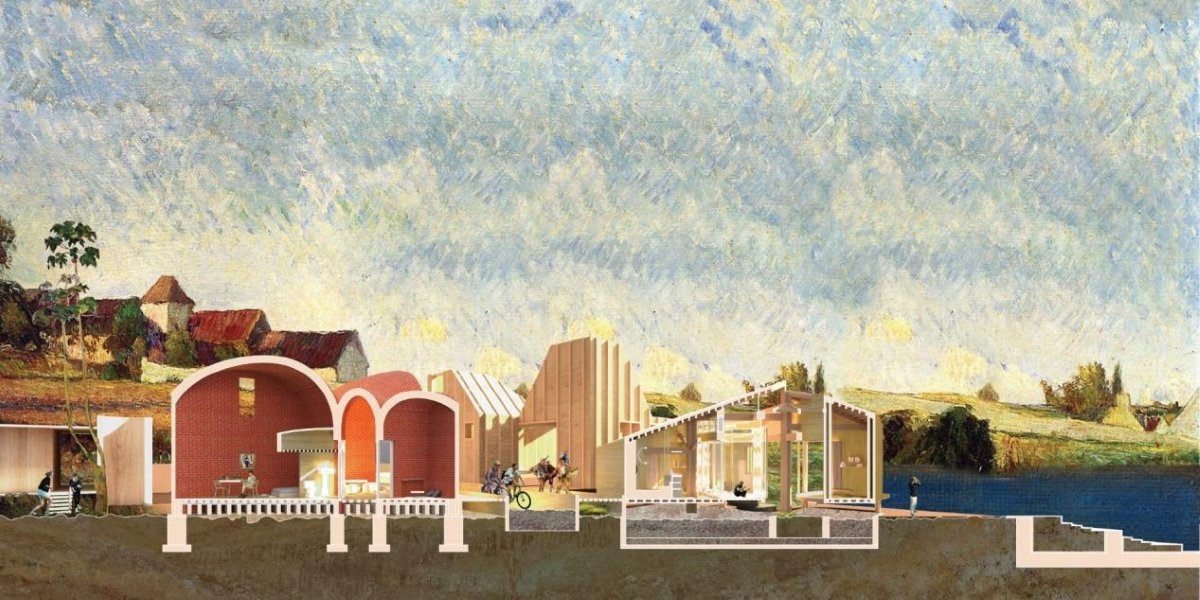
At the residential block scale, Permeable City is designed as a framework rather than a single-author composition. Different architects may develop different blocks as long as they follow shared guidelines, allowing formal diversity without losing systemic coherence. In the prototype block we developed, housing bars run along a horizontal axis to maximize sunlight, while interior volumes are split to allow wind passage and microclimate ventilation. Between the bars, bridges, and toolbox nodes frame the yards as inhabited commons. Housing typologies vary by soil coverage: some homes allow direct ground contact, others provide fully covered decks and enclosed thresholds, enabling residents to select their preferred degree of intimacy with soil. The design process is framed through three linked components—open yard, in-between space, and personal space—so that soil contact can be tuned across communal, semi-public, and domestic registers.
Material and construction choices reinforce the project’s claim that soil is not an enemy but a source. We selected three primary enclosure systems—brick, straw bale, and wood frame—each deployed according to structural behavior and environmental performance. Foundation strategies are intentionally differentiated to reduce harm to soil: heavier loads use more traditional stone or brick foundations with limited but careful contact; lifted foundations reduce disturbance; lighter wood-frame systems can sit on shed foundations infilled with rammed pebble and soil, maintaining permeability and enabling small organisms to move through. At the detail level, the project treats permeability as a construction ethic: the city’s health is advanced by allowing the ground to breathe, drain, host life, and remain legible as a living substrate.
Permeable City reframes symbiosis as a civic choice architecture. Instead of prescribing a single hygienic lifestyle, it offers an expandable spectrum of soil integration—ecological, social, and material—through which residents can decide how they live with the ground, and how the ground, in turn, sustains urban life.
Human and Human: Symbiosis in the City
Starting from Permeable City, I understand symbiosis as a spatial practice of redistributing boundaries: loosening hardened ground and regimes of separation, reintroducing soil into everyday contact, and redefining health not as distance alone but as a relational condition shaped through proximity, exposure, and care. Extending this inquiry into the urban context, the object of symbiosis shifts from ecological systems to social systems, and the central question moves from how humans live with nature to how humans sustain one another amid intensified specialization and pervasive uncertainty. In this sense, buildings and blocks are dense with overlooked interfaces and interstitial spaces; they can support not only water, soil, and microclimates, but also sharing, collaboration, and mutual aid, allowing social symbiosis to materialize as an organized structure of daily life.
Within this framework, the pandemic’s employment instability exposes a stratified urban reality: certain occupations migrate into remote work, while others absorb immediate risks of layoffs and work stoppages. This project responds by reconfiguring the relationship between work and everyday life through a distributed spatial system that treats urban voids and interstitial spaces—within blocks and between buildings—as operative surfaces for neighborhood infrastructure. Through modular, scalable communal-office units, residents’ spatial surplus is converted into shared resources: domestic fragments may be re-scripted as public workstations, pop-up cafés, and small activity rooms, shifting across personal use, shared access, and rental over time. What emerges is not merely a co-working typology, but a reciprocal network that links work opportunity, supplemental income, and community exchange. A gridded structural envelope provides continuity across iterations while orchestrating public openness and residential privacy within a single spatial logic, positioning symbiosis as an everyday governance mechanism rather than an abstract ethic.
Summary
Resilience is often framed as autonomy: a system that can isolate itself, control its boundaries, and continue operating under stress. Across the projects discussed here, that definition proves insufficient. In the hygienic imagination of the modern city, impermeable ground sought safety through separation, yet it also produced rigid surfaces, standardized life, and a narrowing of what “health” could mean. Permeable City proposes a different premise: health emerges through negotiated proximity, where soil is not treated as contamination but as a living medium, and where the city’s ground becomes an active interface for ecological repair, food equity, and everyday choice. Extending this logic into the urban social field, Communal-Office shifts symbiosis from human–nature relations to human–human relations, translating spatial surplus into shared capacity and turning interstitial space into neighborhood infrastructure.
From autonomy to symbiosis, resilience becomes a relational property rather than an individual achievement. It is produced through interfaces—between hard and soft ground, private and public life, personal need and collective support—where systems remain adaptable because they remain connected. In this sense, the city’s future health depends less on perfect control than on designed forms of reciprocity that allow both ecological and social life to co-evolve.


