

By: Isabella Martinez
On December 7, 2025, Montclair State University’s Cali Opera Program presented a chamber opera production of Gian Carlo Menotti’s The Medium. The performance marked a significant moment for the university’s opera program, showcasing the talent of both emerging artists and seasoned performers. Under the direction of Karen Driscoll, the production brought Menotti’s intense psychological drama to life with remarkable depth and emotional resonance.
In Karen Driscoll’s staging, the director’s finely detailed portrayal of the “medium’s” household thrusts the audience straight into a family consumed by violence, turmoil, and hypocrisy.
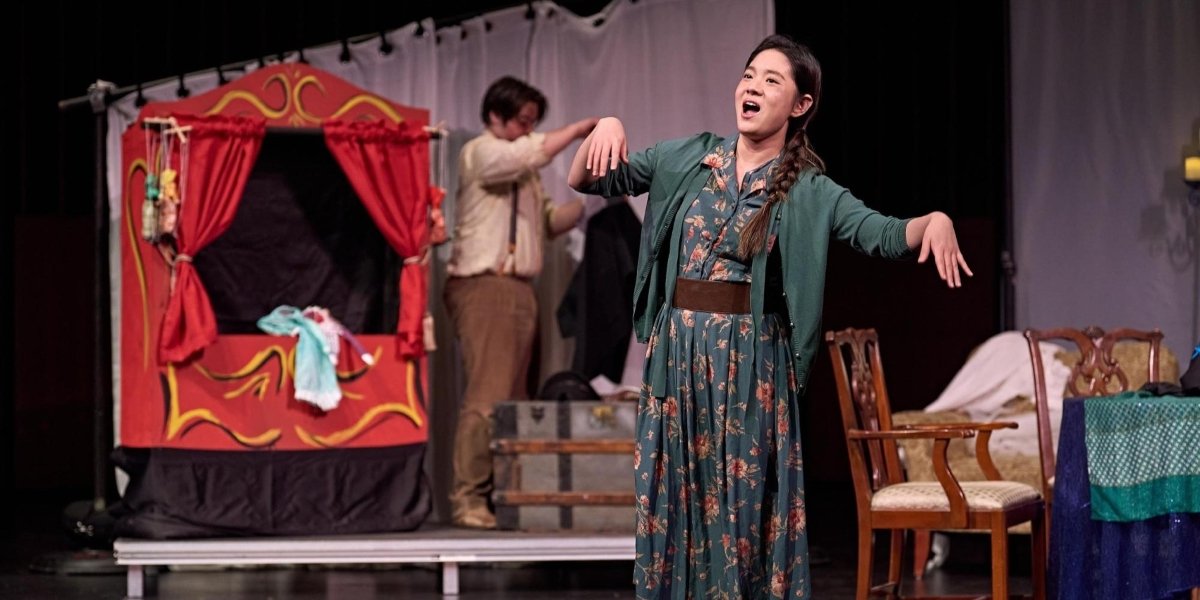
The production stars with Chinese soprano Haiming Wu as Monica. As the production’s only Asian cast member, Haiming Wu distinguished herself with remarkable stage presence, excellent vocal craftsmanship, and commendable clarity in her English diction. She navigated her role with heartbreaking finesse. The character demands great emotional and musical complexity as Monica grapples with her relationships with Baba, Toby, and, ultimately, herself. Her innocence in the opening scene was the only ray of sunlight in the entire production. During the séance, her rendition of “Mummy, Mummy Dear” soothed the ritual participants and deeply moved the audience. Haiming’s plush, rounded high notes were mainly affecting, as though they were her most heartfelt confession to her mother.
Her subsequent interactions with Baba revealed tremendous inner conflict and striking musicality. In the confrontation between Monica and Baba, Haiming delivered a dark lullaby—“The Black Swan”—with a deeply expressive tone. The unsettling lyrics, paired with her calming gestures, created a chilling contrast. Her recurring motifs and anguished high notes blended seamlessly with the “ghostly voices” echoing in Baba’s mind, creating a hypnotic atmosphere of surrender to an inevitable fate.

Photo Courtesy: Haiming Wu
Though Monica ultimately witnesses the death of her closest companion and silent beloved, Toby—an event that propels the drama toward its tragic conclusion—Haiming’s performance in the celebrated aria “Monica’s Waltz” crafted a portrayal both convincing and captivating. She mimicked Toby’s imagined voice in dialogue and, with his silent partnership, carried out a brilliant confession scene on her own. Her humanity emerged from a place almost anyone could understand and even empathize with.
Gabrielle Guida as Baba served as the drama’s volatile core. Her alcoholism and deteriorating mental state cast a deep shadow over the household, and she embodied Baba’s inner torment with remarkable precision. She wove elements of religious fervor into her portrayal with subtle nuance. In her final monologue, “Afraid, am I afraid,” she exposed the depths of Baba’s fear, confusion, and desperate longing for comfort. The climactic moment—when she tragically mistakes Toby for a ghost and kills him—was rendered with harrowing emotional truth, pulling the audience entirely into the opera’s turbulent psychological landscape.
Eoin Bentancourt, as Toby, brought a quiet yet essential presence to the production. Portraying the mute adopted son, he supported Monica and Baba’s performances with understated sensitivity, perfectly embodying a state of withdrawn silence. His final moments, culminating in his death, propelled the opera into its devastating climax and left a lingering emotional weight that shaped the entire audience’s experience. His portrayal of silent anguish gave Toby a profound depth, allowing the audience to feel his sorrow without a single word spoken. Through subtle gestures and a poignant stillness, Eoin captured the essence of a character trapped in a world of silence, yet whose emotional resonance was felt deeply by all.
Together, the cast, direction, and musical interpretation converged to create a vividly textured and emotionally gripping performance of The Medium. The production balanced psychological depth with musical precision, allowing each character’s unraveling to echo powerfully throughout the evening. Montclair State University’s Cali Opera Program presented not only a faithful reading of Menotti’s work, but an interpretation that illuminated its darkest corners and its most fragile humanity—leaving the audience both shaken and profoundly moved.