

Artistic careers tend to follow zigzag paths, shifting from one phase to another as the artist’s vision develops. For some, the transition is gradual, a shift hardly realized; for others, it is clear and deliberate. In Inam M. Inamullah’s life, the direction his style has progressed appears both unique and groundbreaking, from a highly realistic representation of nature-inspired subject matter to the more emotive and abstract works with which he currently works. His transformation reflects not simply changes in approach and aesthetic inclinations but instead a significant shift in philosophical foundation in the way that he works with art overall.
Inam’s initial works were marked by realism, depicting the delicate harmony of nature and its intricacies with remarkable detail. His landscapes were inspired by the world around him, often featuring common subjects like trees, fields, and forests. The texture of the landscape was brought out by his distinctive palette knife technique, creating thick, layered oil paint applications that rendered the scenes nearly palpable. This method, coupled with his keen sense of light and dark, gave all of his landscapes depth that engaged the viewer and invited them to become a part of it. The realism of his early works was due to his desire to portray the world as it exists through an eye that saw the beauty and tranquility of the natural world.
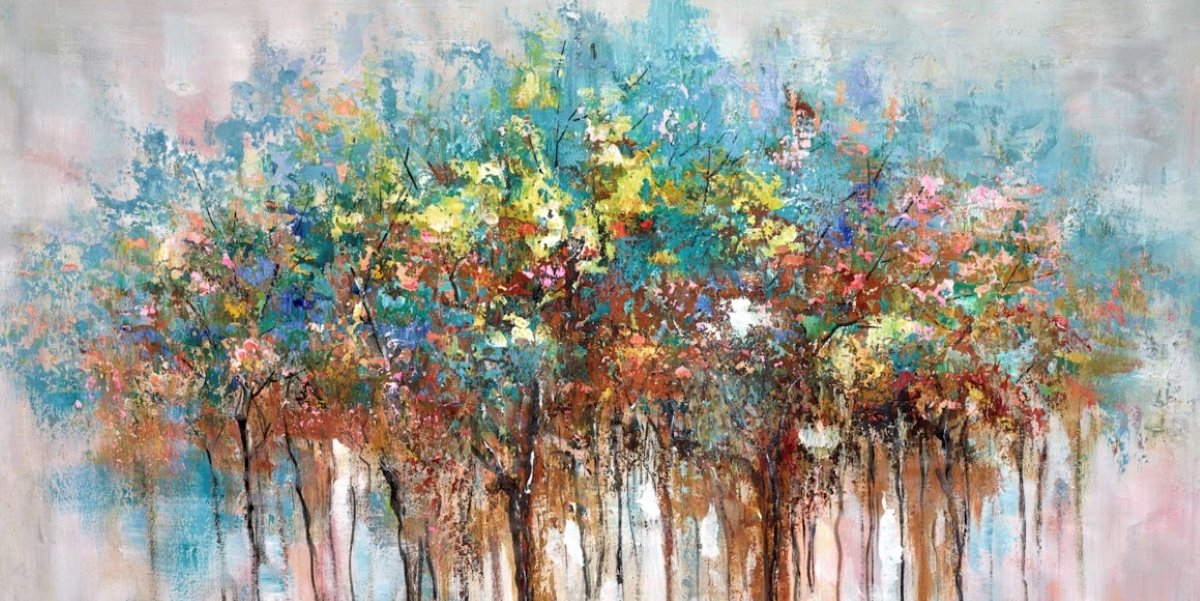
However, the last few years have seen Inam shift towards progressively more abstract forms of expression, a far cry from the work he was doing previously. This can particularly be seen in his Single Tree Series, which differs greatly from the super-realistic landscapes he once painted. The series, with its color and brushstrokes, is a clear sign of how much Inam has been captivated by abstraction.
This shift in style is not a mere technical adjustment but a reflection of Inam’s evolving philosophical reaction to art. Where his previous work attempted to depict nature in its most realistic sense, his latest works adopt an emotional and kinetic style, with the artist prioritizing personal expression over realistic representation. Through this change, Inam navigates the struggle between order and chaos, control and spontaneity, echoing the human experience and our relationship with nature.
Despite the shift towards abstraction, Inam still maintains his distinct use of texture, something that has been a constant in his work for years. In his Single Tree Series, the thick layers of paint remain, but now they serve to accentuate the dynamism and movement of the piece. The texture itself is used as a means for him to convey his spiritual and emotional connection to the subject since each swipe of the palette knife adds to a general sense of rhythm and energy.
The use of color in these abstract works is also an evolutionary step away from his earlier landscapes. While earthy browns and natural hues characterized Inam’s palettes, his recent works utilize brighter, bolder colors that bring a sense of contrast and vitality. The juxtaposition of colors reflects the artist’s tendency towards representing feeling rather than representation, each color carefully chosen to elicit some specific feeling or atmosphere. Inam’s abstract landscapes now seem to hum with energy, as the color options introduce vitality into the paintings and encourage the viewer to feel a more energetic sense of attunement to nature.
This change in Inam’s work is a graceful transition in his career, one that reflects his greater awareness of the relationship between artist, viewer, and subject. It reveals a heightened sense of the strength of art to communicate emotion and share something on an intimate level with others. By going from realism to abstraction in this way, Inam illustrates that art is not a static form, but more a fluid depiction of what lies outside of ourselves and our interior lives.
His abstract works are not a rejection of his previous style but an expansion of it, a way of exploring new facets of the human condition and the world we inhabit. Although his landscapes are no longer as literal, they remain based on the feelings and energy that nature evokes. Apart from his newfound prominence in the art circles, Inam’s work has earned a great deal of recognition. Inamullah’s distinctive style has earned him several recognitions, including being named one of the “Top 50 Emerging Artists” by Art Business News in 2012 and winning the “Best Landscape Artist” award from the Pakistan Arts Council in 2022. His affiliation with the Qatari royal family, along with his affiliation with various art institutions, has contributed to his status, allowing him to bridge both conventional and modern art cliques.
His works, such as the Single Tree Series, deviate from his traditional landscapes but retain the essential elements that have defined his art, such as texture and strong affinity with nature. This change indicates that Inamullah’s art is not just about painting the world the way it exists but about expressing the emotional form of the natural world, so his work finds meaning at a universal level. Through his continued artistic progression, Inam M. Imanullah’s art will likely remain a growing pursuit of the confluence between art, emotion, and nature.