By: Xiyu Zhang
It’s easy to imagine a clichéd movie scene.
In a society rocked by violent upheaval, young people step out of their doors to blend into protest crowds, only to return to bedrooms filled with a constant flow of sexual and amorous desires. When we strip away the filters reworked by studios and pornographic videos to reexamine the resistance inherent in private life, the result is often bleak. After history is replaced by high-frequency fluctuations, the bedroom and the private life of resistance that once existed within it become mere nodes in the spectacle. In other words, the bed has transformed from a desire-producing machine of the baby boomers’ adolescence into a more territorialized assemblage. For artists or curators attempting a return to realism, IKEA has become an unavoidable waystation.
In the exhibition Come Rot in My Bedroom, opening at Accent Sisters on February 27th, curators Ahzel and Alison Long create a portrayal of the counter-productive spatiality of the bedroom within another counter-productive production space. Entering Accent Sisters, a sense of exhaustion lumbles beneath the comfort, lingering after the stagnation of meaning and resistance. The embers of fatigue continue to pile up until objects fill the entire space, potentially driving away all desire. By directly exhibiting the bedroom, this private space, to the audience, the curators juxtapose the real outside with the internalized, concluded exterior, brutally documenting the neurosis of this era. At the gallery’s center, Alison Long’s video and performance work articulates this substitution. A disheveled bed lies strewn with objects, including artist Yiwei Lu’s exceptionally adorable ceramic cigarettes. The artist herself, weary, lies refreshing social media feeds while a projector behind her live-streams her phone screen. Spectacle remains on the softest front lines. Lethargic, powerless daily life may starkly signify a public destiny trapped under hyper-visibility.
Perhaps this hyper-visibility stems from the birth of fluid influence, manufactured hallucinations, demanded authentic pasts, and history stripped of its authenticity. Ahzel and Huang Ziyue’s video works respectively examine the trans-synchronized intertextuality of this modernity. Their pieces construct a subtle symmetry: the use of short videos and news footage compresses the fluid present into an instantaneously consumable pseudo-historical sensation. Everything is happening, everything has been seen, and thus everything quickly loses the weight of having occurred. The past no longer returns as trauma or experience, but rather as circulating fragments of images, reappropriated anew. News and short videos alike submit to the tyranny of visibility, flattening reality into a continuously updated surface. Within this intertextuality, modernity may manifest as a self-replicating visual fatigue; images summon images, events mimic events, until only distortion itself remains, circulating at high speed.
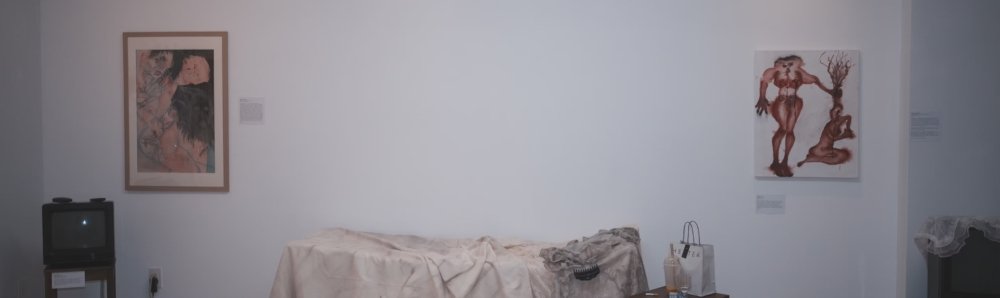
Photo Courtesy: Alison Long (Exhibition view featuring Would you like to share a cigarette with me? by Yiwei Lu, Come Rot In My Bedroom Installation by Alison Long, and various pieces in the group exhibition. Image courtesy of the artists. Photography by Ahzel.)
Devon Chen and Weixi Zhang’s two works touch upon the nature of the bedroom as a parergon, showing how the very content of life becomes the frame that surrounds, supports, yet ultimately exposes existence. Everything Metal in My Life recalls each cold, overlooked metal fragment within the bedroom, revealing the hidden skeleton of intimacy. The warmth of “shared decay” may remain embedded in the weight, wear, and support of materials.
Weixi Zhang’s interactive installation pushes this concept further, transforming the pillow, an accessory meant to cushion the body and emotions, into an interface where pressure is triggered, captured, printed, and archived. Each viewer’s impact translates immeasurable fatigue into bills and cookies, turning the bedroom from a sanctuary into a collection site. In this sense, the concept of parergon gains contemporary relevance not by singling out some isolated “marginal object,” but by revealing that the so-called interior is never truly self-sufficient, and that the subject does not always exist as a complete entity prior to its spatial context. Frames, adornments, supports, and buffers, all these elements seemingly peripheral to the “core,” precisely determine how the core is defined, viewed, and preserved. In this exhibition, the bedroom functions as such a frame: while enveloping the subject in privacy, comfort, and refuge, it simultaneously orchestrates the rhythms of fatigue, the lag of desire, the accumulation of pressure, and the emergence of visibility.
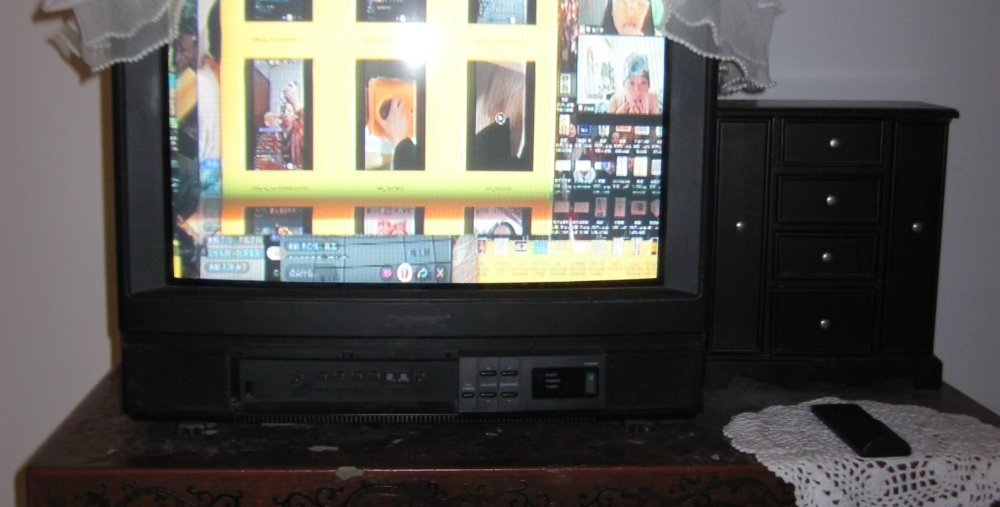
Photo Courtesy: Alison Long (Exhibition view featuring Miss Guanyin, I’ll take you home by Huang Ziyue 黄子玥. Image courtesy of the artist. Photography by Ahzel.)
The bedroom once belonged to an ancient myth of modernity: a place where one withdraws, temporarily disconnects from history, briefly escapes others’ gaze, and rediscovers an unnamed self amid desire, idleness, insomnia, languor, and secrets. Perhaps what we need to abandon is not nostalgia for the bedroom itself, but nostalgia for “interiority” as such. We once believed private space mattered because it preserved a density of life that was unobserved, undisciplined, and unused. Yet today, this very density has been aestheticized, staged, named, and displayed. The bedroom is no longer a site of resistance but merely a posture of resistance. What may truly unsettle us about this exhibition isn’t its depiction of exhaustion, but its revelation: exhaustion no longer opposes anything. It merely lingers on the surface like grime and rust. Thus, the real poverty lies not in losing our sanctuary, but in the sanctuary itself having learned to expose us.