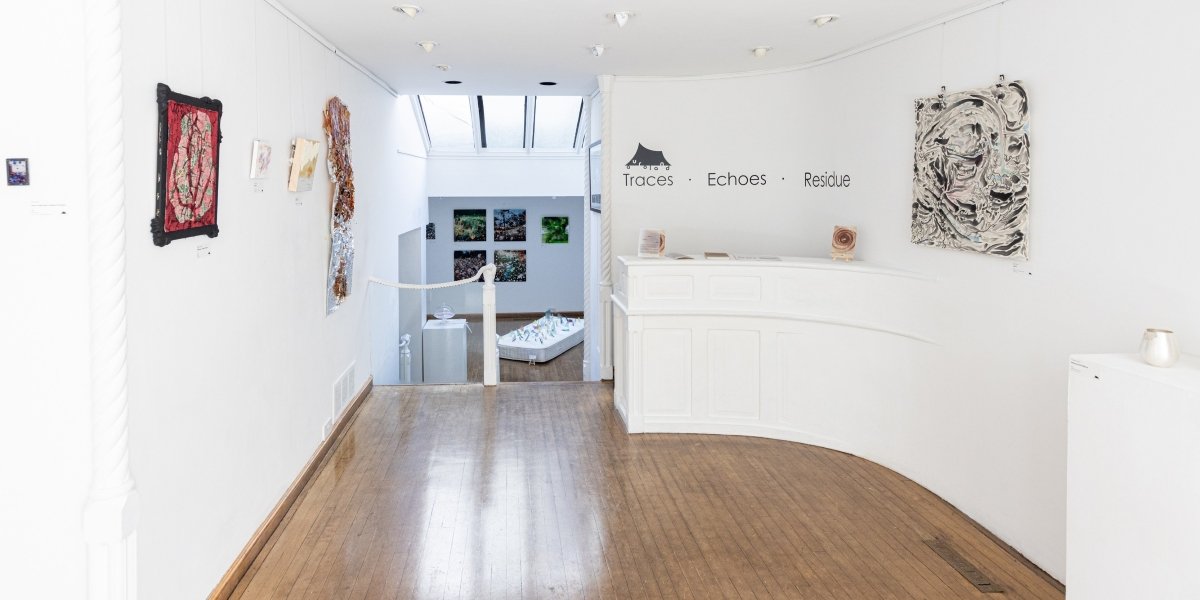

Held from April 6 to 10 at The Coningsby Gallery on Tottenham Street in London, the exhibition unfolds within a restrained and neutral spatial setting. Rather than relying on striking visual spectacle, “Traces, Echoes, Residue” develops in a low-frequency yet continuously expanding manner. Through subtle tensions between different media, it reactivates experiences that have already occurred but have not fully dissipated, allowing them to be perceived anew in the present.
Curated by Anqi Chen of Auraland, with assistance from Cheng Xing, the exhibition does not attempt to unify artistic practices from diverse cultural backgrounds. Instead, through juxtaposition and distance, it allows differences to become a generative force for meaning.

Photo Courtesy: Auraland
Bringing together artists from varied cultural contexts across the world, the exhibition forms a complex and layered structure of co-presence: Yun Chen, Jieyi Chen, Qinyue Chen (Shuyang), Xiaoxiao Chen, Xiaoyun Chen, Zhiying Chen, Yixin Chong, Yunjing Deng, Jason Driskill, Han Gao, Jiayi Gu, Evangeline Huang, Haofeng Ji, Zheyu Li, Xinnuo Liu, Vera Ni, Sen, Han Wang, Aner Wang, Jey Wang, Jinghan Wang, Ting Wang, Yuesu Wang, Ziyu Wei, Jessica Wu, Xinrou Wu, Yiting Wu, Chuhan Xiao, Ketong Xing, Luna Xue, Sana Yichi, Zi Ye, Xinyi Yu, Ziyi Yan, Rongfei Zhai, Huiyuan Zhang, Yuchun Zhang, Zhihao Zhu, and Shanping Zeng. Within this polyphonic structure, individual expressions remain distinct while forming subtle resonances across the shared space.

Photo Courtesy: Auraland
The spatial arrangement further reinforces the layered viewing experience. The ground-floor white cube primarily presents paintings, photography, and other two-dimensional works, interwoven with sculpture and installation, allowing visual and material elements to unfold on the same plane. In contrast, the basement level is dedicated to video works: lighting is deliberately subdued, and sound becomes more concentrated, encouraging viewers to linger in a more enclosed and contemplative environment. This spatial division is not merely functional; it quietly reshapes the mode of viewing, transitioning from open navigation on the ground floor to a more intimate, even immersive, encounter below. In doing so, the notion of “echo” becomes physically perceptible.
Within the exhibition, “Echoes” operates as a mechanism of delay and reappearance. Through loops, interruptions, and temporal disjunctions, moving image and sound works place viewers in a constant state between “grasping” and “missing.” This unstable experience of time transforms viewing from a single act of reception into an ongoing process of adjustment. Visitors often retrace their steps, returning to works in an attempt to catch details that initially slipped past.
“Residue” is activated through materiality. Signs of wear, assemblage, and reuse in installation works evoke a sense of “afterwards”: the works belong to the present while carrying traces of an unseen past. Viewers tend to respond with attentiveness and care, leaning in to examine surfaces, quietly speculating about origins and histories. This almost archaeological mode of looking extends residue beyond visual perception into a cognitive process.
“Traces,” meanwhile, emerge with particular intensity in painting and photography. Layers of overpainting, erased edges, and faintly reappearing forms keep images suspended between formation and dissolution. Viewers often linger in hesitation, attempting to identify what they see while being interrupted by the image’s own instability. In this way, traces become not simply records of time, but events that continue to unfold.
Audience responses throughout the exhibition are marked by a high level of focus and engagement. Rather than quick, surface-level viewing, the exhibition encourages a slower, more reflective rhythm. On the opening night and throughout the exhibition, spontaneous conversations frequently emerged, ranging from professional exchanges among peers to personal reflections shared between strangers. These layered interactions transform the exhibition space into an active site of meaning-making.
At the same time, the exhibition has sparked broader discussions within London’s art community and across social media platforms. Many responses frame it as an exploration of how time is perceived through art, while others note its ability to move beyond superficial multicultural juxtaposition, instead establishing connections through shared methodologies. Such reception has extended the exhibition’s influence, particularly among emerging artists and researchers, offering new points of reference in conversations around memory, embodiment, and material language.
Rather than remaining at the level of concept, “Traces, Echoes, Residue” proposes a way of seeing and understanding. Meaning is not presented directly, but gradually formed through return, pause, and recognition. What the exhibition ultimately engages is not only how the past is preserved, but how it continues to be reconstructed in the present.