
By Tally Daniels
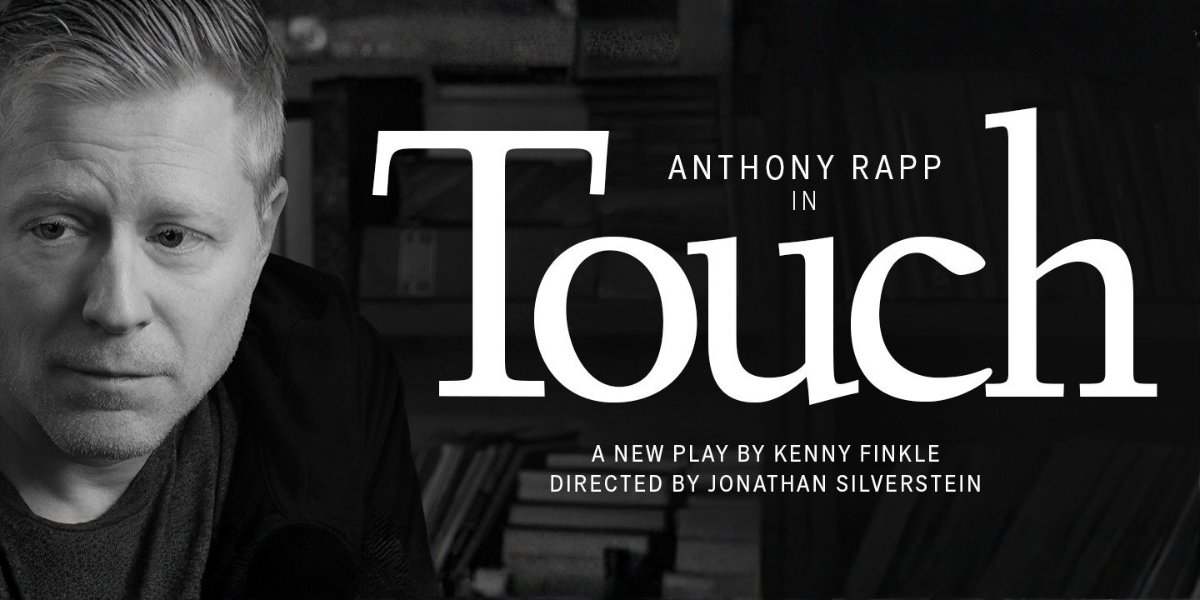
In a small, brick-walled basement in the East Village, a man sits alone under a light and begins to talk. There are no elaborate set pieces, no sweeping score, no cast of dozens, just a single actor, a story, and the fragile, electric space between performer and audience. And yet, in TOUCH, that simplicity becomes something unexpectedly expansive.
Written by Kenny Finkle, directed with careful precision by Jonathan Silverstein, and performed with remarkable depth by Anthony Rapp, TOUCH is the kind of intimate theatrical experience that feels almost radical in its restraint. It invites the audience not to observe from a distance, but to lean in, to listen, to question, and perhaps to recognize themselves.
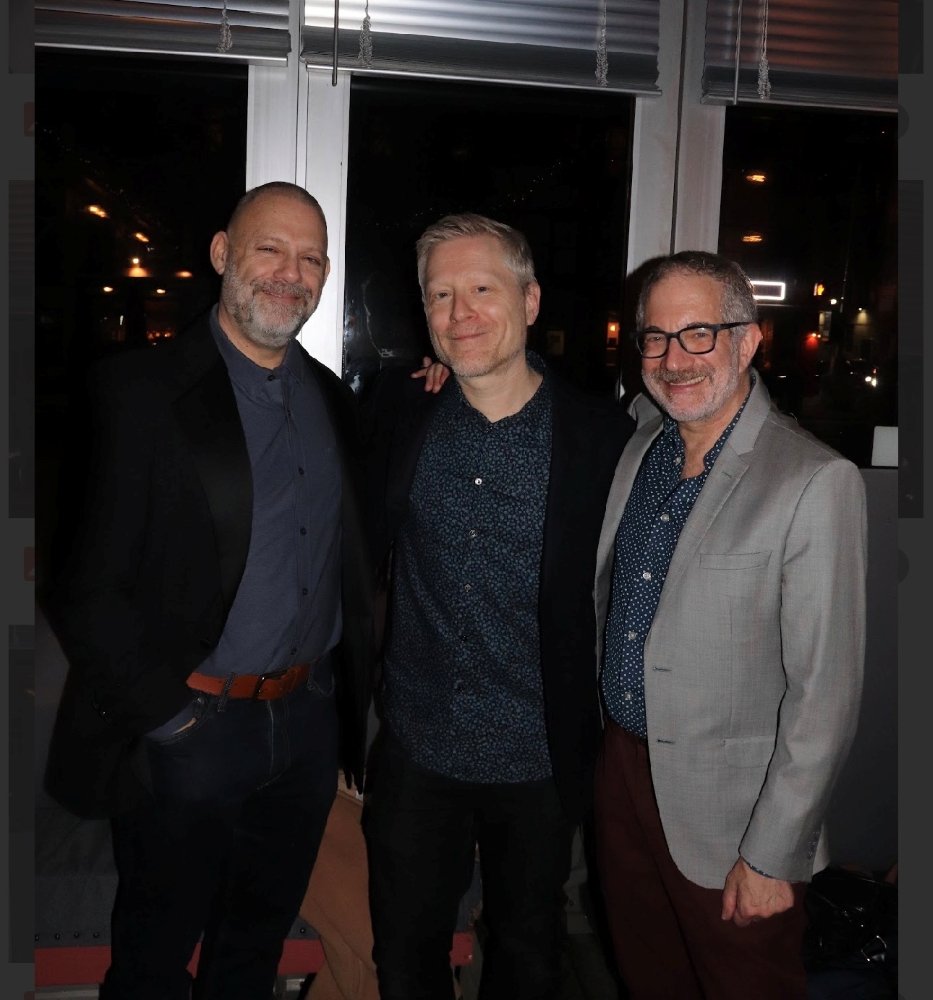
Photo Courtesy: Table 7 Strategies / Kevin Kulp (Kenny Finkle, Anthony Rapp, and Jonathan Silverstein at the opening night of TOUCH.)
At the center of the play is Syd Blatter, a middle-aged gay man, former writer, and weary teacher whose life is quietly unraveling. When an unexpected encounter with a former student resurfaces memories long buried, Syd is forced into a reckoning, not just with his past, but with the subtle, often invisible ways we shape one another’s lives.
The seed of the play, Finkle has said, came from a chance meeting of his own. Running into a former student years later stirred something deeper than nostalgia, it opened up questions about influence, responsibility, and the lingering imprint of human connection. That moment evolved into a broader exploration of how even fleeting interactions can ripple outward in ways we rarely anticipate.
What makes TOUCH so compelling is its refusal to offer easy answers. Instead, it lingers in the gray areas, those uncomfortable spaces between intention and consequence, memory and truth. Syd is not a hero, nor is he a villain. He is, as Finkle has crafted him, profoundly human: flawed, searching, and achingly aware that time has a way of complicating everything.
Finkle has described Syd as someone trying to tell “the whole truth,” even as he struggles against his own instincts to deflect, justify, or rewrite. That tension, the push and pull between honesty and self-protection, becomes the engine of the play. As Syd speaks, what emerges is less a confession than an excavation, each layer revealing something messier, more vulnerable, and ultimately more recognizable.
The solo format amplifies this effect. There is nowhere for Syd to hide, and no one else to carry the narrative weight. The structure, which Finkle likens to an aria, unfolds with a musicality that feels both deliberate and organic. The language builds, shifts, and occasionally surprises, guiding the audience through a landscape of emotion that feels at once intimate and expansive.
Director Jonathan Silverstein leans fully into that intimacy, staging the production in a way that collapses the distance between actor and audience. In the East Village Basement, spectators are not passive observers, they are participants in the act of listening. Syd speaks to them directly, and in doing so, transforms the audience into a kind of silent counterpart.
Silverstein has described the play as a “confessional,” and that sensibility permeates every aspect of the production. The staging is minimal, almost invisible, allowing the focus to remain squarely on the story and the performance. It evokes something primal: the simple, ancient act of gathering to hear a story told aloud.
That simplicity is deceptive. Beneath it lies a carefully calibrated collaboration between playwright, director, and actor. Finkle, Silverstein, and Rapp approached the text with rigorous attention, refining not just the structure but the smallest details of language and rhythm. In the process, they stripped away excess, sharpening the play’s emotional core.
Rapp’s performance sits at the center of it all, and it is nothing short of mesmerizing. Known for his work in Rent and a career that spans stage and screen, Rapp brings both technical precision and emotional openness to the role. His Syd is quick-witted, self-aware, and often very funny, but beneath that humor lies a deep undercurrent of vulnerability.
What makes the performance particularly striking is its sense of immediacy. In a space this intimate, every shift in tone, every pause, every glance carries weight. The audience can feel the performance evolving in real time, shaped by the shared energy in the room.
Silverstein notes that in a piece like this, the audience becomes an essential part of the storytelling. Their reactions, laughter, silence, even the smallest intake of breath, feed back into the performance, creating a dynamic that is different every night. It’s a reminder of theatre’s unique power: its ability to exist fully in the present moment.
And yet, for all its immediacy, TOUCH lingers. Long after the final lines are spoken, the questions it raises continue to echo. What do we owe each other? How do we measure the impact of our actions? And perhaps most hauntingly: what are the consequences of the things we set in motion without even realizing it?
Finkle has said that the title itself carries multiple, even contradictory meanings. That complexity is woven throughout the play, inviting audiences to sit with uncertainty rather than resolve it. It’s a bold choice, and one that ultimately gives the piece its quiet power.
In an era often defined by spectacle and speed, TOUCH offers something different, a chance to slow down, to listen closely, and to engage with a story that unfolds not in grand gestures, but in the subtle, often invisible moments that shape a life.
It is, in the end, a reminder that theatre doesn’t need to be large to be profound. Sometimes, all it takes is one voice, one story, and a room willing to hear it.
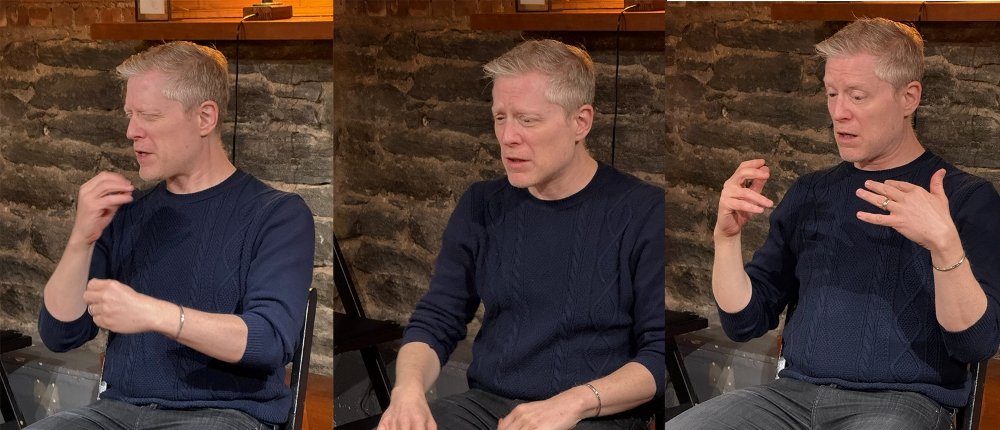
Photos Courtesy: Table 7 Strategies (Anthony Rapp in TOUCH)
Tickets for TOUCH are available exclusively through TodayTix, with additional information at touchplaynyc.com. Produced by Jack DePalma and Andrew Stein, with executive production by Mix and Match Productions, the limited run and intimate seating make early booking essential, this is the kind of theatrical experience that thrives on proximity, and the closer you are, the more it lingers.