
Imagine one business requesting the same working capital from three different sources in the same week. Its numbers don’t change, but the answers do. Laying those three quotes side by side is the clearest way to see what you actually pay for speed.
Meet Lakeview Plumbing Supply, a fictional distributor with $120,000 in monthly deposits, four years in business, and a personal credit score of 670. It needs $50,000 to stock up ahead of a contractor rush. The quotes below are illustrative, and rates in the real market vary with risk and timing.
Quote A: The Community Bank
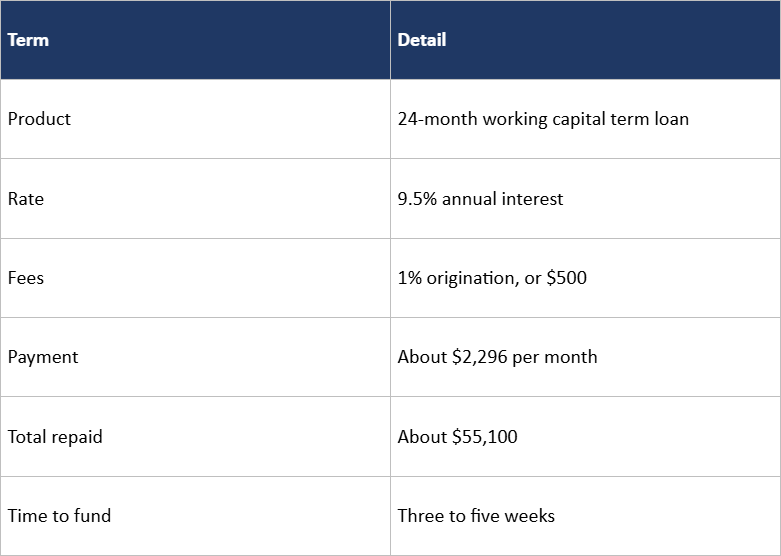
Total cost: About $5,600, including the origination fee.
What’s good: The lowest cost by far. Monthly payments are easy to plan around.
What’s bad: The rush begins in nine days, so this money would arrive too late to catch it.
Quote B: The Online Lender
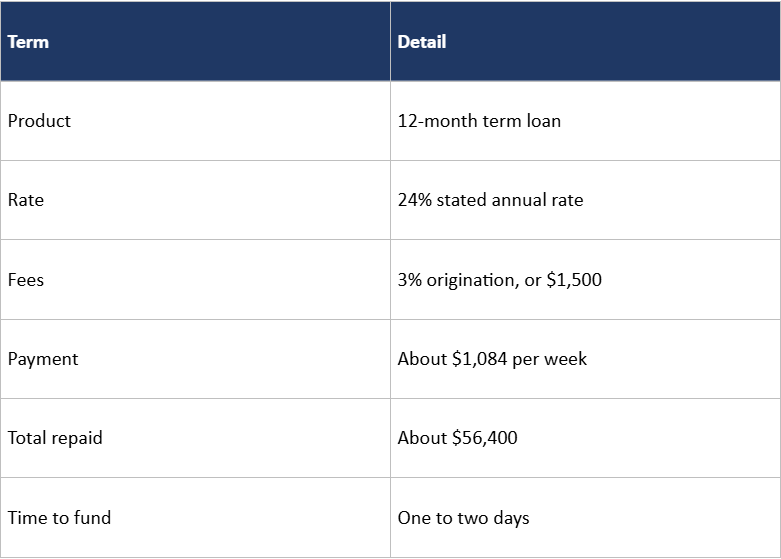
Total cost: About $7,900, including origination.
What’s good: It’s fast, and interest declines as the balance falls.
What’s bad: Weekly payments begin almost immediately. The origination fee pushes the effective APR close to 30%.
Comparing a fast provider’s terms is easier when you can see how it describes them, and Fundivi fast working capital funding is one example of how a provider presents a product like this.
Quote C: The Advance

Total cost: $16,750.
What’s good: It’s the easiest to qualify for and the quickest.
What’s bad: It costs three times as much as the bank loan. Daily debits begin right away. Assuming roughly 126 business days for repayment, the estimated APR runs well over 100%.
All Three Side by Side

The price of getting money next week rather than next month is $2,300 (the difference between A and B). The price of getting it tomorrow from an advance rather than an online lender is another $8,850.
Now the question becomes useful: is the extra speed worth that amount?
What Makes a Rate Rise or Fall
Rates for working capital are set by perceived risk and the provider’s own costs. Here are the main drivers.
Time in business. Longer histories generally earn lower pricing.
Revenue level and stability. Steady, verifiable deposits reduce risk.
Bank account behavior. Fewer negative days generally means better terms.
Credit history. It can matter significantly for term loans and less for advances.
Existing debt. A company already making daily payments poses more risk.
Term length. Shorter loans often have higher annualized costs, though lower total dollars.
Industry. Restaurants, trucking, and construction are sometimes priced as riskier.
Market rates. Benchmark interest rates and the provider’s funding costs filter through to borrowers.
Who’s selling. A broker’s commission could be built into your price.
It’s useful to look at several sources. A summary of unsecured working capital lenders can give you an idea of how products differ, but only a real quote using your actual numbers will tell you your rate.
Three Numbers That Confuse Owners
The stated interest rate tells you what’s charged on the balance but ignores fees.
The factor rate tells you the total multiple of the money borrowed, but says nothing about how quickly you pay it back.
The APR puts everything on an annual basis, including certain fees, so it’s the best single yardstick for comparison. Still, a high APR on a very short loan might represent a small number of dollars. So look at both.
Example: A $10,000 loan with a $500 charge repaid in 30 days has an annualized rate of more than 60%, but it costs only $500. A $10,000 loan at 25% over 3 years has a much lower rate but costs about $4,300 in interest.
How Lakeview Decided
Lakeview’s owner calculated the benefit. Pre-rush stock purchases would generate about $38,000 of gross profit over 60 days. Missing the rush would mean losing at least half of those sales.
Anyone with mainly card revenue might consider something different from these three options. This Ironton Tribune story on card receipts lending describes a related structure, and it should be analyzed the same way as any other quote: net cash received, total repayment, payment rhythm, and approximate APR.
For Lakeview, the options looked like this:
- Bank: Money arrives too late. Cost of $5,600, but lost profit of $19,000.
- Online loan: Money arrives in time. Cost of $7,900.
- Advance: Money arrives in time. Cost of $16,750.
The online loan provided nearly all of the benefit at about half the advance’s price. The owner chose B and made a note to apply for a bank line after the rush, so that next year’s stock buy could be funded at the lower rate.
Lowering Your Own Rate
Before you accept a fast quote, try these steps:
- Ask for your best rate in writing, and show a competing offer.
- Request a shorter term if the total cost is your priority, or a longer one if cash flow is.
- Negotiate origination.
- Pay down small existing balances to clear daily debits.
- Reduce the amount. A smaller request can sometimes be priced better.
- Ask about prepayment. Interest-based loans reward early repayment, whereas fixed-fee products may not.
- Keep your account positive for a full month before applying.
Quotes Are Only Part of the Story
Provider reputation matters too. Best Rated Business Loans publishes a 4.9 score naming Fundivi its top verified lender on BestRatedBusinessLoans.com provider scorecards. Learn how any rating is calculated, and remember that it can’t tell you what you’ll be charged. Your quote will.
Three Questions Before Signing
Once you’ve got your quotes on a single page, pause and answer:
What happens if revenue falls by 20%? Could you still make the payments?
What will this money produce? Name the dollars and the date.
Is there a cheaper way to solve part of this? A supplier’s extended terms or a partial early payment from a customer could shrink the amount you need.
When the Highest Rate Can Still Be Right
Occasionally, the most expensive quote is the rational choice. If a business would lose a profitable contract or be forced to close without money by tomorrow, and neither of the cheaper options can arrive in time, paying more may protect far more value. The key is being honest about the deadline. Many deadlines turn out to be negotiable after one phone call. Ask your supplier, landlord, or customer whether a few extra days are possible. A short extension can move you from the most expensive column to a much cheaper one, and that single conversation could easily save thousands of dollars.
Frequently Asked Questions
What’s a typical working capital loan rate?
It ranges widely, from single digits at banks to well over 100% APR for some advances, depending on the product and borrower.
Why is fast funding so much more expensive?
It reflects higher risk, lighter documentation, quick decisions, and in some cases broker commissions.
Can I negotiate a working capital rate?
Often, particularly with competing offers and a clean file.
Is a lower payment always better?
No. A lower payment might be the result of a longer term and higher total cost.
Do rates change with the Fed?
Bank rates tend to follow benchmark changes. Short-term online products are less directly tied to them.
Should I compare APR or total dollars?
Both. APR allows comparison across terms, and dollars show the actual cost.
Are origination fees included in APR?
Usually, under standard APR calculations, though you should confirm which fees are included.
Can I refinance into a lower rate later?
Often, after a period of on-time payments. Check first for prepayment costs.
Are there working capital loans with no fees?
Some products advertise no origination fee, but the cost may be built into the rate. Compare total repayment.