
A manuscript can be beautifully written and thoroughly edited, yet may still fail to make a strong impression if it is not properly formatted. Formatting is the technical and visual backbone of a published book. It determines whether your interior pages look clean and professional or cluttered and amateur. Professional book formatting services are designed to help your manuscript meet the standards required by print and digital platforms while supporting readability and overall presentation.
At Bright Field Publishing LLC, formatting is treated as its own specialized discipline, separate from editing and cover design, because it requires a distinct set of technical skills, layout knowledge, and attention to detail.
What Book Formatting Actually Involves
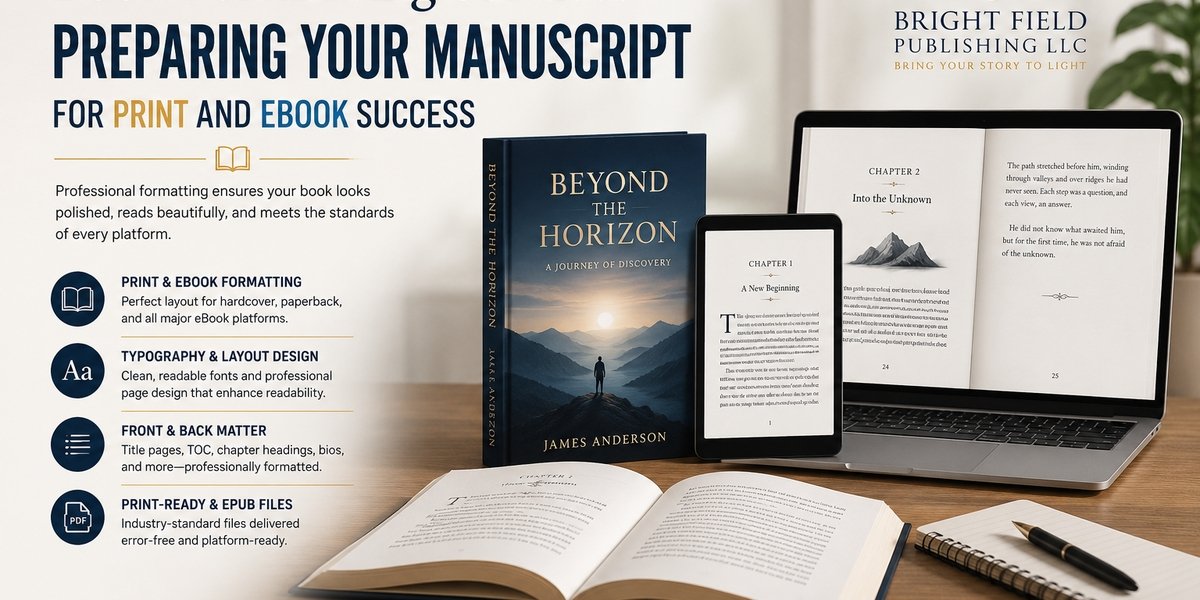
Formatting goes far beyond simply choosing a font. A complete interior book design process typically includes:
• Typography selection: Choosing readable, genre-appropriate fonts for body text, headers, and chapter titles.
• Margins and spacing: Setting consistent margins, line spacing, and paragraph indentation suited to the selected trim size.
• Chapter structure: Designing chapter openings, drop caps, scene breaks, and section dividers.
• Headers and footers: Adding page numbers, running headers, and consistent navigation elements.
• Front and back matter: Formatting title pages, copyright pages, dedications, tables of contents, acknowledgments, and author bios.
• Image and table placement: Helping ensure visual elements are properly sized, aligned, and positioned within the text.
• File conversion: Producing print-ready PDF files and properly coded EPUB files for eBook platforms.
Each of these elements affects how readable and professional your finished book feels, even if many readers never consciously notice the formatting itself. That is part of the point of doing it well.
Why Print and eBook Formatting Require Different Approaches
One common mistake self-published authors make is assuming a single formatted file can work for both print and digital publishing. In reality, print and eBook formatting follow very different technical rules.
Print Formatting
Print books require fixed-layout files that account for:
• Trim size: Determines page dimensions and margin requirements.
• Bleed and gutter margins: Helps ensure text does not get cut off during printing or lost in the binding.
• Consistent pagination: Keeps page numbers and chapter breaks fixed throughout the book.
• Font embedding: Helps ensure fonts display correctly regardless of the printer or production system used.
eBook Formatting
eBooks use reflowable text that adapts to different screen sizes, devices, and reader preferences. This requires:
• Clean, properly coded EPUB files that render correctly across Kindle, Apple Books, Kobo, and other platforms.
• Flexible formatting that holds up when a reader increases font size or switches between a phone, tablet, and e-reader.
• Simplified front matter, since fixed page numbers do not translate well to digital formats.
• Properly embedded metadata, supporting accurate display of the title, author name, and table of contents navigation.
A formatting team experienced in both areas understands these differences and can produce separate, correctly optimized files for each format rather than relying on a single generic conversion.
Why DIY Formatting Often Causes Problems
Word processing software can technically produce a formatted manuscript, but it often introduces hidden issues that are not visible until the book is printed or uploaded to a retailer. Common problems include:
• Inconsistent spacing that looks fine on screen but causes uneven pages in print.
• Font substitution errors that occur when a printer does not have access to the exact font used, leading to unexpected changes.
• Broken EPUB code that causes eBooks to display incorrectly or fail platform quality checks.
• Awkward page breaks that split chapters, sections, or images in visually distracting ways.
• Inconsistent header and footer placement across chapters.
These issues often go unnoticed by the author until a reader points them out or until a print proof reveals the problem late in the process. Professional manuscript formatting for self-publishing is specifically designed to catch and reduce these issues before publication.
How Strong Formatting Improves the Reading Experience
Good formatting works quietly in the background, but its impact on readability can be significant. Thoughtful book layout design can improve:
• Reading flow through appropriate spacing and paragraph structure.
• Visual hierarchy by helping readers easily distinguish chapters, sections, and special content.
• Professional credibility because clean formatting can signal a polished, well-produced book.
• Cross-device consistency by helping eBooks look clean on phones, tablets, and e-readers.
• Print quality by helping avoid awkward breaks, cramped margins, and inconsistent spacing in physical copies.
Readers may never consciously notice effective formatting, but they may notice poor formatting, often in the form of a critical review mentioning a hard-to-read or unprofessional layout.
What a Professional Formatting Process Should Include
When evaluating book formatting services, look for a process that includes:
• Manuscript Preparation: Cleaning up the source file to remove inconsistent styles and hidden formatting errors.
• Trim Size and Layout Decisions: Selecting dimensions appropriate to your genre and printing method.
• Typography and Style Setup: Establishing consistent fonts, headers, and chapter formatting throughout the manuscript.
• Front and Back Matter Design: Formatting title pages, copyright information, dedications, acknowledgments, tables of contents, and author bios.
• Print File Production: Generating a print-ready PDF that meets the specifications of your chosen printer or publishing platform.
• eBook File Production: Creating a properly coded EPUB file optimized for digital retailers.
• Quality Review: Conducting a final check across formats to confirm consistency and catch any remaining issues.
A strong formatting process can give your book a polished interior and help prevent avoidable publishing delays.
Choosing the Right Formatting Partner
Not all formatting services offer the same level of detail. Before committing, ask:
• Will I receive both print-ready and eBook-ready files?
• What trim sizes and platforms do you have experience formatting for?
• How are images, tables, or special elements handled within the layout?
• Is there a quality review process before final delivery?
• Can you provide a sample of previous interior formatting work?
A transparent, experienced formatting team should be able to answer these questions clearly and show real examples of their work.
How Bright Field Publishing LLC Approaches Formatting
At Bright Field Publishing LLC, formatting is handled as a dedicated, detail-driven stage of the publishing process. Our team provides:
• Custom interior layouts tailored to your genre and trim size preferences.
• Separate, correctly optimized files for print and eBook formats.
• Careful handling of front and back matter, including title pages and author bios.
• Properly coded EPUB files tested for compatibility across major platforms.
• A thorough quality review before final delivery.
We treat formatting as an essential part of your book’s overall presentation, not an afterthought squeezed in after editing and design.
A Professionally Formatted Book Can Help Build Reader Trust
Formatting may be one of the less visible parts of the publishing process, but its absence can be noticeable. Clean, consistent book formatting services help your manuscript look as professional on the page as it reads in your mind, across both print and digital formats.
If you are ready to give your manuscript a polished, publication-ready layout, Bright Field Publishing LLC can handle the formatting details so your story can be presented with clarity, quality, and confidence.