
By: Robert Harrison, Americana Music Review
The Pittsburgh singer-songwriter teams with her 98-year-old father for a heartfelt examination of American heroism, national memory, and the complicated history behind a familiar patriotic refrain.
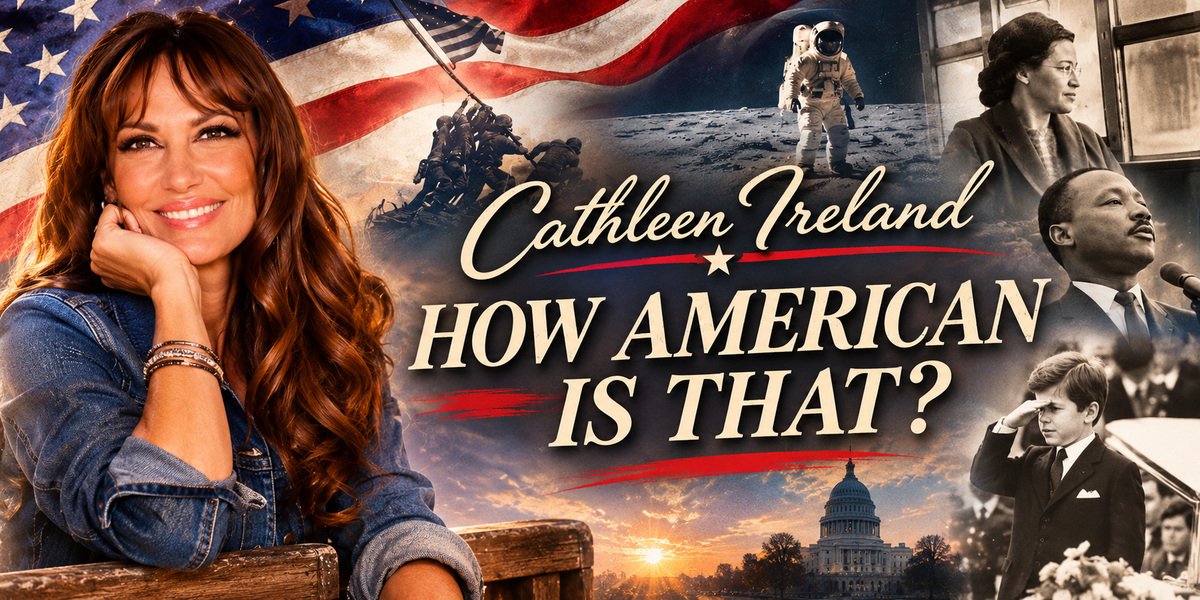
American country music has never had much trouble celebrating the flag. From Johnny Cash’s patriotic recordings to Lee Greenwood’s “God Bless the U.S.A.,” the genre has repeatedly returned to the symbols of national identity, often with commercial success. What’s more difficult is writing a patriotic song that says something distinctive about the country beyond the usual declarations of gratitude and pride. Cathleen Ireland takes an interesting approach to that challenge on “How American Is That?”, the single from her acoustic album Roots & Wings, released November 6, 2026.
Rather than building the song around abstract notions of freedom or national greatness, Ireland fills her verses with recognizable historical figures and events. Neil Armstrong and Buzz Aldrin walk on the moon. Ira Hayes helps raise the American flag on Iwo Jima. Three-year-old John F. Kennedy Jr. salutes his father’s casket during the president’s funeral procession.
These aren’t fictional characters invented to illustrate a songwriter’s argument. They’re people whose actions became part of the country’s shared historical memory. By placing them alongside one another, Ireland suggests that America’s identity is best understood through the individuals who have shaped it.
The song’s origin gives that approach additional meaning. Ireland wrote “How American Is That?” with her 98-year-old father, who conceived the idea during sleepless nights following his wife’s death. He began recalling historical moments that had made lasting impressions on him, eventually proposing that his daughter turn those memories into a song.
Ireland developed the lyrics, contributed the bridge, and worked with her father to refine the composition. She has said that he still cries whenever he hears the finished recording.
That family connection is arguably the most affecting aspect of the entire project. An elderly man remembering the country he has watched change over nearly a century provides the raw material for a song performed by his daughter. The collaboration transforms historical references into something more intimate: memories passed between generations.
The opening verse recalls the Apollo 11 moon landing, one of the rare twentieth-century events that genuinely justified the language of national accomplishment. Armstrong and Aldrin’s achievement represented enormous scientific progress, but it also became part of American folklore, a story retold so frequently that its details have acquired the familiarity of an old ballad.
Ireland’s reference to Ira Hayes belongs to another country-music tradition entirely.
Hayes, a Pima Native American Marine who participated in the famous flag raising on Iwo Jima, was the subject of Peter La Farge’s “The Ballad of Ira Hayes,” which Johnny Cash recorded in 1964. That earlier song examined the tragic circumstances of a decorated veteran whose military heroism did not protect him from discrimination and personal suffering.
Ireland approaches Hayes differently, emphasizing the achievement rather than the tragedy. Her version is celebratory, while La Farge’s was accusatory. Both recognize the historical importance of the same individual, but their contrasting perspectives demonstrate how the meaning of patriotism can shift depending on the storyteller.
That distinction becomes especially relevant when Ireland introduces Rosa Parks and Martin Luther King Jr. in the song’s bridge.
Neither Parks nor King became historically significant by accepting the American social order as it existed. Their achievements required challenging laws, customs, and institutions that denied Black Americans fundamental rights. They demonstrated that loyalty to a country’s highest ideals sometimes requires resisting its established practices.
Their inclusion alongside astronauts, scientists, soldiers, and first responders gives Ireland’s patriotic vision a broader foundation than simple military or political triumphalism.
The bridge also acknowledges Jonas Salk, whose polio vaccine changed public health, Dr. David Ho, whose HIV/AIDS research helped transform treatment, and Chesley “Sully” Sullenberger, whose emergency landing on the Hudson River saved 155 lives.
Taken together, these figures suggest that American heroism is less a matter of occupation or ideology than of accomplishment, courage, and service to others.
The chorus, however, is considerably less complicated than the verses.
Built around the repeated question “How American Is That?”, it asks listeners to remove their hats, place them over their hearts, and celebrate the nation. Its language is direct, its sentiment unmistakable, and its appeal rooted in familiar patriotic traditions.
There’s nothing inherently wrong with that approach. Country music has always relied on plainspoken emotion, and a memorable refrain often depends on clarity rather than sophistication.
Still, the chorus occasionally flattens the historical distinctions that make the verses interesting. Armstrong’s moon landing, Parks’ resistance to segregation, and Hayes’ military service were profoundly different experiences. Their significance becomes richer when those differences are acknowledged rather than absorbed into one uncomplicated expression of national pride.
This is where “How American Is That?” reveals both its strengths and limitations.
Ireland has explained that she and her father deliberately selected moments they associated with greater national unity, hoping the song might bring Americans closer together. The intention is admirable, even if historical unity often looks considerably less convincing when examined from the perspectives of those excluded from it.
The song doesn’t explore those contradictions in depth, but it does provide enough historical variety to encourage listeners to consider them.
Its acoustic setting also suits the material. By foregrounding the lyric rather than an elaborate contemporary production, Ireland places the historical references at the center of the composition. The result belongs more naturally to the storytelling traditions of folk and country music than to the bombastic patriotic anthems frequently associated with public ceremonies.
The accompanying lyric video, directed by Michael Stover, extends the nostalgic presentation.
Ultimately, “How American Is That?” is most persuasive not as a definitive statement about American exceptionalism but as a document of family memory.
Its historical figures supply the recognizable names, but the emotional center belongs to a father who conceived the song and a daughter who helped bring it into existence.
That relationship offers a more convincing expression of national continuity than any flag-waving declaration could provide. Countries preserve their identities through the stories people tell, the memories they share, and the questions each generation asks of the one before it.
Cathleen Ireland’s single may not resolve the complicated relationship between American ideals and American history, but it does something worthwhile: It reminds listeners that the country’s most enduring accomplishments were made by human beings rather than abstractions.
And in the end, the most memorable people in “How American Is That?” may be the two songwriters themselves, working across generations to preserve the stories they believe still matter.