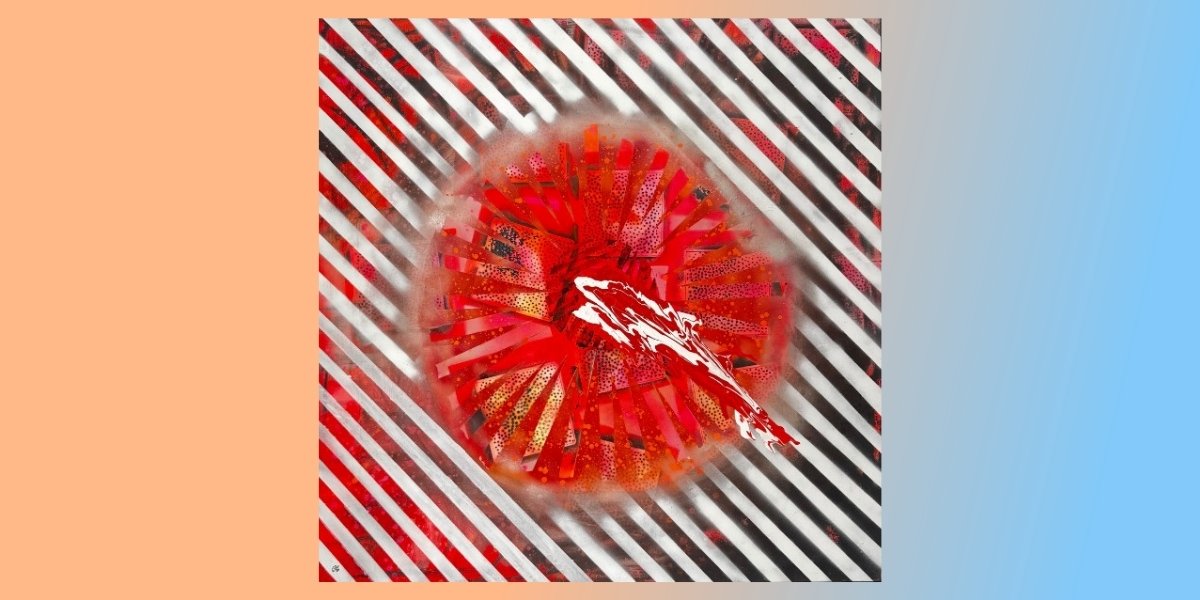

Working under the pseudonym Ernesto Artig, the artist approaches abstraction not as a stylistic choice but as a way of creating space—space for attention, resonance, and human presence. The pseudonym allows the work to stand apart from biography, encouraging encounter over authorship and protecting the quiet, inward nature of the practice. For Artig, what matters is not who the artist is, but what unfolds between artwork and viewer.
His paintings do not instruct or explain. They invite stillness. Meaning is not embedded as a message but emerges through engagement, forming slowly in the space between surface, perception, and response.
A Practice Rooted in Presence
Based between the UK and Europe, Artig works across painting and poetry, allowing each medium to inform the other. Paintings carry rhythm, texture, and movement; poems respond to emotional undercurrents that surface during or after the act of painting. Neither medium exists to illustrate the other. Together, they form parallel languages—two ways of listening.
As a self-taught artist, Artig approaches painting intuitively. Each canvas evolves through layering, erasing, and reworking with acrylics, spray paint, impasto, and texture until it reaches its own resolution. Some works unfold through repetition and geometry; others emerge through energetic contrast. Across the practice, authenticity and attentiveness take precedence over formula or trend.
The studio process is intentionally slow. Paintings are allowed to pause, resist, and change direction. For Artig, a work completes itself only when a certain silence enters the surface.
Abstraction as Human Language
Artig treats abstraction as a form of conversation rather than representation. His canvases suggest movement, tension, and release without resolving into narrative. Viewers are not guided toward interpretation but invited into reflection.
Every mark functions as an opening rather than a statement. The work holds ambiguity deliberately, allowing personal memory, emotion, and sensitivity to shape the encounter. In this way, abstraction becomes a shared language—one that operates through intuition rather than explanation.
The Connecting Conditional Art Movement (CCAM)
At the heart of Artig’s practice lies the Connecting Conditional Art Movement (CCAM)—an artistic framework grounded in the belief that shared aesthetic experience can open pathways to deeper human connection.
Not all of Artig’s works are part of CCAM. Some paintings exist as standalone pieces. Within CCAM, however, selected artworks are created in dialogue with other paintings held by different collectors. These works are conceptually linked rather than visually mirrored, and they exist across separate homes.
Artig’s premise is simple yet intentional: when two people are genuinely touched by paintings that are already in dialogue with one another, they may also share a deeper point of connection themselves. Being moved by the same artistic exchange suggests a resonance beneath surface preference—a shared attentiveness, emotional sensitivity, or way of perceiving the world.
The connection is conditional. It begins with curiosity—about the counterpart artwork and about the person who lives with it. Collectors are made aware that their painting forms part of a wider, quietly linked structure. Any further contact remains optional, organic, and self-directed.
Rather than enforcing interaction, CCAM creates the possibility of a meaningful encounter. Art ownership shifts from a solitary act toward a reflective one, where art functions as a bridge between inner experience and human relationship. Connection, if it unfolds, does so from a shared place of having been touched.
Poetry as a Parallel Language
Poetry plays an integral role in Artig’s practice. Selected paintings are paired with original poems that do not describe or interpret the image, but resonate alongside it. The text mirrors the openness of the painting, offering another point of entry rather than a conclusion.
Looking ahead, Artig plans to extend this dialogue through audio-based poetry experiences within exhibitions, allowing visitors to listen to poems while standing before the paired paintings. This layered encounter—combining sound and image—is intended to deepen presence and invite slower, more attentive engagement with the work.
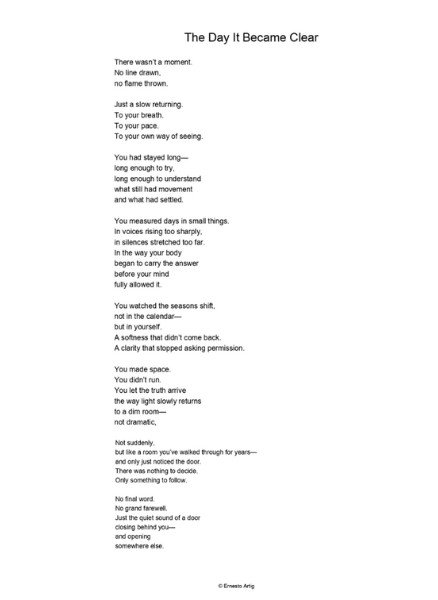
Photo Courtesy: Ernesto Artig (Poem: The Day It Became Clear)
Collecting as Relationship
Collectors of Artig’s work are drawn less by status than by experience. His paintings ask for time, attentiveness, and emotional availability. For those participating in CCAM, this experience extends beyond the individual artwork into an awareness of connection.
Here, collecting becomes participatory. The way a painting is lived with—noticed, returned to, or quietly contemplated—becomes part of its ongoing life. The artwork remains open, shaped as much by presence as by material.
International Presence Without Spectacle
From exhibitions in Venice, Paris, Rome, London, and the United States, Artig’s work maintains the same intimacy found in his studio practice. Installations are intentionally restrained, favouring clarity and space over spectacle.
Each exhibition functions as an extension of the artist’s philosophy: that art is something to be encountered, not consumed, and that connection arises through attention rather than display.
Depth Over Acceleration
Ernesto Artig continues to expand his paired painting–poetry works, develop audio-based exhibition experiences, and refine the conceptual structure of CCAM. His practice remains rooted in curiosity, presence, and emotional resonance rather than visibility or trend.
In a world that moves quickly, his work invites stillness. Meaning emerges not through explanation, but through quiet encounter—formed in the space between artwork, viewer, and attention.