
By: Ester Freider
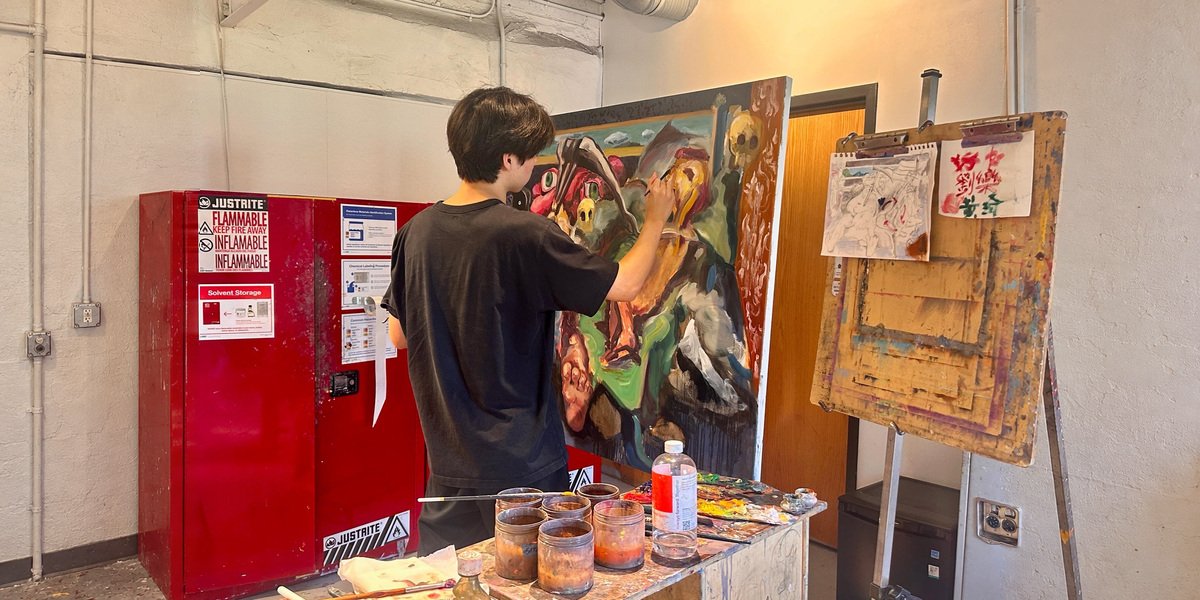
Recently, my close friend has started working for a storefront window display designer. Their company’s clients include some of the most memorable beauty, wellness, and accessory brands on the market. Now I look at window displays differently, noting the role that lighting, shelves, and text play in not just accentuating, but in essence, creating the product itself. Just as clothing re-fashions our identity as human agents, the frames in which we ornament our objects re-fashions them. Through paintings delimited by the canvas, Xiaoze Zhang’s body of visual work translates the storefront ethos to a scenography of the gallery space.

Photo Courtesy: Xiaoze Zhang
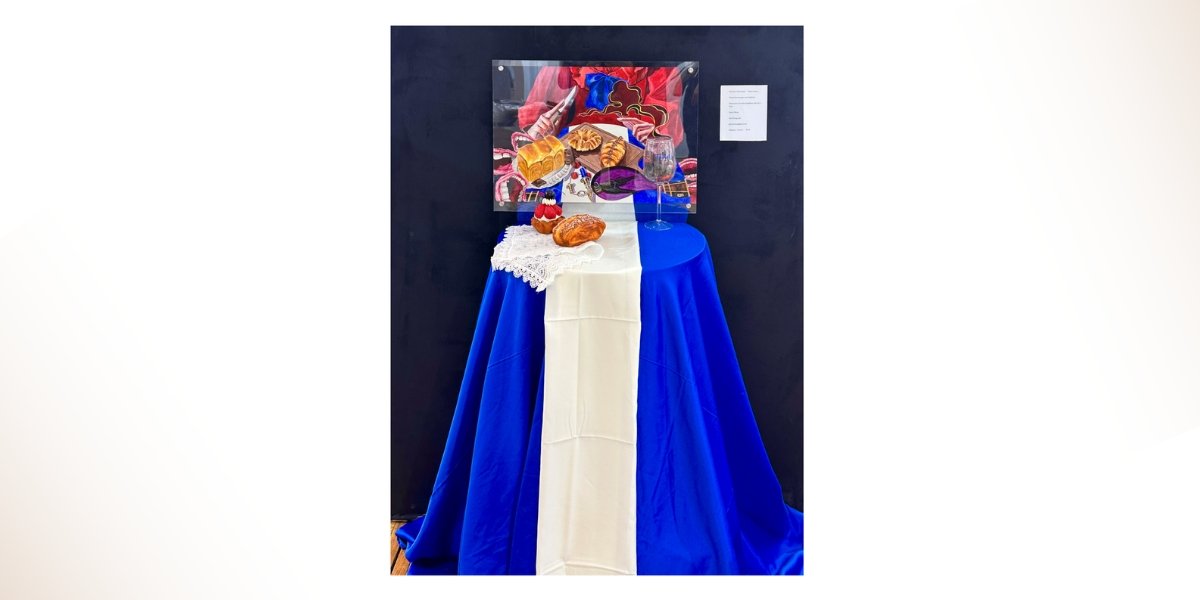
In The Great Table Escape (2025), a watercolor torso in a clown red blouse sits cutting pastries with a knife, all behind a glass wall. The blue table in the painting extends onto a real-life blue table, complete with a mirrored white runner and two hyperreal, frosting-topped pastries on a doily. A wine glass, forged into half, refracts back into a whole through the glass mount of the painting. The pastries recall the replica food items showcased in Japanese cafes, so you can see what you will eat glisten a la ageusia in 3-D, before you even order it. In Dessicant V. Rain (2025), another glass-mounted watercolor extends beyond the canvas through fake pouches of desiccant, and orange splotches that accentuate the wall behind it. The simplest yet, to me, most graceful rendering of the display-as-art occurs in the aptly titled Not True (2022), in which a small canvas with a large frame, split into four monochrome areas in the shape of an X, has its depicted flowers extend all the way to the outer edge of the frame. What is the frame, as the painting’s premium tried-and-tested display case, if not a controller of first impressions? In these works, distorting the line between work and display creates an awareness of the artwork as a product, while simultaneously bringing us into a funhouse of kitsch, frivolity, and fairytale.
In works such as the Hide series (2023) and My friend will never leave me (2023), collage is evoked through swirling cutout shapes that separate one “layer” of the painting from another. Xiaoze tells me that the images in these works are meant to feel like “they come from different timelines”, replicating the anti-linearity of dreams. By incorporating elements of collage and fragmented imagery, Zhang’s work not only evokes the dreamlike quality of shifting timelines but also challenges our understanding of how visual cues shape our emotions and memories.

Photo Courtesy: Xiaoze Zhang
In My friend will never leave me, a completely watercolor work, girls in fluffy satin dresses dance in a circle, overlaid with a shot of a dark liquid being poured and slivers of mock yellow wallpaper. The images are wishful and candied (in the Hide series, quite literally). The theme of wallpaper continues in the delicate florals of Dream of Flowers (2022) as well as the borderless Sweet Nightmare (2023) series, in which the lavender purple wall once again forms part of the work itself. The prevalence of the wall in the compositions feels like a tirade against the foreground. If walls are spaces in which things are occurring or shown, what does it mean for a wall to be ornate? For Xiaoze, the lack of a centre point of focus is intentional: she prefers to “not direct the viewer toward one fixed storyline”, opting instead for a maunder of the eye that again calls back to dreams.
The parallel between dreaming and window shopping is in the behavior of the eye: a lolling reminiscence of desires, aspirations, and childhood regrets through sweet and absurd symbols that tempt us. In Xiaoze Zhang’s work, paintings become miniature realms in which the eye tests its own – unconscious – expectations.
For more information on Xiaoze Zhang’s work, visit her official website at xiaozezhang.com, follow her on Instagram at @x1aoze.z, or explore her portfolio through this link.