
By: Jim Manley
For more than three decades, New York’s Mint Theater Company has rescued forgotten works from obscurity. Now, Artistic Director Jonathan Bank is bringing two provocative plays about love, sex and marriage back into the spotlight.
Somewhere in the archives of a library, buried in an old newspaper review or tucked away among manuscripts untouched for decades, there may be a play waiting for its second act.
For Jonathan Bank, artistic director of New York’s Mint Theater Company, finding that play is only the beginning.
“The trick isn’t finding the play; it’s recognizing its value,” Bank said. “I think taste plays as big a role in my process as any research method.”
Since taking the helm in 1995, Bank has transformed the Mint into one of Off-Broadway’s most distinctive institutions, devoted to rescuing neglected plays and returning them to the stage. Founded in 1992, the company has built its reputation on a deceptively simple proposition: A forgotten play is not necessarily an outdated one.

Its first major breakthrough came in 1999 with the American premiere of Harley Granville-Barker’s The Voysey Inheritance. The production ran for 10 weeks and helped establish the company’s identity. Since then, the Mint has presented 65 lost or neglected plays, earning special Obie and Drama Desk Awards along the way.
Its motto, “Lost Plays Found Here,” has become both a mission statement and a promise.
But Bank resists the notion that he is simply a theatrical treasure hunter.
“Serendipity probably plays the leading role,” he explained. “I’m often researching one thing when I run into something else entirely along the way.”
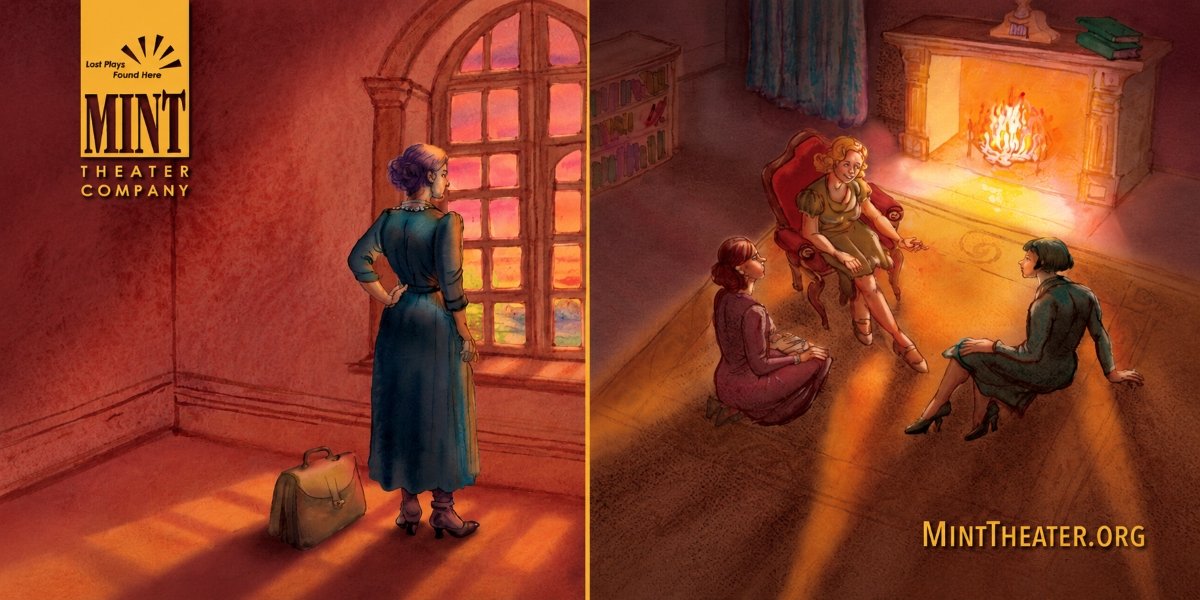
That is precisely how the Mint discovered its current production, Phyl, a rarely seen 1913 comedy by British playwright and suffragist Cicely Hamilton.
While researching the American premiere of Harold Brighouse’s Zack, which the Mint produced in 2026, Bank stumbled upon a newspaper account of a play banned in Oxford in 1913. Its author was familiar: The Mint had produced Hamilton’s Diana of Dobson’s in 2001.
The title, however, was new to him.
The script had never been published, but a surviving copy was preserved at the British Library in its Lord Chamberlain’s Plays collection. More than a century later, Phyl has returned to the stage.
Directed by Britt Berke, the production runs through November 7 at Theatre Row, with an opening night on October 22. Lily Ganser, whose Broadway credits include Stereophonic, stars as Phyllis Chester, a frustrated young governess whose desire for independence and fulfillment threatens to upend her carefully constrained existence.
The ensemble includes Tessa Bilmes, Jennifer Blood, Curzon Dobell, Katie Firth, Betsy Hogg, Livvy Marcus, Anthony Michael Martinez and Charlotte Van Ledtje.
Hamilton, an outspoken advocate for women’s rights, wrote about subjects that challenged the social conventions of her era. Although Phyl passed the scrutiny of Britain’s Lord Chamberlain without changes, Oxford University authorities banned its planned presentation. The play eventually premiered in Manchester.
For Bank, its value lies not in the controversy surrounding its origins but in the humanity of its characters.
“I don’t look for historical interest,” he said. “I want plays that are really good. And, to me, that means being about human things that are timeless.”
His test is surprisingly straightforward: “Do I care what happens and does what happens surprise me?”
The second production in the Mint’s season, The Fanatics, by Miles Malleson, begins performances February 13, 2027, under the direction of Davis McCallum, artistic director of Hudson Valley Shakespeare.
Set in the aftermath of World War I, the play follows siblings John and Gwen Freeman as they challenge conventional ideas about love, sexuality and marriage while living beneath their parents’ roof.
Bank first encountered Malleson’s writing in 2004 while researching plays about the First World War. Two of the writer’s antiwar one-acts had been banned for eight years, their publisher raided and copies confiscated by British authorities.
The discovery prompted a lasting fascination.
“I remember sitting in the reading room at the Fifth Ave library resolving to read everything else this brilliant writer had written,” Bank recalled.
The Mint subsequently produced Malleson’s Yours Unfaithfully in 2017 and Conflict in 2018, followed by adaptations of Russian stories in Chekhov/Tolstoy in 2020.
Yet The Fanatics remained a favorite, waiting for the right companion piece.
That companion turned out to be Phyl.
Together, the productions form a season titled “Let’s Talk About Sex,” examining desire, relationships and the conventions governing intimacy. The season is dedicated to the memory of longtime theatrical press agent David Gersten.
“Both plays show characters wrestling with sex, love and marriage in ways that feel fresh and valuable,” Bank said.
He asked Berke to read the works and consider whether their themes would resonate with a younger generation.
Bank is wary of directors attempting to modernize older plays through contemporary embellishments. Such approaches, he believes, can emphasize their age rather than illuminate their relevance.
“We preserve the worlds in which they were written, because we believe the world has changed far less than we think,” he explained.
The Mint’s commitment extends beyond its stage. Through publications and free streaming of previous productions, it has introduced forgotten playwrights to audiences across all 50 states and 50 countries.
For Bank, the mission remains as urgent as ever.
“Lately, I have wanted to share plays with our audience about people and relationships, rather than politics and policies.”
More than three decades into the Mint’s history, its greatest achievement may be demonstrating that the past still has plenty to say, provided someone is willing to listen.
Performance and Ticket Information: Phyl runs through November 7, 2026, and The Fanatics runs February 13 through March 20, 2027, at Theatre Row, 410 West 42nd Street, New York City. Tickets start at $39 and are available at MintTheater.org, by calling 212-714-2442, ext. 2, or at the Theatre Row box office. Service fees may apply.