
Genealogy, visual art, handwriting examination, and historical research often rely on close observation, records, and comparisons between sources. Family photographs can often help establish relationships, illustrations can preserve visual details, and handwriting samples can be examined for differences that may indicate whether a signature is authentic. Other fields, including astrology, music, and adult education, involve different methods but can also draw on research, documentation, and communication. Joelle Steele developed her professional work across these areas over several decades, alongside her established careers in publishing, horticulture, and photography.
Steele began researching genealogy in 1974, initially investigating her own family history. The work later expanded into commissioned family histories and illustrated accounts of family relationships. Her published work includes Researching and Writing Your Family History and Memoirs, which addresses how to record and present personal and family histories. Her website reported that she completed 39 genealogical histories for clients by 2026. The research involved tracing family connections, organizing historical information, and using photographs as evidence. A 2012 interview described how unidentified photographs in family albums first drew her to questions of identity and the interpretation of historical images.
Photography also connected her genealogical work with other forms of visual analysis. Family albums can contain portraits whose subjects, dates, and relationships have become uncertain over time. Steele’s interest in these records led to further study of facial features and the external ear as means of comparing people in photographs. Her work in this area later developed into a separate professional specialty. She also included photographs in her genealogy publications, where she used images alongside written records to document family histories. The combination of text and images formed part of her approach to presenting historical material for clients and general readers.
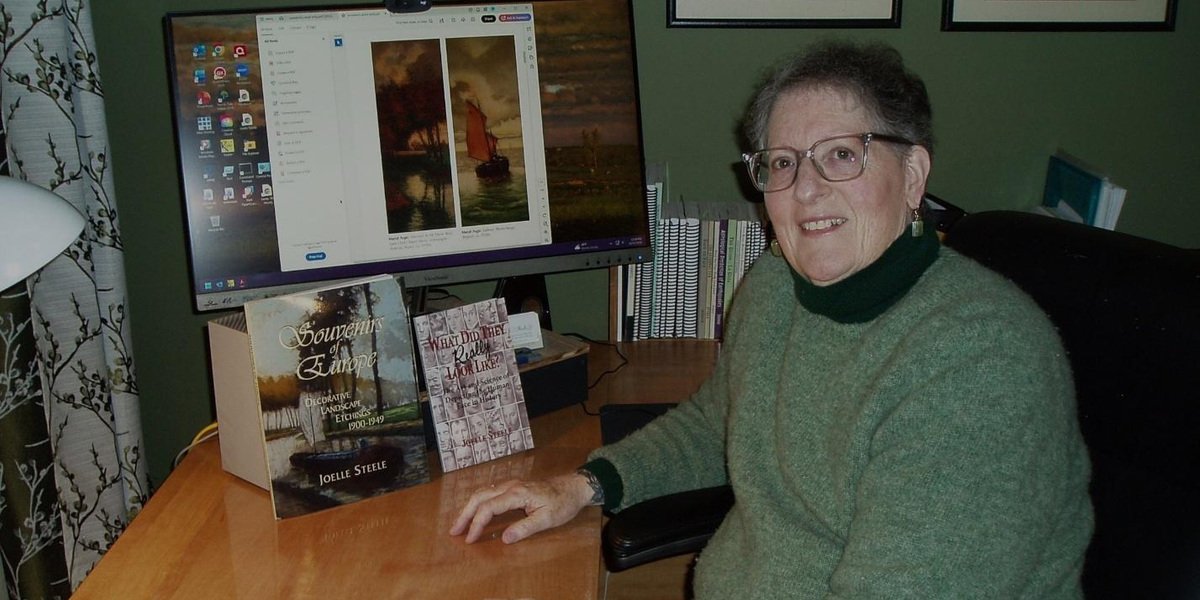
Steele’s artistic work began in childhood through drawing and painting, followed by formal instruction in California. Her work included botanical illustration, graphic design, photography, commissioned paintings, and artwork for books and commercial projects. She held her first art exhibition in 1976, displaying eight large oil paintings. During the 1980s, she also produced acrylic paintings for interior designers seeking artwork suited to particular spaces. Her illustration work included Diana J. Dennett’s Tell Me More Ancestor Stories Grandma, linking her visual practice with family-history writing. Graphic design and commissioned artwork also formed part of her broader publishing work, including book covers, advertisements, and other printed materials.
A separate professional focus developed around handwriting and the detection of forgery. Steele’s interest began with graphology, the interpretation of handwriting, but she later concentrated on comparing signatures and handwritten documents for signs of imitation. In an interview published on September 3, 2007, she said she first became court-certified as a handwriting expert around 1987, with later court appearances around 1992 and 2005. Her work involved examining features such as letter formation, spacing, slant, pen movement, and consistency between samples. She described her role as assessing the handwriting evidence rather than advocating for either party in a dispute.
Her publications on handwriting include Graphology: An Introduction to Handwriting Analysis and Personnel Selection, an earlier booklet on handwriting analysis and personnel selection, and Sign Here! Detecting Forgery in Handwritten Signatures, published by Joelle Steele Enterprises in 2021. According to its Google Books bibliographic record, Sign Here! is a 144-page reference book containing more than 250 illustrations. It discusses signature comparison, handwriting characteristics, expert witnesses, and assessing possible forgery. Steele also published online articles about questioned-document handwriting analysis and the importance of comparing suspected signatures with reliable examples. These materials cover both handwriting interpretation and examination for authentication.
Astrology became another long-running area of work. Steele’s published biography places her interest in the subject in adolescence, and her own account states that she began practicing astrology in 1972. Her research later extended to earthquakes, resulting in the Seismic Data Collection project and the book The Astrological Prediction of Earthquakes and Seismic Data Collection. First published in 1994, the book was revised in 1998, 2003, 2009, 2013, and 2020. The 2020 edition reported more than 3,500 earthquake and volcanic eruption records, including dates, times, and epicenters where available. Steele began collecting earthquake data in 1972 and supplied more than 2,000 earthquake records for the Kepler and Sirius astrology programs.
The earthquake project combined historical data collection with Steele’s interest in astrological interpretation. Her book covered seismic events, measurement methods, historical sources, and astrological theories, presenting data for readers interested in exploring possible relationships between planetary positions and disasters. This subject requires a clear distinction between collecting historical records and establishing a reliable prediction method. In the first chapter, Steele explained the problems with predicting mundane events in detail.
Adult education brought several of these subjects into her teaching. Steele began teaching continuing education classes in Southern California in 1983, starting with poetry writing. Her later courses covered writing, publishing, genealogy, art, astrology, horticulture, small-business management, website design, HTML and CSS, and other practical subjects. She taught at UCLA and Fullerton College before working at California State University, Monterey Bay, from 1998 to 2003. In Washington State, she taught at The Evergreen State College from 2006 to 2008, Pierce College from 2006 to 2016, Centralia College from 2007 to 2026, Tacoma Community College in 2009, and South Seattle College from 2010 to 2013. She took her final class at Centralia College in May 2026.
Music formed another part of Steele’s professional background. She studied piano for nine years as a child and later co-owned a recording studio in the San Francisco Bay Area during the mid-1970s. The studio produced and co-produced demonstration recordings, commercials, and corporate soundtracks. In the late 1980s and early 1990s, she wrote advertising jingles, songs, and lyrics. From approximately 1984 to 1996, she occasionally sang lead vocals with a band at fundraising events in Southern California. Her reported musical recognition includes the Music City Song Festival Award of Excellence and the American Song Festival Certificate of Merit. These activities connected sound production and songwriting with the commercial and creative work that accompanied her publishing career.
Across genealogy, art, handwriting examination, astrology, teaching, and music, Steele’s career combined written production with visual documentation, research, and instruction. The fields differed in their methods and professional standards, but they shared a recurring emphasis on collecting information and presenting it through books, articles, illustrations, courses, and other formats. Together with her publishing, horticultural, and photographic work, these activities form the wider professional record of Joelle Steele.