
By Daniel R. Mitchell
Rock ’n’ roll has always had a complicated relationship with alcohol. It has celebrated the bottle as an instrument of rebellion, a social lubricant, a source of inspiration, and occasionally a suitable replacement for professional therapy. The history of popular music is littered with songs about getting drunk, staying drunk, and finding someone to blame for the headache afterward. What it hasn’t always done quite so enthusiastically is examine the psychological wreckage that accumulates when drinking stops being entertainment and becomes an occupation.
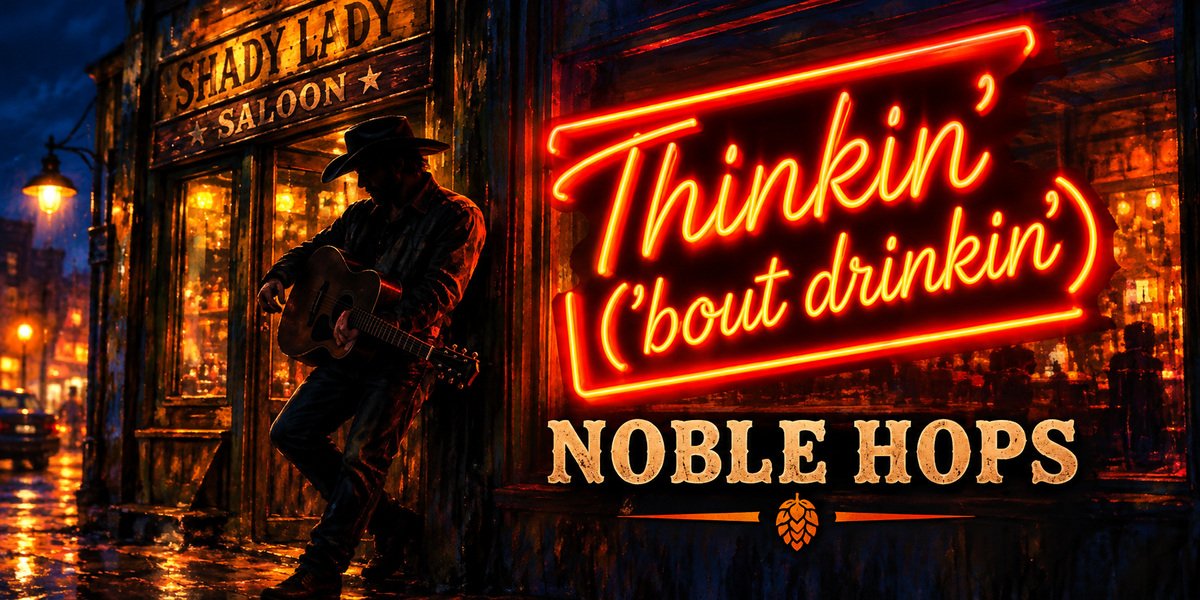
Pittsburgh-area rock band Noble Hops addresses precisely that uncomfortable territory with “Thinkin’ (‘Bout Drinkin’),” released October 10, 2026, through Shady Lady Records in association with MTS Records. It’s a muscular, lyrically direct examination of alcohol’s capacity to transform personal freedom into something resembling voluntary imprisonment.
And there’s a delicious contradiction here: Noble Hops is named after an ingredient essential to brewing beer.
That irony alone is worth considering. A band whose identity evokes the pleasures of a cold one has produced a song examining what happens when those pleasures become liabilities. It’s rather like a cigarette company releasing a ballad about emphysema, except that Noble Hops approaches the subject with considerably more humanity and none of the corporate hypocrisy.
Frontman Utah Burgess originally composed the music nearly two decades ago during his tenure with B.U.M., collaborating on the lyrics with former bandmate Marty Roppolo. The song’s resurrection in 2026 suggests that certain subjects remain stubbornly resistant to becoming outdated.
People drank to escape their problems twenty years ago. They do it today. And popular music continues to provide an extensive soundtrack for both the escape and its consequences.
The opening verse establishes its protagonist with remarkably little wasted motion. He’s drinking directly from the bottle, chasing liquor with beer, and discovering that his mouth has developed an unfortunate independence from his judgment.
There’s a recognizable character here: the fellow who begins the evening entertaining everybody and finishes it exhausting them.
But the narrator recognizes something more troubling than mere embarrassment. The bottle is beginning to dictate his actions.
That reversal of authority is central to the composition. Rock music traditionally celebrates drinking as an assertion of independence, but Noble Hops presents it as the surrender of independence itself.
The chorus compresses that contradiction into two deceptively simple lines:
“Now I’m thinkin’, ’bout drinkin’ / And I’m drinkin’, to keep from thinkin’.”
It’s the kind of wordplay that could easily become a novelty-song refrain in less thoughtful hands. Instead, it functions as a compact description of the psychological machinery behind dependency.
The narrator drinks to silence his thoughts. His actions generate additional problems. Those problems create more thoughts he wants to silence. The cycle repeats, presumably until the money, relationships, or liver runs out.
There’s no grand metaphor required. The circular construction does the work.
Musically, Noble Hops draws upon the durable traditions of guitar-driven hard rock. Burgess supplies vocals and electric rhythm guitar, Tony Villella handles rhythm and lead guitar, Johnny “Sleeves” Costa provides bass, and Brad Hurlburt plays drums.
Recorded at Rattle Clack Studio, the single was engineered, produced, mixed, and mastered by Jazz Byers, with Burgess serving as co-producer.
The choice of a harder rock presentation is appropriate. This isn’t material particularly suited to delicate introspection or fashionable electronic embellishment. Its story benefits from the directness associated with amplified guitars, a sturdy rhythm section, and the familiar vocabulary of working-class rock.
That connection to rock’s blue-collar traditions deserves attention.
For generations, drinking songs have offered listeners an accessible language for disappointment, exhaustion, loneliness, and economic or emotional frustration. The bar becomes a temporary refuge from responsibilities that cannot actually be abandoned.
But there is a difference between drinking to celebrate surviving another difficult week and drinking because facing another day has become unbearable.
“Thinkin’ (‘Bout Drinkin’)” occupies the troubling space between those experiences.
The second verse introduces the narrator’s romantic predicament. A woman who once promised love and companionship has departed, apparently after enduring the consequences of his behavior.
His realization comes only when sobriety returns.
It’s an effective inversion of one of popular music’s oldest narrative devices. Conventionally, the abandoned lover heads for the bottle because his relationship has ended. In Noble Hops’ version, the relationship ends because he keeps heading for the bottle.
That distinction transforms a familiar situation into something considerably less comfortable.
The narrator doesn’t provide a detailed accounting of his mistakes. He simply recognizes that someone important has disappeared while he wasn’t paying sufficient attention.
Burgess has explained that the song isn’t intended as an indictment of everyone who enjoys alcohol. He openly acknowledges his own fondness for beer. His concern is the boundary separating pleasure from compulsion, particularly when consumption becomes a method of suppressing unresolved emotional difficulties.
The release date reinforces that perspective. October 10 coincides with World Mental Health Day, connecting the song’s themes with broader conversations about psychological distress and substance use.
Yet the track avoids the greatest danger of message-oriented rock: allowing the lesson to overpower the humanity.
Its narrator isn’t an educational example designed to illustrate a diagnosis. He’s a flawed individual confronting the consequences of decisions he struggles to control.
There is no miraculous recovery waiting in the final chorus. No girlfriend returns. No declaration of sobriety suddenly reorganizes his existence.
Instead, the central anxiety remains: the fear that intoxication might reveal aspects of his personality he’d prefer to conceal.
That unresolved ending matters. Addiction rarely follows the convenient dramatic architecture of a three-minute song, and Noble Hops wisely declines to pretend otherwise.
The group’s approach also raises a larger question about rock’s enduring mythology.
The genre has always glorified the outsider, the rebel, the individual who refuses to accept society’s limitations. But what happens when the limitations aren’t imposed by society? What happens when they’re created by the individual’s own habits?
That’s a more difficult story, and one rock has occasionally been reluctant to tell.
Noble Hops doesn’t reinvent the musical language of the drinking song. Instead, the band changes its perspective, transforming familiar barroom imagery into a study of isolation and personal accountability.
The result is a thoughtful addition to a long tradition of popular music examining the distance between pleasure and regret.
What distinguishes “Thinkin’ (‘Bout Drinkin’)” isn’t its claim to offer answers. It’s the recognition that some of life’s most destructive habits begin as perfectly ordinary diversions.
A drink becomes another drink. An evening becomes a pattern. A pattern becomes an identity.
And eventually, the person holding the bottle has to confront the possibility that the bottle has been holding him.
For a band named Noble Hops, that’s a considerable statement.
The Verdict: “Thinkin’ (‘Bout Drinkin’)” is a sturdy, emotionally perceptive rock song that challenges the romantic mythology of intoxication without abandoning the musical traditions that helped create it. Noble Hops understands that rock ’n’ roll doesn’t always have to celebrate the party. Sometimes its most meaningful contribution is explaining why someone should leave before the lights go out.