
By: Lin Zi
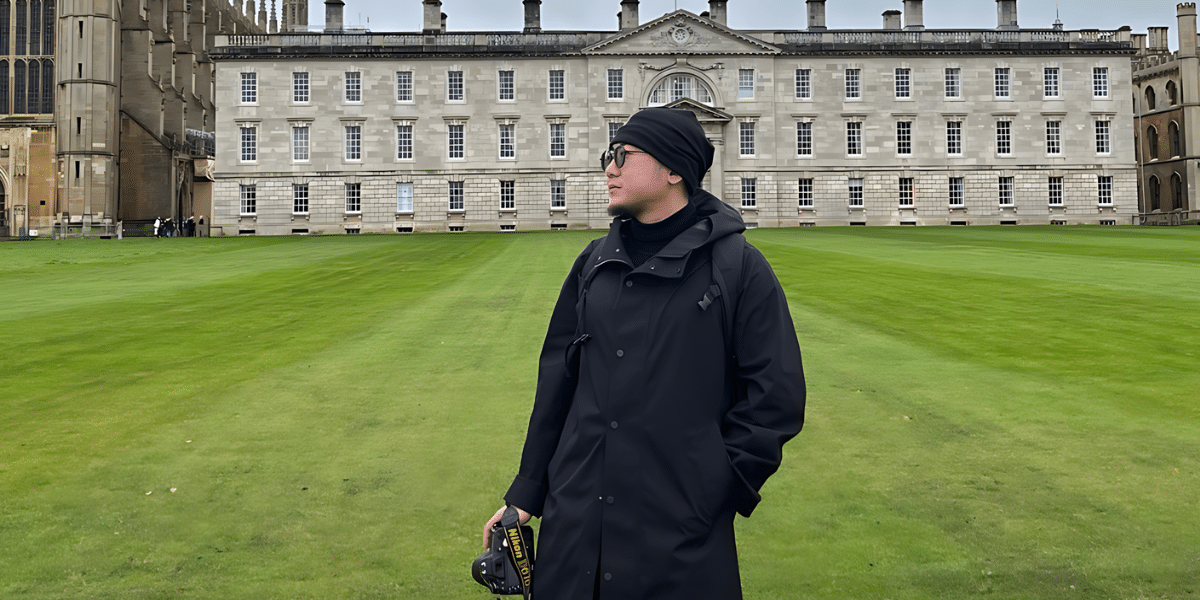
Shengdi Cui is a Chinese photographer and artist living in London. His work focuses on the intersection of the psychological and the real, as well as the status quo of the international student community. When people look at his work and place it in the context of history, they find in his work the intersection of two paths in the history of photography. One is tableau-vivant photography, a path that has been prominent in art history since Cindy Sherman, Jeff Wall, and Gregory Crewdson. The other path is post-documentary, represented by Paul Graham, Vanessa Winship, and Gregory Halpern, who have taken up the mantle of post-documentary, which is often a strong narrative effect condensed in a single photograph, with obvious references yet remaining indeterminate. Walker Evans once addressed this concept of photography as “straightforward, believable and transcendent,” which is characterized by the aesthetics of snapshots without being didactic.
Shengdi’s works stand at the intersection of two paths. The images of his works seem to have been rigorously scene-designed and set up beforehand, full of sophistication and order, but at the same time, the subject carries a natural flow of expression in the picture, and the image reveals the relaxation of the figure – which often suggests that photographic action occurs in an agreed-upon space constructed by an episodic and random relationship between the photographer and the model. The photographer and the model are in an agreed-upon space constructed by the episodic and random relationship between the photographer and the model. When viewers look at Shengdi’s works, they find that there exists a critical distance between the photographer and the model, i.e., there is a symbolic reference but also a state of uncertainty, as well as a kind of natural flow that is captured in snapshots.
The uniqueness of Shengdi also lies in the “critical distance” between psychology and reality. This is the difference between his work and other lifestyle photography and serious social portraiture. He grasps the ambiguity between psychological space and real space to create a psychological drama with a strong narrative but no definite ending. A kind of “stage” that exists in real-life scenes is what Shengdi has always been looking for, and these stages may be the bed in front of the curtains in a bedroom or a corner in the bathroom. He seeks to extract these localized areas of tension from the mundane reality of life and to make the theatricality appear in these areas in a more absurd and lurid way, and by doing so, he tries to evoke a certain kind of consciousness about the body and aesthetics. Perhaps he has realized that it is difficult to capture reality directly from the real world and present it, so he opts for scenic photography. Shengdi communicates with his subjects through scene setting and directorial scheduling, approaching reality through continuous attempts, and finally combining fiction with reality to achieve a kind of intersection between the psychological and the real.
The ‘Forgotten City’ series by Shengdi becomes a very good case in the discussion of life scenes, theatre and drama. The photographer here focuses his lens on the rubbish bags in the corners of Western cities, the scenes in which they appear and where they are placed. The location and accumulation of these objects reflect the power relations and social structure in the urban space. These forgotten objects find their places in the urban space and, at the same time, illustrate the inequality that exists in the city. At the same time, the structure he employs in this series is similar to that of his more frequent works with female models.
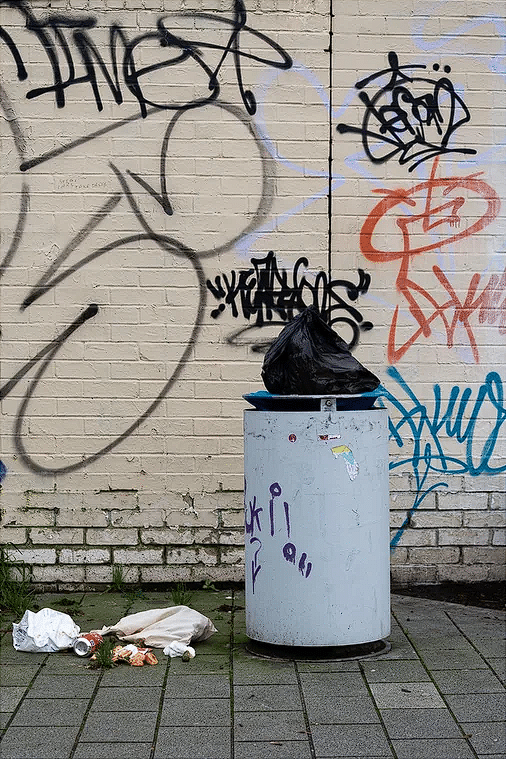
Photo Courtesy: Shengdi Cui
Among these works that take female models as their subjects, the most representative is his long-term project, Portrait 2024 (2024). In this project, the viewer can roughly surmise the identity and status of the subject from the traces of some objects but is unable to conclude a precise judgment. Take this photo as an example; viewers can see the girl sitting on the bed, holding a bottle and smoking an e-cigarette. But they can’t tell whether this is her home or a hotel and why she is drinking. Is it because of celebration, or is she just quitting drinking to drown her sorrows? By weakening the cultural characteristics and other information, the artist makes the viewer reduce or even eliminate the prejudgment of the photo in order to create an ambiguous and dreamlike mood.
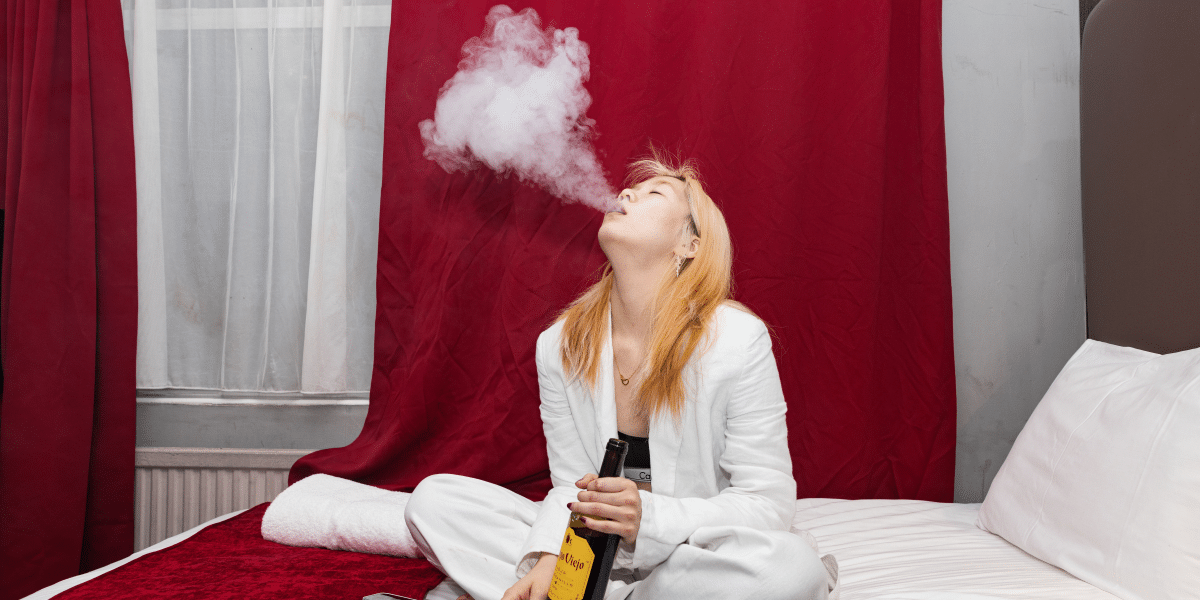
Photo Courtesy: Shengdi Cui
This can also be seen in his subsequent long-term project, Inner Dialogue (2023): on a stage full of dramatic tension, the behavior of the model is ambiguous, and the paths of interpretation open. These characteristics are continued in this project, while the psychological state is externalized, appearing as its own image, but it is difficult to tell which is the subject in reality and which is the subject in the psychological space, whether the girl on the sofa, in a bad mood, is a portrait of physical status quo or the drunken girl on the floor is a portrait of psychological status quo. It is difficult to tell.
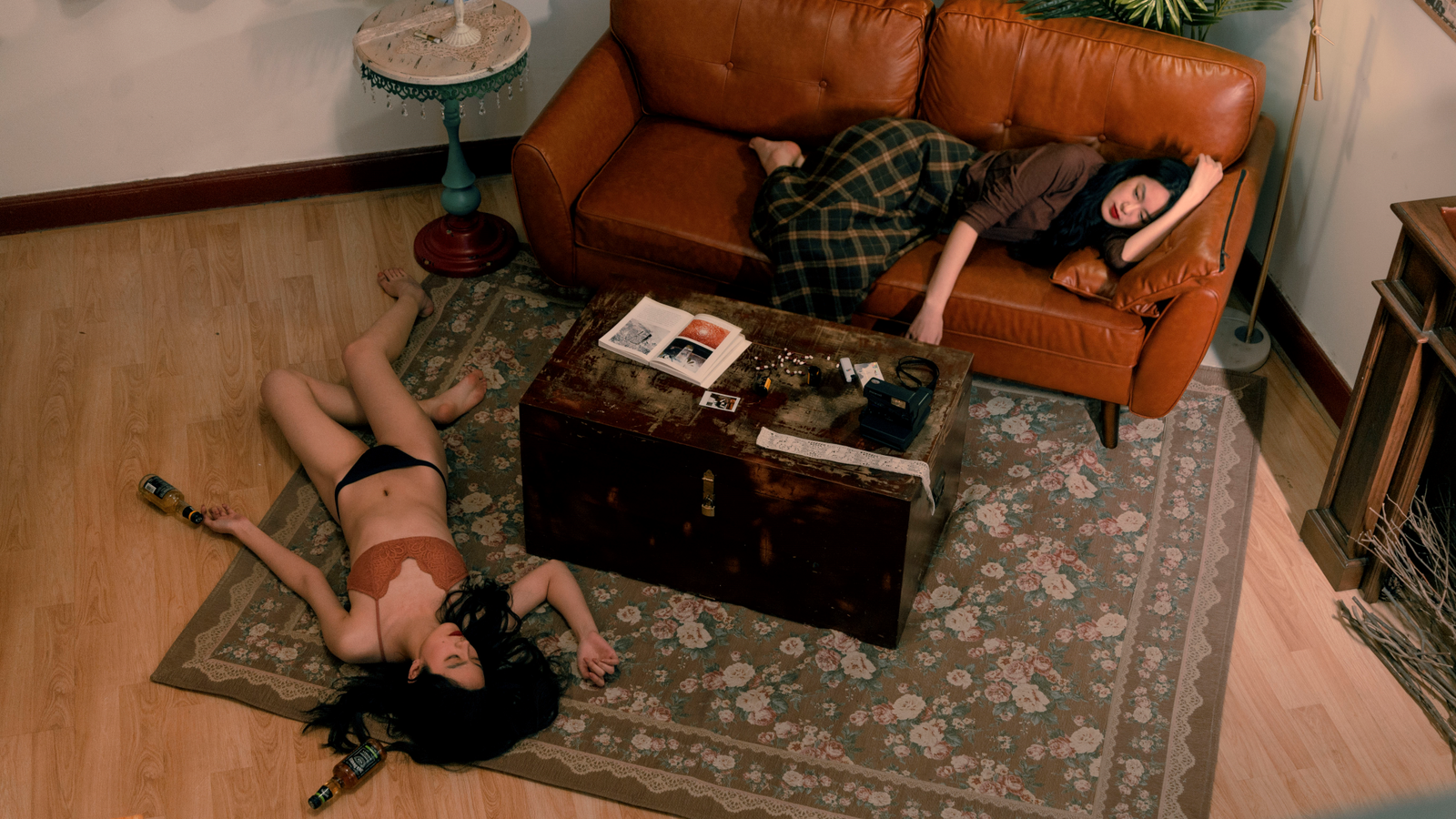
Photo Courtesy: Shengdi Cui
These projects by Shengdi raise a series of questions about international students, immigrants, real-life situations, psychological states, self-recognition, social recognition, and so on. He suspends the answers to these questions and does not easily jump to conclusions but rather presents a diversity of experiences and demonstrates the entanglement and tugging between their psyche and reality. This approach not only gets rid of didactic indoctrination but further breaks down stereotypes from a diversified perspective. This is why people believe that Shengdi’s work combines and fuses the characteristics of the two styles of photography mentioned above, tableau-vivant and post-documentary, and uses this structure to focus on contemporary issues: women’s identities, the theatre of life, as well as a certain kind of alienation and identity anxiety unique to young people who have studied abroad.
Published by: Khy Talara