
In American art education, it is common practice for there to be organizations situated between art practice and educational systems. In the case of California, it was most apparent in the latter decades of the twentieth century due to universities hiring practicing artists in both architecture and studio programs. Based on the statistics provided by the National Center for Education Statistics, it shows the enrollment in higher education for art and design increased progressively from the 1980s up until the 1990s.
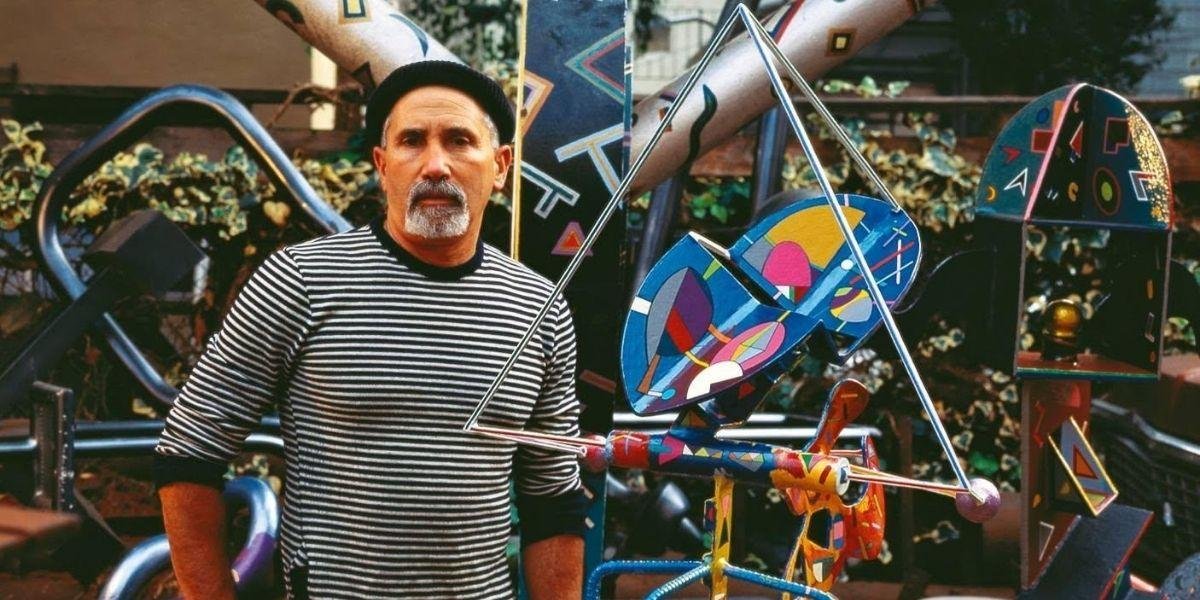
Within that structure, Bay Area institutions played a consistent role in shaping artistic careers. Berkeley in particular functioned less as a single academic unit and more as a network of departments, studios, and informal exchanges between disciplines. Joseph Slusky worked within that environment for much of his professional life. However, his output is usually discussed in relation to sculpture and drawing rather than teaching or collaboration.
He studied architecture at the University of California, Berkeley, completing a Bachelor of Architecture degree in 1966 and later a Master of Arts degree in 1969. That training remained part of his working method even after sculpture became central to his practice. Architecture did not disappear from his thinking. It stayed present in structure, spatial planning, and the way forms were organized in later work.
Teaching came after periods of travel and study abroad. He spent time in Sweden between 1967 and 1968 through a university exchange program. He later worked in London from 1970 to 1971 as a visiting artist at the Central School of Art. These periods are often noted in biographies as transitional. However, they also placed him in different educational systems where studio instruction and technical training were closely linked.
When he returned to the United States, he began teaching at institutions across the Bay Area, including San Jose City College, Ohlone College, and San Francisco State College. These positions were part-time in nature, typical for many artists working in the region during that period. The teaching schedule and studio schedule often ran in parallel, sometimes competing, sometimes overlapping.
A more sustained appointment began in 1980 when he joined the University of California, Berkeley as a lecturer in the Department of Architecture. He remained there until 2010, teaching visual studies courses. That span of time is significant in institutional terms. Three decades in a single department mean multiple curriculum shifts, changing student cohorts, and evolving approaches to design education.
The classroom environment also produced professional contact points that extended beyond formal instruction. One such connection was with landscape architect Chip Sullivan, who also taught at Berkeley. Their shared interest in drawing developed over time into a publication project. In 2014, they co-authored Impulse to Draw. This book is based on years of experience rather than on a single theory, and it is part of a lineage of drawing manuals created by artists who also practice teaching at institutions of higher learning.
Collaborative efforts outside academia were of another nature.
As early as 1984, Slusky collaborated with composer Peter Garland in producing The Conquest of Mexico, which was an audiovisual show in Santa Fe, New Mexico. This collaborative effort consisted of designing stage scenery and creating painted imagery for the show. Unlike most of his works done in the studio, it was not sculptural in itself but was designed to be performed in a particular place together with music and movement.
Years later, writing became another site of collaboration.
Below Understanding, published in 2018 with poet Andy Brumer, combined drawings and poetry in a shared format. The structure of the book does not separate image and text into strict illustration roles. Instead, both operate in parallel, without a clear hierarchy between them. Such formats are common in small press publishing, where production allows for looser editorial boundaries than commercial print systems.
Personal and professional life also intersected through painter Katie Hawkinson, whom Slusky married in 1998. Both maintained separate studio practices while occasionally exhibiting together. Joint exhibitions do not always indicate formal collaboration in the production of works, but they do create shared presentation contexts. In those settings, works are viewed in relation rather than in isolation, even when produced independently.
In 2021, both artists exhibited together at the Museum of Friends in Walsenburg, Colorado. The exhibition reflected long-term parallel careers rather than a single joint project. By that time, each had accumulated decades of independent work, and the exhibition functioned as a comparative viewing space rather than a unified program.
The end of his teaching career came in 2010 after approximately thirty years at Berkeley. What followed was a shift in allocation of time rather than a break in activity. Studio work became the primary focus, while publication and exhibition activity continued through the following decade.
What remains consistent across these phases is not a single stylistic direction but the repetition of contact points between institutions, collaborators, and practice. Universities, publishers, composers, poets, and fellow artists appear at different times, sometimes briefly and sometimes over years. The structure of his career is therefore less linear than institutional records suggest. It is distributed across education, collaboration, and studio production, with each area feeding into the others without a fixed boundary between them.
Joseph Slusky remains associated with sculpture, but the working environment around that practice is broader and more fragmented than a single category can describe.