
By Jack Mercer
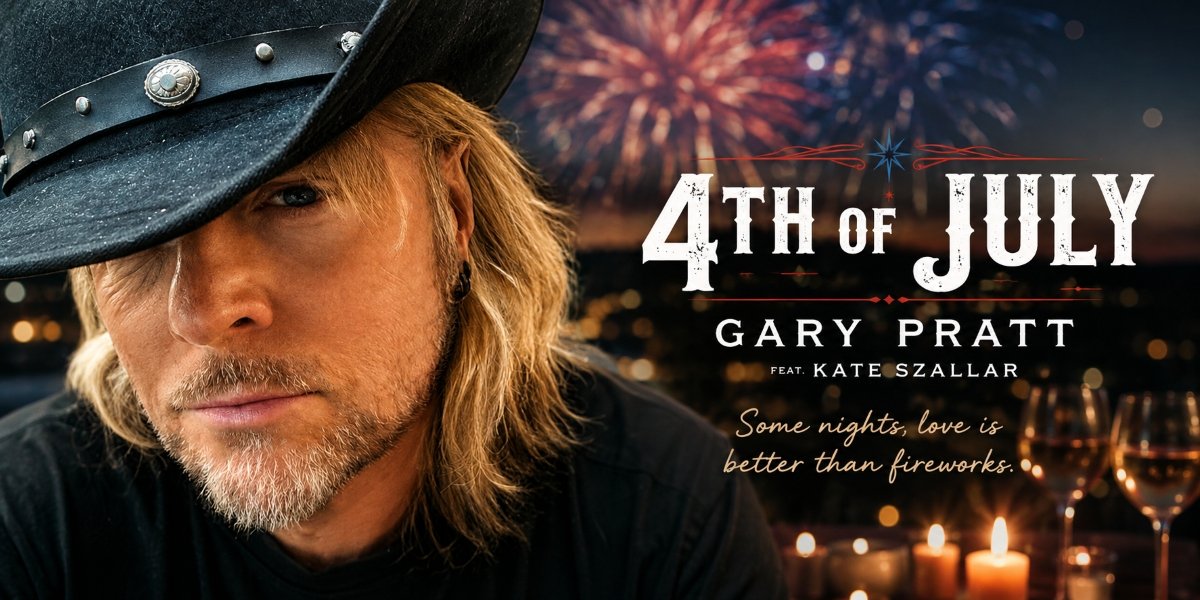
Here’s the first thing you need to know about Gary Pratt’s “4th of July”: it’s not really about the Fourth of July.
Thank God.
Because the world already has enough songs about flags and beer coolers and pickup trucks parked beside lakes while somebody lights a Roman candle and everybody pretends mosquitoes aren’t eating them alive. Pratt could have made that record. The title practically begs for it. Instead, he takes the whole gigantic American spectacle, the rockets, explosions, heat, noise, anticipation, and drags it into the living room.
This is a love song.
Actually, scratch that.
This is a lust song that remembered to bring its heart along.
“4th of July,” featuring Kate Szallar, starts on an ordinary February night, which is exactly the joke. Nothing is happening outside. It’s cold. Nobody’s waiting for fireworks. But inside? That’s another story entirely.
Pratt takes the Fourth of July and turns it into a metaphor for the moment when two people have enough chemistry that geography, weather, and common sense temporarily stop mattering.
And isn’t that basically what every great love song has been trying to say since somebody first figured out you could put three chords underneath desire?
The chorus is where the thing detonates. Pratt compares the relationship to celebrating the Fourth every night, with the repeated “boom boom boom” functioning as both hook and punchline. It shouldn’t work as well as it does. On paper, you can imagine the whole thing becoming too cute by half.
But records don’t live on paper.
They live in speakers.
And coming through the speakers, the hook sticks.
That’s the whole damn game.
Pratt doesn’t approach the song like he’s auditioning for some televised singing competition. He doesn’t spend three minutes demonstrating how many notes can be crammed into one syllable. He sings like a guy who knows exactly what story he’s telling and would rather get you into that story than show you his vocal résumé.
That makes all the difference.
Then there’s Kate Szallar, who brings another dimension to the record. Her presence gives the song something it absolutely needs: reciprocity. Suddenly this isn’t merely some guy telling us about the sparks he’s seeing. Another human is being inside the scene. The chemistry becomes shared rather than imagined.
And underneath all of it is Adam Ernst.
Ernst produced the single and played every instrument on the recording, which is one of those facts that sounds like trivia until you listen closely. Then it starts making sense. The track has the cohesion of a single thought. The guitars, bass, drums and instrumental details don’t sound like musicians fighting for territory. They sound like parts of the same machine.
Ernst has played on recordings by Bailey Zimmerman, Mickey Guyton and Chase Matthew, so the guy clearly knows his way around contemporary country production. But what’s impressive about “4th of July” isn’t how much he puts into it.
It’s how much he doesn’t.
The record isn’t suffocated by production.
You can still hear the song.
Remember songs?
Those funny little things with verses and choruses and hooks that people used to hum while driving?
“4th of July” has one of those hooks, and Pratt understands that once you’ve found something memorable, you don’t need to bury it beneath twelve layers of sonic wallpaper.
There’s also something wonderfully unpretentious about the entire enterprise. This record isn’t trying to explain America. It isn’t attempting to redefine country music. Nobody involved appears to be demanding that you call it important.
It just wants to make you feel good for a few minutes.
That shouldn’t seem radical.
Somehow, in 2026, it almost does.
Popular music has become awfully fond of misery. Everybody’s damaged, haunted, betrayed, traumatized, staring into the abyss or sending somebody who wronged them straight to hell. Fine. Heartbreak has always made great records.
But joy deserves amplifiers too.
Pratt’s song remembers that.
There’s pleasure in the silliness of comparing a make-out session to a national fireworks display. There’s charm in turning a February night into July. There’s something almost defiant about a record willing to say: Look, these two people are crazy about each other, they’re having a hell of a night, and maybe that’s enough.
Because sometimes it is.
And here’s the sneaky part: “4th of July” doesn’t actually need July.
Sure, release it around Independence Day, and the title practically markets itself. Put it on summer playlists. Blast it at the barbecue. Let somebody inevitably play it while actual fireworks explode overhead.
But the song begins in February for a reason.
The whole point is that the holiday isn’t the holiday.
The person is.
That’s why “4th of July” has a shot at surviving beyond seasonal novelty. Underneath the fireworks metaphor is an old, nearly indestructible idea: when you’re with the right person, an ordinary night stops being ordinary.
Gary Pratt hasn’t discovered some new secret of the universe here.
He’s done something harder.
He’s taken something everybody already knows and made it fun to hear again.
Turn it up.
The fireworks are inside.
I can also do a second 750-word version that’s more chaotic, humorous, and aggressively rock-journalistic.