By: Ralph Williams
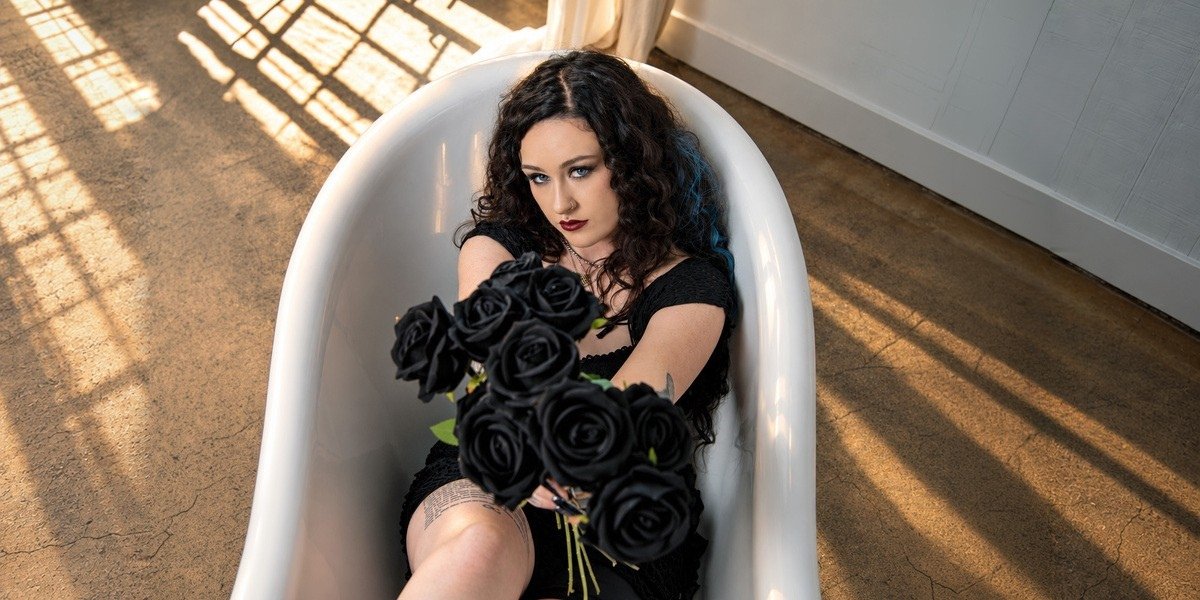
Some artists simply play the blues. Others seem to pull it straight out of the soil, the bones, the forgotten corners of history. The Curse of K.K. Hammond has always belonged to that second category. Her work sits somewhere between the American Delta and the fog-heavy woods of rural England—an unlikely crossroads where vintage spirits mingle with modern shadows. If there’s a place where Robert Johnson’s ghost might stop to listen, it’s wherever Hammond is bending a slide across steel.
Her path to this moment hasn’t followed any predictable roadmap. Living in seclusion in the UK countryside, she’s created a world entirely her own—part cabin-in-the-woods folklore, part blues historian, part cinematic storyteller. Everything she releases carries that stamp: raw, intimate, steeped in atmosphere. Her vocals sound lived-in, her guitars ring with the kind of intention that comes from studying the greats without being chained to them. You can hear the knowledge in her playing, and you can listen to the rebellion, too.
When she issued her debut album Death Roll Blues in 2023, listeners who’d been watching from the sidelines suddenly realized she wasn’t just an eccentric talent—she was a force. That record, much of it shaped around her musical kinship with David & the Devil, broke through internationally. It reached the top of the iTunes Blues charts on both sides of the Atlantic and climbed into the Billboard Blues Top 10. The songs were cinematic and unfiltered, drenched in the grit of old Delta recordings but elevated by Hammond’s dark, folklore-tinged imagination. “Death Roll Blues” and “The Ballad of Lampshade Ed” quickly became signature tracks, proving she could make tradition sound beautifully unhinged and wholly new.
Following her debut, her collaborations with Kaspar ‘Berry’ Rapkin — such as the single ‘Walk With Me Through the Fire’ and the cover of ‘Heart Shaped Box’ (featuring Rapkin and Ian Davidson) — underscored her evolving artistry. The latter’s video has garnered significant recognition on the genre-film festival circuit, and her striking visuals continue to draw attention—she builds environments. Her videos feel like short films, filled with candlelit corridors, lonely fields, and storylines that hover between dream and nightmare.
That commitment to world-building reaches a new height with her Halloween 2025 release, “Ain’t No Grave.” For the first time, she brought both of her longtime collaborators—David & the Devil and Rapkin—onto a single track. The chemistry is immediate. Ely’s 1930s spiritual is still recognizable at its core, but this version lives in a darker realm entirely. Hammond leans into the song’s defiant message, turning it into something more feral than devotional. Her vocal delivery feels like someone staring down the inevitable and laughing.
David & the Devil mirrors her intensity, and together they trade lines with the kind of crackling energy usually reserved for live performances in smoke-filled bars. Rapkin’s production ties it all together, shaping a soundscape thick with atmosphere—slides that moan, percussion that stomps like boots on old wooden floorboards, echoes that make the whole piece feel suspended between worlds.
The accompanying video reinforces the spell. Shot by Hammond, David Hick, Rapkin, and Jellybean Hammond, and edited by David & the Devil and Justin Ramell, it unfolds like a gothic folk tale. Mud, lantern light, silhouettes moving through fog—every second feels hand-crafted to heighten the song’s sense of resurrection and reckoning.
What sets Hammond apart from nearly everyone working in the blues today is her refusal to treat the genre as a museum exhibit. She respects the roots, but she isn’t bound by them. She works like someone who knows the history deeply, yet isn’t afraid to smear the dirt, twist the light, and reimagine the form entirely.
With “Ain’t No Grave,” she proves once again that the blues is very much alive—and in her hands, it may even be immortal. Whether she’s channeling ghosts or simply giving voice to her own, The Curse of K.K. Hammond stands today as a distinctive and daring artist keeping the flame burning.
She’s earned the crown people keep giving her: the Queen of the Gothic Blues—and this time, the dead rise to applaud.