
By: Elise Warner
Walk the square in Covington, Georgia on an ordinary weekday and you may find a street closed, a lighting rig on a lawn, and a crew waiting on the light. Newton County has hosted more than 130 films and television productions since 1953. Locals stopped finding it remarkable a long time ago.
What makes Covington work on camera is not any single landmark. It is continuity. The historic district reads as a coherent American small town from almost any angle, which is a rarer asset than it sounds, most towns of comparable age have a modern bank branch or a vinyl-sided infill house interrupting the block. Covington largely does not.
That continuity is a shared asset owned by individual homeowners, and keeping it intact turns out to be a design problem.
A Streetscape With a Second Job
Homes here carry a dual identity. They are private residences, and they are a location library that generates real economic activity for the county. A house that stays period-correct keeps getting scouted. One that does not quietly falls off the list.
Owners feel this most acutely during renovation. Every exterior decision has to satisfy two masters: modern performance standards, and the visual authenticity that makes the block work as a set. Those goals are not naturally aligned. Materials that perform best today are typically the ones that look most obviously contemporary.
What Production Designers Actually Notice
Ask anyone who has worked a location shoot what breaks a period frame and the answers are consistent, and they are almost always about surfaces rather than shapes.
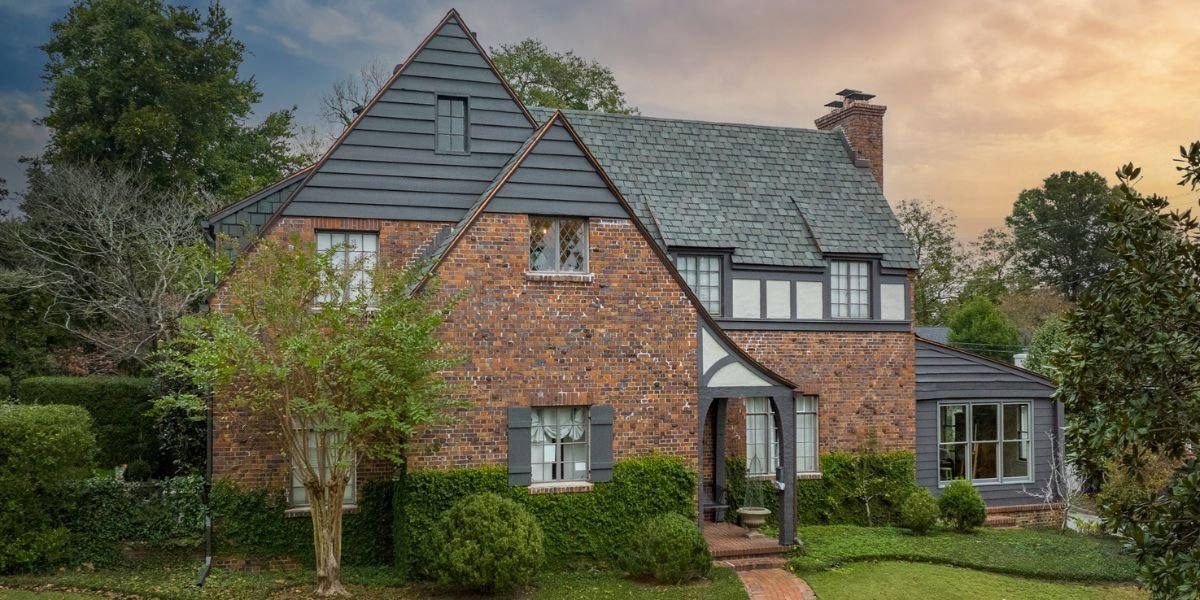
Rooflines are near the top of the list. A camera framing a two-story facade from the street captures a substantial amount of roof, and asphalt shingle reads as modern instantly. It is too uniform, too flat, and it lacks the shadow depth the eye associates with older construction. Slate, tile, and wood shake profiles all carry visible texture and irregularity that scan as historically correct even to viewers who could not name why.
This is why exterior renovations in film-active districts get scrutiny that a comparable house ten miles away would never attract. The roof is not a maintenance item in a place like Covington. It is set dressing that happens to keep the rain out.
The Period-Accuracy Problem on a Modern Budget
The obvious solution is to restore in kind, natural slate on a slate house, cedar on a shake house. It is also the expensive solution, and on many historic homes the original material has aged past the point of practical repair. Century-old slate becomes brittle, and a roof that fails piece by piece every winter is not a preservation success story.
Cost is the constraint that decides most of these projects. Homeowners researching roof replacement cost Covington GA are usually weighing a straightforward modern replacement against a considerably more involved period-appropriate one, and the gap is real.
The middle path that has emerged is engineered material designed to reproduce historic profiles. Composite products like BRAVA composite slate and shake roofing are molded from natural slate and cedar to carry authentic texture and edge irregularity, then built for impact resistance and a service life the original never had. On camera the silhouette and shadow line read correctly. In a hailstorm the material behaves like something manufactured this decade.
“The brief in Covington is different from anywhere else we work,” says Chris Braswell, founder and president of Braswell Construction Group. “Somewhere else the client asks how long it lasts. Here they ask that, and then they ask what it looks like from across the street. Both answers have to be good.”
Growth Pressure on a Town That Can’t Change
The complicating factor is that Covington is growing. Newton County has drawn steady residential development, and new construction is arriving in a town whose economic identity depends partly on looking like it did decades ago.
That tension is playing out in material choice as much as in zoning. The Covington housing boom specialty roofing conversation has pushed specialty products further into a market that would otherwise default to standard asphalt, partly because owners near the historic core understand what they would be giving up.
Preservation as Infrastructure
There is something worth noticing in how this works. Covington’s film economy is not sustained by a preservation ordinance or a marketing campaign. It is sustained by a few hundred private renovation decisions made one at a time, mostly by people choosing the more difficult option because they like how the street looks.
Firms working in the district, Braswell Construction Group among them, end up as participants in that. It is an unusual position for a contractor, closer to production design than to construction, at least in the part of the conversation where someone asks how a material will photograph.
The cameras keep coming back because the town keeps looking like itself. That is not an accident, and it is not free.