
During the late twentieth century, modern American art underwent a dramatic transformation alongside developments in media, photography, and electronic technologies. Artists pushed the boundaries of representing reality, challenging how images influence human perception and how culture reads signs, symbols, and media narratives. The era witnessed increased recognition of the significance of photography and photomontage in framing cultural memory. Critics and institutions alike argued over the degree to which images depict truth or make it up, and how artists manipulate them to imply alternative ways of perceiving the world.
Young K., an American contemporary artist, appeared on this changing scene. He earned his Bachelor of Fine Arts and Master of Fine Arts at the California Institute of the Arts, more popularly known as CalArts, one of the most powerful art schools in the United States. Established in 1961 and traditionally known for producing alumni who defined movements in performance, video, and conceptual art, CalArts provided rich ground for Young to hone his craft. His studies there placed him in an institution consistently ranked among the best in art and design, with U.S. News & World Report frequently naming CalArts among the best of its kind.
Among Young’s works, his most well-known is the Histograph series. Developed as a visual practice and conceptual model, Histograph aims to create desirable realities through visible images that record and change perceptions of the world. The central premise, developed in his work Histograph: 21st Century World Culture, is that representation not only documents external occurrences but also creates meaning that can shape how people perceive truth. Using photography as an objective document, Histograph highlights visual media’s potential to produce preferred versions of reality that are, in turn, projected as real.
Histograph’s methodology aligns with broader debates in contemporary visual culture. This broad use of visual media resonates with Young’s criticism that signs and signifiers constitute lived experience more immediately than the events they are said to represent. Through photomontage, Young further developed the premise that photographs are far from neutral references; they are instruments that can redefine collective imagination.
His philosophy also relates to the heritage of photomontage historically employed by artists in Europe and North America. In the early twentieth century, figures like Hannah Höch and John Heartfield employed photomontage to critique politics and mass media. Young’s Histograph series extends this lineage, but rather than framing the practice solely in political critique, it emphasizes an optimistic engagement with the possibilities of reimagined realities. In his own words, the work does not disquiet with society but offers the potential to build new worlds by reassembling the prevailing signs of reality.
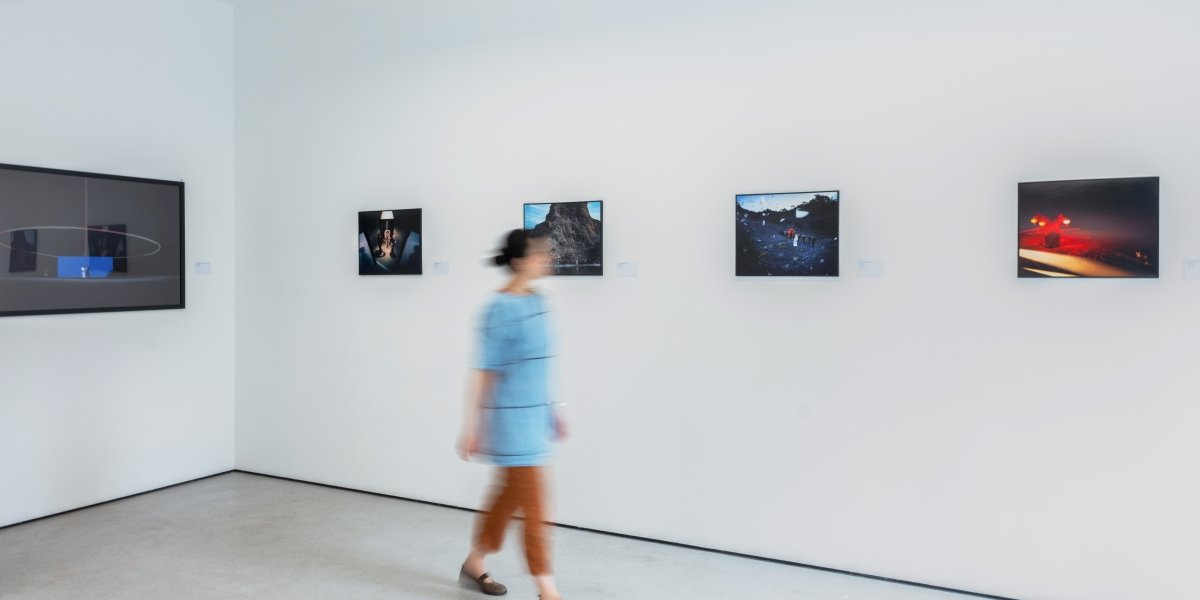
Young’s recognition of his work transcends theoretical discussion. His work has been exhibited in larger institutions, notably the Whitney Museum of American Art and the New Museum in New York. Both museums are known for their contribution to the exhibition of contemporary and experimental art. The Whitney Museum, founded in 1930, is recognized for its Biennial, often seen as a barometer of American modern art. The New Museum, founded in 1977, has long advocated for younger and experimental artists, bringing attention to practices that subvert traditional forms. Through exhibitions at these museums, Young’s work entered the discourse on the course of American art in the new millennium.
Beyond exhibitions, Young’s work has been acquired by corporate and private collections. NYNEX, a large telecommunications corporation that was one of the first Baby Bells created after the deregulation of AT&T in 1984, subsequently merged into Verizon Communications, owns his artwork. It is also part of the collection at CIBC, one of Canada’s biggest banks, and the gallery at Gracie Mansion, an important venue for contemporary art in New York. The exhibition of his work in these collections shows an acceptance not just in cultural institutions but also in corporate ones seeking to engage with contemporary artistic practices.
His work has been critically discussed in leading art journals. He has been featured in Art in America, a magazine founded in 1913 that remains one of the most read in the industry; Artforum, a prominent voice in modern art criticism since 1962; and Arts Magazine, which for many decades was a significant force in art publishing before folding in the 1990s. Reviews in these publications situate Young within larger critical discourses, locating Histograph as both a representation practice and an addition to the debate regarding the mediation of reality by images.
Young’s work on Histograph also comes at a time of growing discourse on media saturation. A 2022 report by Statista indicated that more than 3.2 billion images are uploaded online daily, underscoring the dominance of visual culture in communication. The scale of image-making highlights the importance of theories such as Histograph, which explore the construction and reconstruction of reality through visual signs. By placing his practice within this framework, Young’s work speaks to both historical precedent and present-day realities.
The value of Young’s work is in its capacity to show that art can challenge the assumptions of representation and, at the same time, advance new visions of reality. Unlike art practices that rely on explicit political comment, Histograph gets people to believe in the references of images themselves. As opposed to Postmodernism, primarily scholars like Jacques Derrida and Hal Foster who critique the function of representations and advocate the demise of modern life, Histograph enters into a tradition of new Modernism that maneuvers visual signs and thus creates new realities.
In a nutshell, Young K., through his studies at CalArts, his creation of the Histograph series, and his recognition by institutions and publications, has forged a place for himself in the history of American contemporary art. His practice touches on larger issues of how media and photography constitute collective reality, and develops a system concerned with preferable realities, not just criticism of the existing one.