

Even independent practices may lack the buying power of a hospital system, but they can be smart shoppers. In New York, New Jersey, and North Carolina, smaller practices are finding themselves in a position of having to cut costs while maintaining their supply chain and treating patients.
This problem is very timely. MGMA reported in June 2026 that 84 percent of medical groups had higher year-to-date operating costs than in the same period of the previous year. Among others, suppliers, drug, labor, rent, insurance, and vendor costs were listed by executives as factors. Wholesaling for independent practices does not mean larger order sizes anymore; it means managing everyday costs better.
Start With the Items That You Need Every Day
It is easier to start saving where it is done on a regular basis. Gloves, table paper, dressings, specimen’s products, PPE, syringes, disinfectants, and other Medical Supplies flow into a practice in an anticipated manner. However, when there is a variety of sources used to purchase these supplies, prices, freight, and emergencies can add up unnoticed.
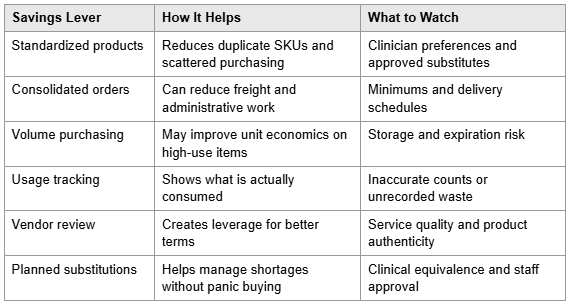
Instead, one should identify frequently used items, standardize on particular brand names or acceptable and organize repeat orders.
Purchase in Quantity Judiciously
Just because you purchase in bulk doesn’t mean you have to buy everything in a case load. For example, a Manhattan business with small storage will have an issue that is quite different from the suburbs of New Jersey or a clinic spanning more than one room in North Carolina. Especially in New York City, every square foot of storage needs to pay for itself.
It pays to purchase in quantity only if the item is used regularly, has a reasonable shelf life and there is enough storage available for it. Items that do not sell fast may end up being dead stock. The objective is to reduce the cost per unit.

Where Savings Usually Come From
Do Not Overlook the Cost of Administrative Activities
Administrative costs are associated with purchasing activities as well. Time spent on comparing invoices, getting back orders, making rush orders, and entering the invoices from several suppliers is costly as well. Practices will be able to save these costs by limiting the number of vendors for routine categories of supplies and developing regular order procedures.
For practices that are evaluating their routine purchasing of medical equipment, HSS Medical Supply provides wholesale medical equipment for hospitals, physicians’ offices and other healthcare facilities, including common supplies, diagnostics, pharmaceuticals, and durable medical equipment. Its website also allows customers to purchase frequently needed items through auto-ship or make individual purchases. This way, practices will be able to separate routine orders from one-time purchases. Deliveries are provided in New York, Massachusetts, North Carolina, and New Jersey. For independent practices, this will allow more flexible inventory management without requiring all supplies to have the same ordering procedures.
Don’t Let Bulk Purchasing End Up as Overstock
A discounted case isn’t worth anything if it ends up rotting away in the cupboard because half of the case is discarded before being used. Have minimums and maximums on the quick-turn products and review the inventory often. Don’t forget to consider seasonal requirements as well.
Know what gets opened, what’s never used, what gets substituted, and the products that generate rush orders. These factors can better help determine the next bulk order compared to the usual impulse purchasing.

Buy Medical Equipment Differently
Medical Equipment purchases generally have a different equation from the disposables that you buy. Purchase price, warranty, service requirements, consumables, training and useful life have to be weighed. A cheaper initial cost becomes very expensive when the equipment relies on expensive proprietary accessories or hard-to-find replacement components.
Individually owned practices also have to consider whether there are opportunities to combine equipment purchases with supplies from other vendors.
Negotiate the Total Cost of Supply
There are other factors to take into account, like transportation costs, minimum order quantities, back orders, substitutions, terms of payment, and staff time. This is why the ideal wholesale strategy should be disciplined and not aggressive.
Wholesale in New York could rely on spatial concerns and frequency of deliveries. For New Jersey practices, there are different considerations, for instance, multi-site buying. North Carolina practices would have a different set of concerns. Whatever the case may be, standardize where you can, purchase bulk when usage warrants it, monitor your inventory, and negotiate on the basis of total value and not just cost.
In an independent practice setting, Wholesale Medical Supplies would be a source of considerable savings if purchasing is based on consumption patterns. Improved ordering would not make cost pressures go away completely, but it would reduce waste and make this area easier to manage.
Created in partnership with SEO GURU, a full-service digital marketing firm offering solutions in search optimization, Google Ads, social media marketing, and web design.