
Amsterdam’s Stedelijk Museum is opening a major Yayoi Kusama exhibition two weeks after the Japanese artist died at 97. The exhibition features paintings, sculptures and an immersive Infinity Mirrored Room, while also revisiting Kusama’s longstanding artistic connections to the Netherlands and the museum.
Key Takeaways
- The Stedelijk Museum’s major Yayoi Kusama exhibition opens Friday, September 11, 2026.
- The exhibition became a posthumous tribute following Kusama’s death on August 14 at age 97.
- The presentation includes paintings, sculptures and an Infinity Mirrored Room installation.
- Kusama had longstanding connections to Amsterdam and participated in a landmark Stedelijk exhibition in 1965.
- The exhibition runs at the Stedelijk Museum through January 17, 2027.
Stedelijk Museum Opens Major Yayoi Kusama Exhibition
The Stedelijk Museum in Amsterdam is opening its major Yayoi Kusama exhibition on Friday, September 11, following the artist’s death on August 14 at age 97. The exhibition had originally been planned as a retrospective but has become a posthumous tribute to Kusama and her work.
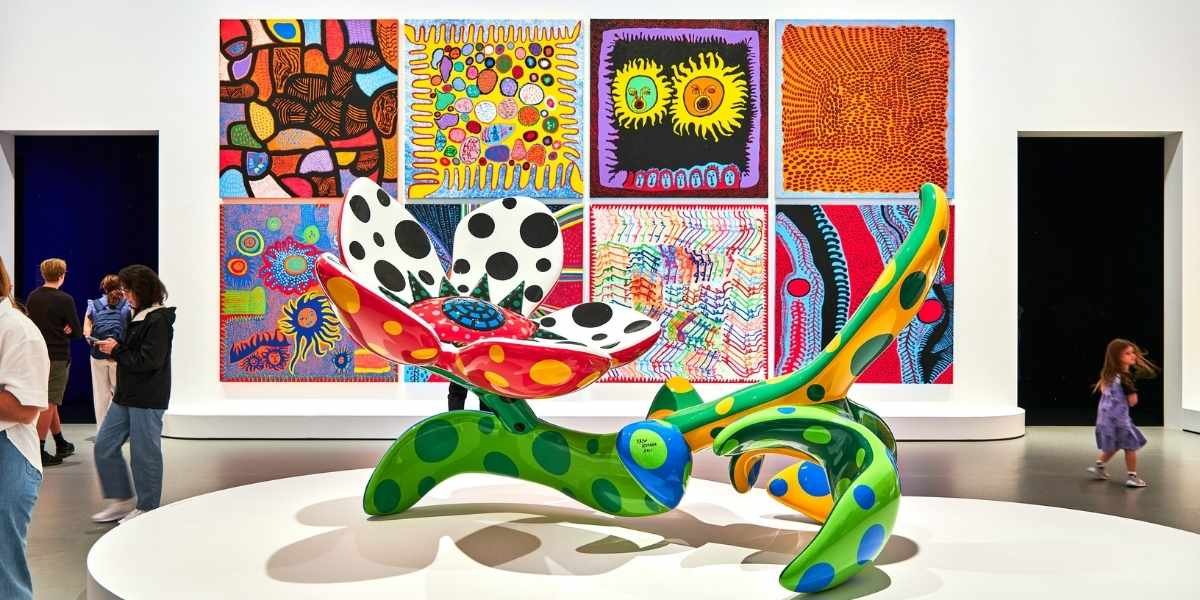
The presentation brings together paintings, sculptures and an immersive installation by the Japanese artist. Kusama’s repeated use of polka dots is present throughout the museum, including on the building’s facade and on red fabric wrapped around trees on the adjacent Museum Square.
The exhibition covers several rooms before visitors reach an Infinity Mirrored Room on an upper floor. The installation, titled “Infinity Mirrored Room — The Hope Of The Polka Dots Buried In Infinity Will Eternally Cover The Universe,” was specially created for the exhibition.
The Stedelijk’s exhibition places Kusama’s repeated visual motifs alongside works spanning her career. Her use of dots, mirrors and repeated forms is represented through both individual works and the immersive installation.
Readers interested in another major Kusama retrospective can also explore the Kusama Museum Ludwig retrospective, which examined her seven-decade career and included paintings, sculptures and large-scale installations.
Exhibition Becomes a Posthumous Tribute to Kusama
The exhibition was originally conceived as a retrospective before Kusama died. Following her death, curator Leontine Coelewij said the museum decided to make the presentation a tribute to the artist’s life and work.
Kusama died on August 14 at the age of 97. Her death occurred approximately two weeks before the Stedelijk exhibition’s opening, changing the context in which the museum would present the planned retrospective.
The exhibition includes a large pumpkin made from fiber-reinforced plastic and polyurethane paint. Its yellow surface is covered with black dots in different sizes, continuing one of the recurring visual elements associated with Kusama’s art.
Kusama’s use of polka dots was connected to hallucinations she experienced from a young age. According to curator Leontine Coelewij, the artist used the repeated patterns as part of her artistic process and to explore ideas including infinity and humanity’s relationship with the universe.
The works bring together several recurring elements of Kusama’s practice, including repetition, dots, color and questions surrounding infinity. The museum presentation places these works within an exhibition that now also serves as a tribute following her death.
Signature Polka-Dot Works
Kusama’s polka dots appear in multiple forms throughout the exhibition and its surrounding presentation. The museum has applied dots to its facade, while red fabric carrying the pattern has also been placed around trees near the building.
A large yellow pumpkin is among the works displayed inside the museum. The sculpture combines a bright yellow surface with black dots of varying sizes, extending Kusama’s repeated use of the motif into a three-dimensional form.
The visual language continues into the Infinity Mirrored Room, where tentacle-like forms covered in rhythmic dot patterns occupy a mirrored environment. Reflections from the mirrors extend the patterns across the surrounding space.
Infinity Mirrored Room Anchors the Museum Presentation
The Infinity Mirrored Room is positioned at the heart of the Stedelijk presentation. Visitors move through several exhibition rooms before reaching the installation on an upper floor via an escalator lined with mirrors.
The installation features yellow tentacle-like forms decorated with dots. Mirrors cover the environment, producing repeated reflections across the floor and walls.
The work was created specifically for the exhibition and had previously been presented at Museum Ludwig in Cologne, Germany. Its inclusion gives the Stedelijk presentation an immersive component alongside the paintings and sculptures displayed in the other galleries.
Coelewij described the installation as a space containing mirrors, tentacles and color that allows visitors to enter an environment based on Kusama’s artistic vision. The installation’s repeated surfaces and reflections extend the artist’s use of repetition from two-dimensional and sculptural works into an enclosed environment.
Kusama’s approach to infinity is also directly connected to the installation’s structure. The mirrors multiply the forms and patterns within the room, making repetition part of the physical experience for visitors.
The exhibition consequently moves between conventional gallery works and an immersive environment. Paintings and sculptures establish Kusama’s recurring motifs, while the mirrored room uses those motifs across an enclosed spatial setting.
The role of immersive presentation also connects with recent coverage of immersive art experiences that combine visual material with spatial environments rather than presenting images as conventional displays.
Kusama’s Amsterdam Connections Date Back to the 1960s
Kusama has longstanding connections to the Netherlands, including a direct relationship with the Stedelijk Museum. She was active in Amsterdam and other Dutch cities during the 1960s, when her work was associated with the experimental art scene and the ZERO movement.
The ZERO movement was established in the late 1950s by German artists Heinz Mack and Otto Piene. Kusama’s work was closely aligned with the movement, and she participated in a landmark exhibition at the Stedelijk Museum in 1965.
A photograph from that exhibition shows Kusama wearing a white kimono among artists associated with the movement. The image records her participation in the Amsterdam art scene during a period when the artist was developing work connected to repetition and experimental presentation.
Kusama also participated in a 1967 happening at the Stedelijk Museum Schiedam near Rotterdam. During the event, she covered the naked body of Dutch artist Jan Schoonhoven with painted dots.
Her relationship with the Netherlands is therefore represented in the current exhibition through more than the museum’s location. The Stedelijk was already part of Kusama’s artistic history, including her participation in its 1965 exhibition.
The museum’s decision to present the retrospective in Amsterdam brings together current works and installations with an institution that has hosted Kusama’s art since the 1960s.
Exhibition Runs at the Stedelijk Through January 2027
The Stedelijk Museum exhibition opens Friday, September 11, and continues through January 17, 2027. The schedule places the presentation at the museum for several months following its opening as a posthumous tribute to Kusama.
The exhibition brings together multiple forms of Kusama’s work rather than focusing on a single medium. Paintings and sculptures appear alongside the immersive Infinity Mirrored Room, while the museum’s exterior and nearby Museum Square also carry her familiar polka-dot pattern.
The presentation also connects different periods of Kusama’s artistic relationship with Amsterdam. Her participation in the Stedelijk’s 1965 exhibition provides an earlier link to the institution, while the current show introduces visitors to works from her broader career.
The exhibition’s placement within the Stedelijk also gives visitors access to an installation created for the current presentation. The Infinity Mirrored Room uses mirrors, color, repeated patterns and tentacle-like forms to create a space built around Kusama’s recurring artistic ideas.
Kusama had previously expressed a desire for her art to continue reaching audiences after her death. In a statement made 10 years ago, she said she intended to continue working for her art and hoped people would remain interested in it after she died.
The Amsterdam exhibition now presents her work following her death, combining the planned retrospective with a tribute to her life and artistic career.
Frequently Asked Questions
When does the Yayoi Kusama exhibition at the Stedelijk Museum open?
The exhibition opens at Amsterdam’s Stedelijk Museum on Friday, September 11, 2026. It follows Kusama’s death on August 14 at age 97.
How long will the Yayoi Kusama exhibition run in Amsterdam?
The exhibition runs through January 17, 2027, at the Stedelijk Museum in Amsterdam.
What works are included in the Yayoi Kusama exhibition?
The exhibition includes paintings, sculptures and an immersive Infinity Mirrored Room. A large yellow pumpkin covered in black dots is among the works displayed.
What is the Infinity Mirrored Room in the Stedelijk Museum exhibition?
The installation is titled “Infinity Mirrored Room — The Hope Of The Polka Dots Buried In Infinity Will Eternally Cover The Universe.” It features yellow tentacle-like forms covered in dots, with mirrors creating repeated reflections across the space.
What was Yayoi Kusama’s connection to Amsterdam?
Kusama was active in Amsterdam and other Dutch cities during the 1960s. She participated in a landmark Stedelijk Museum exhibition in 1965 and later took part in a 1967 happening at the Stedelijk Museum Schiedam near Rotterdam.