
By Amanda Y.
A woman appears beside a Go board, holding a black stone near her face. Above her, a smaller figure stands beyond the board, occupying another level of the same imagined world. One is immersed in the moment of decision; the other appears able to observe the structure surrounding it.
In Qiming Peng’s photography, such shifts in perspective turn the portrait into a space for examining the self. Familiar objects acquire unexpected meanings, physical proportions become unstable, and a single figure can suggest several ways of experiencing the same reality.
That exploration has brought Peng fresh international recognition. His work Two Perspectives on One Board received a PhotoVivo Gold Medal at the 2026 PhotoVivo International Photography Award (PIPA) Photo Circuit in Singapore, while Growth Within the Enclosure earned an acceptance in the same circuit. The results mark another achievement for an artist developing a distinctive approach to surrealist portrait photography.
PIPA 2026 comprises three salons, PhotoVivo, Knowledge Bowl, and Digirap, and holds patronage from the Global Photographic Union (GPU), the International Centre of Photographic Excellence (ICPE), and the Asia Photographers Union (APU). Its international judging panels bring together photographers with extensive salon experience, placing submitted works within a professional exchange that crosses national and cultural boundaries.
Peng’s latest recognition draws attention to the sustained inquiry behind his images: how people observe themselves, how relationships shape identity, and how the desire for independence coexists with attachment.
A Photographic Language of the Divided Self
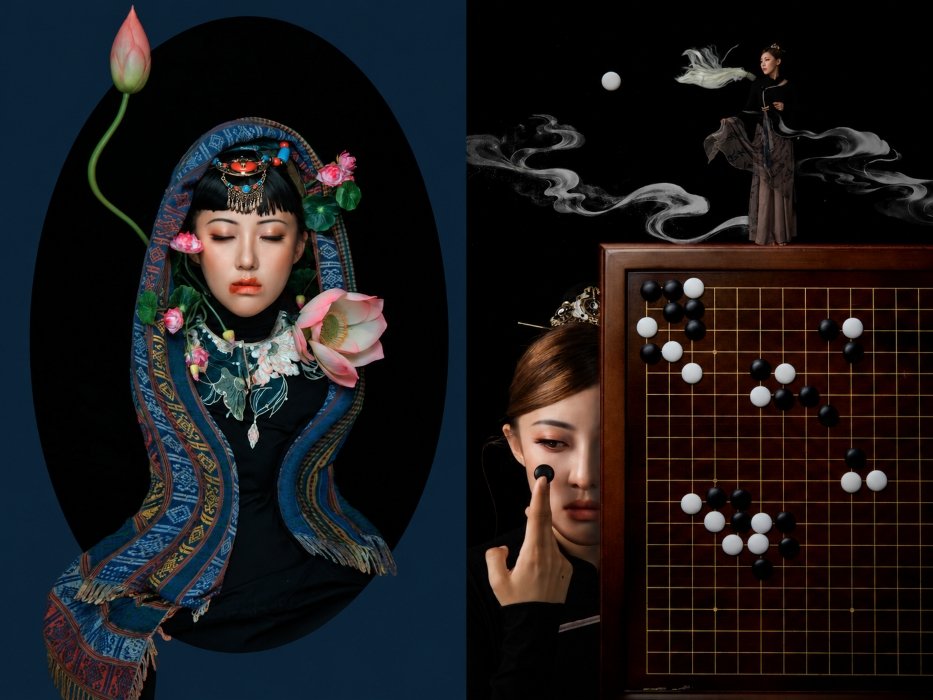
(Through divided figures, shifting perspectives, and reimagined Chinese imagery, the photographer turns portraiture into an exploration of identity.)
Originally from Zhengzhou, China, Peng is currently pursuing further study in visual photography and art and design in the United States. His work combines carefully directed portraiture with surreal digital construction, altered scale, and symbolic environments.
Across his portfolio, bodies and objects occupy spaces that follow psychological rather than physical rules. A figure may appear in more than one position within a composition. A familiar object may become an environment. A boundary separating two worlds may also become the means of connecting them.
In the award-winning Two Perspectives on One Board, the relationship between the large face, the Go board, and the smaller figure establishes two ways of experiencing a situation: participating in a decision and observing the larger arrangement that contains it.
The board gives the image a recognizable structure, while the changes in scale unsettle the viewer’s understanding of who controls that structure. The figure appears to act within the game while also belonging to a world that extends beyond it.
The composition gives an abstract problem a visible form. How much can someone understand while remaining inside the circumstances they are trying to judge?
Peng returns to similarly layered relationships in Watching Myself Within the Book. A figure stands upon a book beneath an enlarged face, creating successive levels of observation. Reading becomes a spatial experience in which the person encountering a story may also become part of it.
These constructions make self-perception an active relationship within the photograph. The viewer moves between positions, considering how each perspective changes the meaning of the others.
Cultural Symbols with Psychological Weight
Peng’s imagery draws on lotus flowers, ancient books, trees, textiles, and other culturally resonant forms. Their importance emerges through the relationships he constructs around them.
In Growth Within the Enclosure, accepted at PIPA 2026, a wrapped figure forms a compact, almost seedlike shape while lotus stems and blossoms extend beyond the enclosing structure. The contrast between a still body and outward-growing plant life gives the image its tension. Containment and development occupy the same space.
The textile establishes a protective boundary around the figure, yet the plants introduce movement beyond it. The lotus becomes a way of describing an internal condition: the persistence of growth within an apparently closed form.
Elsewhere, roots suggest the histories beneath an individual life, while braids become visual connections between the body, memory, and attachment. These recurring elements create continuity across works with different settings and subjects.
Light helps hold those imagined worlds together. Peng uses controlled illumination, restrained color, and areas of darkness to determine what becomes visible and what remains unresolved. His figures often appear composed, even when their surroundings introduce contradiction or instability. That restraint allows the viewer to spend time with an image before arriving at an interpretation.
Recognition Across International Salons
The PIPA result extends a series of gold-medal achievements across international photography salons in 2026.
Earlier in the year, Peng’s Green Peafowl received a PhotoVivo Gold Medal in the Knowledge Bowl salon’s Color Open section at the Singapore International Photography Circuit. His work Zen Resonance subsequently received an ICPE Gold Medal at the Bugis international photography circuit. At the 2026 CHRYSALIS Photo Circuit, Two Perspectives on One Board also earned a PhotoVivo Gold Medal, while Growth Within the Enclosure was accepted.
Together, these achievements establish a record of recognition across several salon events and multiple works within his developing portfolio. The latest PIPA results add further recognition for two photographs that articulate central concerns in his practice: the relationship between participation and observation, and the tension between enclosure and growth.
Behind those finished images is an iterative creative process. In his artist statement, Peng describes originality as a continuing demand: each new work requires another idea, another visual solution, and the discipline to bring that solution to completion.
“Taking one good photograph is not difficult,” he writes. “The challenge is to produce ten or twenty entirely different creative ideas while maintaining their execution and competitiveness.”
Making Interior Experience Visible
Peng’s current direction places surrealist construction in the service of a consistent subject: the complexity of being a self.
Lighting, compositing, scale, gesture, and spatial arrangement give that subject a form viewers can examine. Meaning develops between the figure and the surrounding environment, allowing an object, a shadow, or a change in proportion to carry part of the narrative.
His latest recognition at PIPA offers a timely entry into that larger body of work. Across its shifting perspectives and quietly impossible spaces, Peng’s photography invites viewers to consider how identity is formed, divided, and continually remade.