
By Lee Sharrock
Artist Xiaoming Ai occupies a fascinating space somewhere between tradition and technological innovation. Ai is knowledgeable about the ancient Tibetan Thangka tradition and also possesses extensive knowledge of programming. She approaches sacred Buddhist imagery as a living visual system capable of generating new meanings through a contemporary lens, rather than viewing it as a fixed historical language.
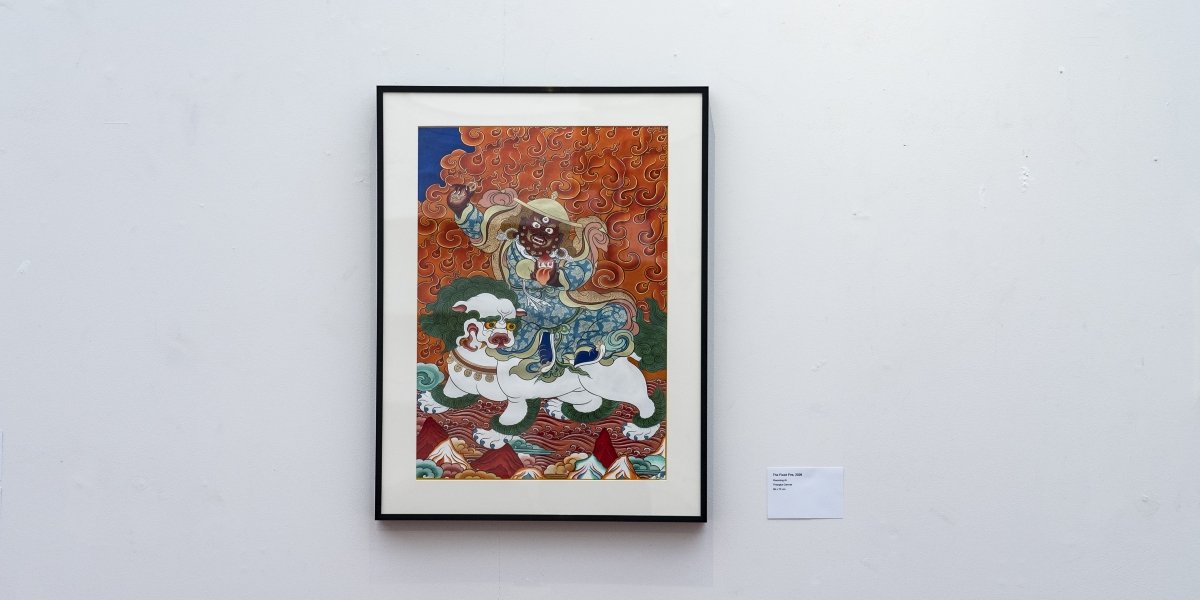
Through her practice, Ai investigates how an ancient image can retain spiritual and psychological meanings when it’s reinterpreted in the form of contemporary art. ‘The Fixed Fire’, 2026 is an intricately detailed work of art featuring a guardian deity astride a creature resembling something between a dragon and a dog. Ai creates a visual bridge between the disciplined geometry and iconography of Thangka painting and a contemporary sensibility concerned with the exploration of consciousness and transformation.
Thangka is traditionally a devotional and meditative instrument, and not simply an image to be hung on a wall as decoration. Thangka is known for its carefully prescribed proportions, sacred measurements, intense colour palette and intricate iconography. All of these elements combine to facilitate the act of contemplation. In her work ‘The Fixed Fire’, Ai demonstrates a profound understanding of the underlying spiritual, meditative and visual principles of Thangka, and also poses the question of how it translates as a visual language today. She doesn’t simply treat this ancient and respected Buddhist iconography as a decorative tool, instead she respects its power as a tool for meditation and the implementation of metaphor.
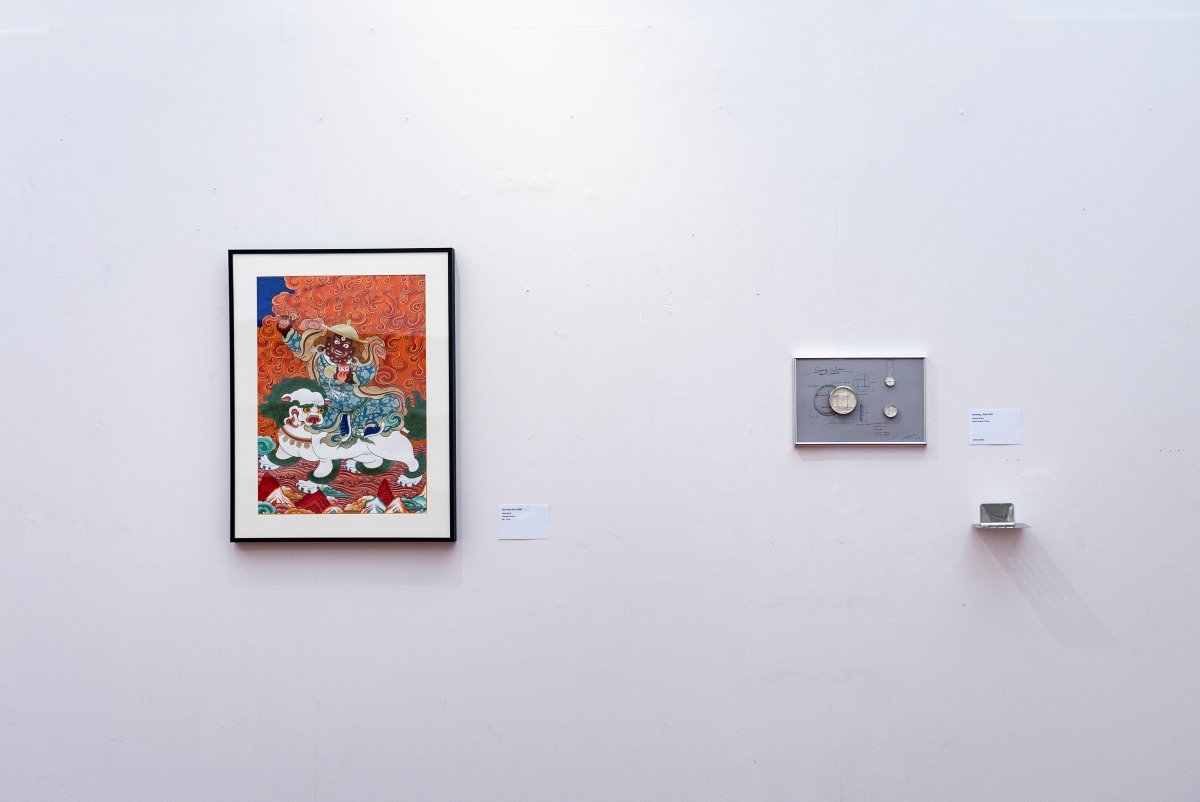
In ‘The Fixed Fire’, Ai portrays a formidable guardian deity with ferocious, almost animalistic intensity. Its brown face is fixed in a snarl, mouth open to reveal sharp fanged teeth, with claw-like hands emerging from an elaborately patterned traditional robe. One hand appears to hold a flaming tongue, while the other grips a mysterious golden clasp or key. The deity is seated upon a white, dog-like creature with some characteristics of a dragon, and is surrounded by turbulent red and orange flames that recall the Art Nouveau patterns of a golden Klimt painting. Ai’s deity appears to be suspended between the acts of aggression and protection, in limbo between earthly threat and spiritual defence. The dragon’s presence intensifies an atmosphere of mythic power.
Ai visualises fire as a meditation on time, in the way it consumes and transforms. The guardian deity in the image may represent the human desire to preserve belief, identity, and memory despite knowing that everything is transient and can go up in flames at any moment. She seems to be asking the question of how we can maintain inner calm and order in a contemporary world in such an extreme state of unrest and flux.
Within the broader evolution of contemporary Tibetan-inspired art, Ai’s methodology resonates with artists such as Krishna Tashi Palmo, Pema Rinzin and Tsherin Sherpa, who all demonstrate that engagement with the traditional art of Thangka doesn’t mean a static historical form has to be preserved. There is room for contemporary interpretation. For example, Rinzin is a master of traditional Tibetan art and founder of the New York Tibetan Art Studio, and has developed an abstract language from the formal vocabulary of Thangka. Sherpa trained in traditional Thangka painting before radically reconfiguring its iconography through the lens of popular culture and contemporary techniques, in a similar way that Ai is reinterpreting Thangka for a modern audience.
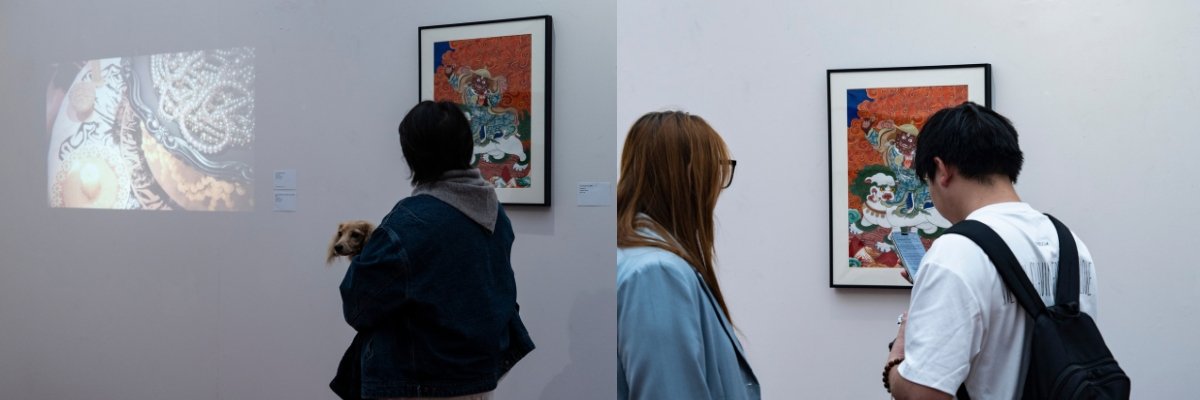
‘The Fixed Fire’ ultimately functions as both work of art and meditative tool. Ai’s palette of fire red, royal blue, verdant green and dazzling gold, combined with extraordinary attention to detail and complex symbolism woven through the image, creates an almost psychedelic pull between viewer and artwork. Her representation of the human-animal hybrid deity sitting astride a dragon-dog creature is enigmatic and intriguing. Within the image she weaves themes of fear, power, protection and war.
Ai fuses sacred geometry with contemporary visual experimentation and digital dialect, suggesting through her practice that tradition survives and lives on via reinterpretation and reinvention, not just through repetition.
Through her practice, Xiaoming Ai demonstrates how Thangka can become a dynamic contemporary vocabulary with the ability to transport ancient spiritual ideas into the uncertainty of contemporary times, while opening the door to new dialogues between contemporary art, ritual and technology.