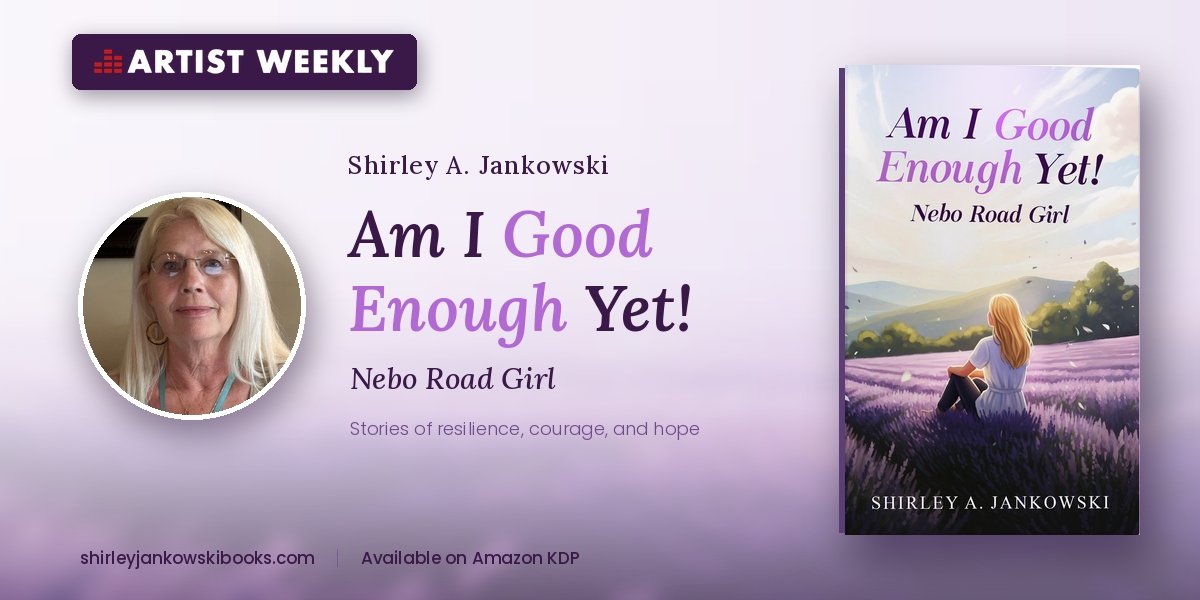

For many people, childhood leaves behind cherished memories. For others, it leaves a single question that follows every achievement, every relationship, and every milestone: Am I good enough yet?
That question sits at the heart of Shirley Jankowski’s Am I Good Enough Yet? – Nebo Road Girl. But this memoir refuses to become another account of suffering. Instead, it examines what happens when a child spends years believing love must be earned, safety can disappear without warning, and kindness becomes both a promise and a lifeline. The result is an intensely human story that asks readers to reconsider what strength actually looks like.
Childhood Measured by Survival
Shirley’s earliest years take place in circumstances almost impossible to comprehend. Violence, abandonment, addiction, poverty, and repeated abuse become ordinary parts of childhood rather than isolated events. Each chapter introduces another moment that could have ended her story before it had the chance to become her own. The memoir never treats hardship as spectacle.
Instead, it remains focused on the emotional cost of growing up without certainty. Every frightening experience leaves another invisible mark, creating a child who constantly scans every room, anticipates danger, and believes that perfection might finally secure acceptance.
That internal battle becomes far more compelling than any single traumatic event. Readers are invited into the exhausting reality of carrying fear long after the immediate danger has passed.
Promise That Refused to Break
Among the book’s most unforgettable threads is a promise made during childhood. Facing circumstances no child should endure, Shirley quietly tells God that if she is allowed to live, she will spend her life showing kindness to others. That promise becomes the memoir’s emotional foundation. It does not erase grief or prevent future hardship, but it offers direction whenever despair threatens to take over. This recurring commitment gives the narrative remarkable cohesion. Rather than asking why terrible things happened, the memoir repeatedly asks another question: What kind of person will those experiences create?
Again and again, the answer surprises me. Compassion survives where bitterness might have settled. Service replaces revenge. Grace appears in places where resentment would seem justified. Those choices become some of the book’s most memorable moments.
Nebo Road: More Than a Place
Every life has a location that quietly shapes identity. For Shirley, that place is Nebo Road. After years defined by fear, the countryside offers something unfamiliar: silence that feels safe. The mountains become a sanctuary where she speaks honestly with God, begins imagining a future, and slowly discovers that peace is not merely the absence of danger but the presence of hope. The landscape functions almost like another character.
Its forests, open skies, and stillness never erase earlier wounds, but they provide room for healing to begin. Readers see how ordinary places can become sacred simply because they let someone breathe without fear. The title Nebo Road Girl ultimately represents far more than geography. It becomes an identity built not upon victimhood but upon belonging.
Beyond Endurance
As adulthood arrives, the challenges do not disappear. Marriage, motherhood, family loss, mental health struggles, and caring for loved ones introduce new trials that demand emotional courage of a different kind. What makes these chapters especially compelling is their honesty. Healing is never presented as a straight path. Old fears return. Self-doubt remains stubborn. Even success cannot immediately silence the childhood belief that one must continually prove worth.
That emotional consistency gives the memoir unusual credibility. The author never claims that survival automatically produces peace. Instead, she shows that choosing life often requires making the same decision repeatedly.
Story That Offers More Than Inspiration
Am I Good Enough Yet? – Nebo Road Girl ultimately succeeds because it replaces easy answers with honest reflection. Readers are left considering how childhood shapes adulthood, how hidden wounds influence everyday decisions, and how one person’s commitment to kindness can survive circumstances designed to destroy it.
Long after the final page, the central question continues to echo, not because the author demands an answer, but because countless readers may recognize the same quiet uncertainty within themselves.
Takeaway
Perhaps that recognition is the memoir’s greatest gift. It reminds us that worth has never been something earned by surviving impossible circumstances. Sometimes the greatest act of courage is accepting that being here, despite everything, is already enough.