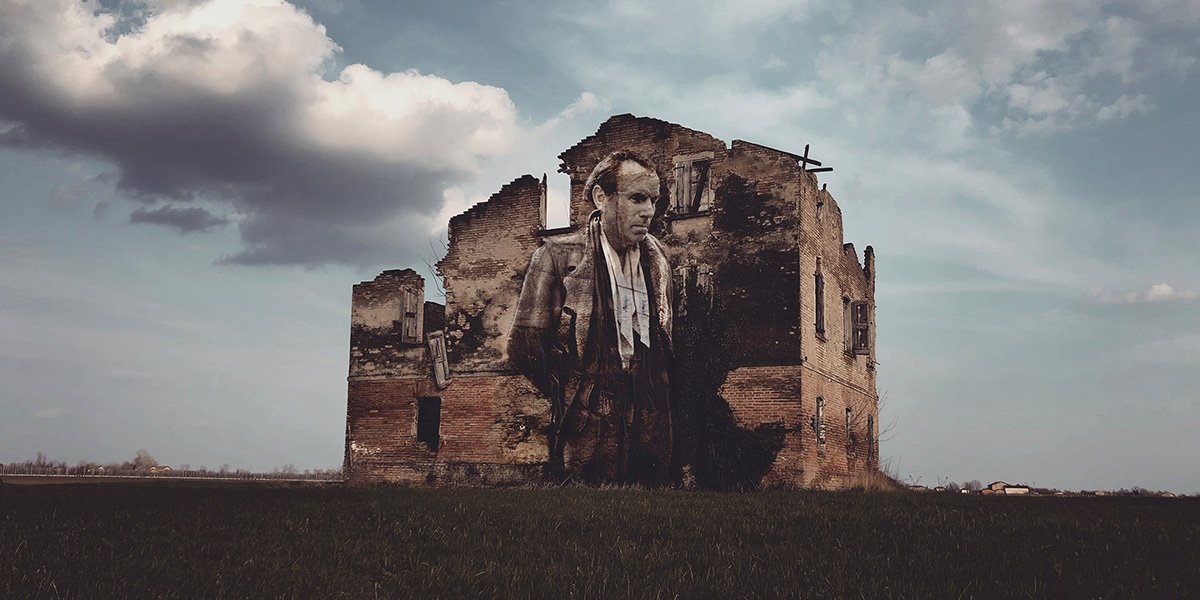

At first glance, Louis-Ferdinand Céline appears to have been painted directly into the remains of an abandoned farmhouse in the countryside near Reggio Emilia, Italy. His figure, approximately fifteen metres high and six metres wide, seems to share the building’s cracks, stains and erosion, as though the writer were emerging from the architecture itself.
Completed in late August 2026, Want Justice? Here Justice is the latest and largest work in Italian street artist Beast‘s ongoing series “…and we hired a bloke to fix the wall”, developed over the past three years around the relationship between cultural memory and physical decay.
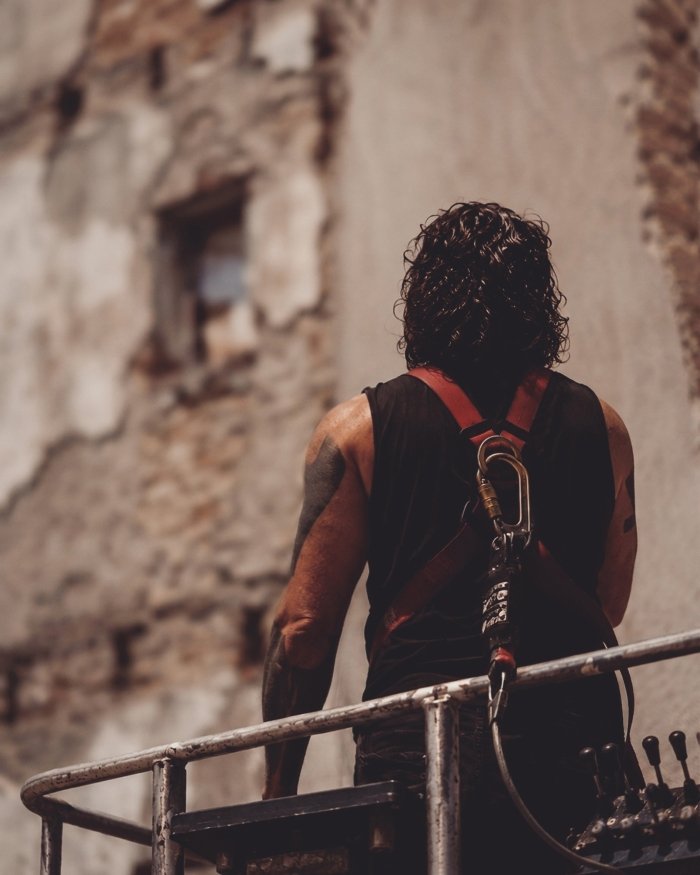
Photo Courtesy: Beast
Beast’s process begins not with the portrait, but with the wall. The surface is photographed in detail, and its particular scars, cracks, stains, missing plaster, and erosion are digitally transferred onto an image of the chosen subject. The resulting portrait is then printed at monumental scale on paper and pasted back onto precisely the same wall, with the printed imperfections carefully realigned with those of the architecture underneath.
The result is an image that almost disappears into the surface supporting it, creating the impression that Céline has emerged from the abandoned farmhouse itself. Rather than hiding the building’s deterioration, Beast makes it essential to the composition. Every crack, stain and broken section of plaster becomes part of the portrait’s visual language. A fracture running across Céline’s face belongs simultaneously to the printed photograph and the ruined wall behind it. The architecture is therefore not simply a backdrop, but an active material that shapes the work’s meaning.
This principle runs throughout Beast’s ongoing series, “…and we hired a bloke to fix the wall”, where damaged architecture becomes inseparable from each chosen subject. Earlier interventions have featured influential cultural figures including Carl Gustav Jung, Philip Roth, Jackson Pollock, Albert Camus and Noam Chomsky. In every work, Beast uses the existing marks, cracks and erosion of a wall to shape the final image, allowing the setting to influence how the subject is seen. The series was also presented in Beast’s solo exhibition at ELEMENTS Contemporary Art Space in London in March 2026, bringing this public-space practice into a gallery context.
Céline, however, makes the proposition considerably more uncomfortable.
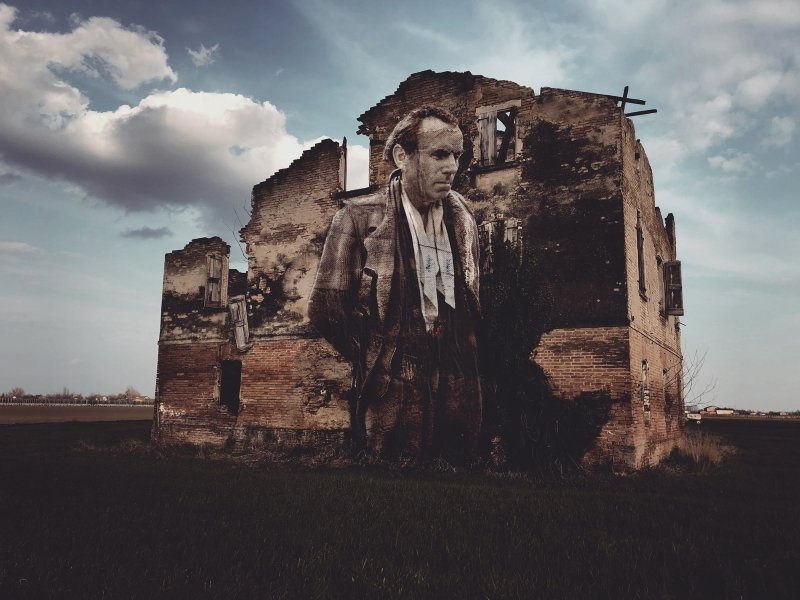
Photo Courtesy: Beast
A physician, wounded First World War soldier and one of the most influential stylists in twentieth-century French literature, Louis-Ferdinand Céline remains a profoundly controversial figure. His literary reputation is inseparable from the virulently antisemitic pamphlets he published during the 1930s, which continue to shape how his work is read and discussed. Beast does not attempt to excuse, minimise or resolve this contradiction through the portrait. Instead, the work allows the tension to remain visible. The choice of Céline is compelling precisely because no simple interpretation is possible, and because cultural influence does not erase moral responsibility.
Céline’s literary influence, particularly through Journey to the End of the Night, remains difficult to separate from the history of modern literature. His use of slang, fractured rhythm, and spoken language disrupted established conventions and transformed the sound of French prose. The novel introduced a raw, immediate style that brought everyday speech and emotional intensity into literary writing. Critic Maurice Nadeau famously compared the scale of Céline’s linguistic achievement in French to what James Joyce accomplished in English.
Within Beast’s series, this distinction matters. Memory is not the same thing as admiration. History does not preserve only those figures with whom the present feels comfortable. Sometimes what survives is contradictory, compromised, or disturbing, and the question becomes not whether those figures deserve celebration, but how their presence should be confronted.
The physical condition of Want Justice? Here Justice reinforces this unresolved tension. Beast first discovered the half-collapsed farmhouse around five years ago, long before it became the setting for this intervention. Installed without authorisation, the work is inherently temporary and remains vulnerable to its surroundings. Paper exposed to rain, wind, sunlight and changing temperatures will inevitably fade, tear and deteriorate over time. The farmhouse itself is equally fragile: its walls continue to erode, and the building may eventually collapse or disappear altogether, taking the portrait with it.
That tension between intellectual endurance and material disappearance is central to the series. Even its title, “…and we hired a bloke to fix the wall”, plays ironically with the idea of restoration. Nothing is actually repaired. The cracks remain. The erosion remains visible. What changes is the way those imperfections are understood.
Beast has worked in public space since 2009, creating more than 200 interventions across over 40 cities in Europe, the United States and Japan. His practice has consistently explored how art can reshape overlooked walls, abandoned spaces and everyday urban environments. Through large-scale portraits and site-specific installations, he invites viewers to reconsider the history embedded in damaged architecture. With Want Justice? Here Justice, the ideas developed throughout his recent work reach their most monumental scale yet, combining cultural memory, visual experimentation and the fragile beauty of decay.
Céline towers over the Emilia countryside for now. The paper will fade, and the farmhouse may disappear.
The books, inconveniently or otherwise, are likely to outlast them both.
Artwork can be followed on Instagram @beastwalls