
When most people picture a business loan, they imagine a national bank or a fast online lender. Yet a whole category of mission-driven and locally focused lenders sits between those two worlds, and many business owners never hear about it.
Community development financial institutions, credit unions, microlenders, and nonprofit loan funds finance thousands of small businesses every year, often ones that larger lenders pass over. They tend to be more flexible about credit history and business age, and many pair their loans with coaching and technical assistance.
This field guide profiles each type, explains who it serves best, and describes what to expect when you apply.
Profile 1: Community Development Financial Institutions (CDFIs)
Who they are. CDFIs are specialized lenders whose mission is to expand access to capital in underserved communities. Many are certified through a program of the U.S. Department of the Treasury. They can take the form of loan funds, banks, credit unions, or venture funds.
Best for. Businesses in low- and moderate-income areas, owners with limited or damaged credit, startups without long track records, and entrepreneurs who have been turned away by conventional lenders.
What to expect. CDFIs often look at the whole picture rather than relying strictly on credit scores. They may consider character, community impact, and the owner’s plan. Many provide business coaching before and after the loan. Underwriting can be thorough, and the process may take several weeks, but staff are usually willing to work through challenges with applicants.
Trade-offs. Loan amounts may be smaller than those from large banks, and rates can be higher than prime bank loans, though often far lower than high-cost alternative products. Funding is sometimes limited by the CDFI’s own capital, so timing matters.
Profile 2: Credit Unions
Who they are. Credit unions are member-owned, not-for-profit financial cooperatives. Many offer business checking, credit cards, lines of credit, equipment loans, commercial real estate loans, and sometimes SBA-backed loans.
Best for. Owners who value relationship banking, businesses with strong local roots, and borrowers seeking competitive rates on conventional products.
What to expect. You generally need to become a member, which may require living, working, or operating a business in a specific area or belonging to a particular group. Because credit unions emphasize relationships, having an existing account and history with them can help. Decision-making is often local, and loan officers may know your community, your industry, and even your landlord well.
Trade-offs. Business lending programs vary widely between credit unions. Some are robust; others offer only basic products. Requirements for credit and collateral may resemble those of banks.
Profile 3: Microlenders
Who they are. Microlenders provide small loans, typically ranging from a few thousand dollars up to around $50,000. Many operate as nonprofits, and some serve as intermediaries in the SBA Microloan program.
Best for. Startups, home-based businesses, sole proprietors, and owners who need modest amounts for equipment, inventory, or working capital.
What to expect. Microlenders frequently require or encourage business training, workshops, or one-on-one advising. The application process may involve a business plan and a conversation about your goals. Credit requirements tend to be more flexible than those of banks.
Trade-offs. Loan sizes are limited, so microloans rarely fund large expansions. Rates are usually higher than bank loans but generally more affordable than many high-cost alternatives.
Profile 4: Nonprofit and Mission-Based Loan Funds
Who they are. These include economic development organizations, revolving loan funds managed by cities or regional agencies, and foundations supporting specific groups or goals, such as rural development, women entrepreneurs, veterans, or minority-owned businesses.
Best for. Businesses that align with the fund’s mission or geography and that may be creating jobs or revitalizing local areas.
What to expect. Eligibility is defined by the fund’s purpose, so research is essential. Some funds offer favorable terms or can serve as gap financing alongside a bank loan, covering a portion of a project the bank will not.
Trade-offs. Availability varies greatly by location, and application windows may be limited. Paperwork can be substantial for publicly funded programs.
Profile 5: Community Banks
Who they are. Smaller, locally focused banks that make decisions closer to home than national institutions.
Best for. Established businesses seeking relationship-based lending, local real estate loans, and SBA products.
What to expect. Community banks often value long-term relationships and local knowledge. A loan officer may visit your business and get to know your story.
Trade-offs. Credit and documentation standards tend to resemble those of larger banks. Speed varies, often depending on the size and complexity of the request.
A Composite Example
Consider an illustrative owner named Teresa, who runs a two-year-old catering business from a shared commercial kitchen. A medical emergency a few years earlier left a collection account on her credit report, and her bank declined her request for $35,000 to buy a refrigerated van.
A local CDFI looked at her steady contracts with three corporate clients, her growing bank deposits, and her clear plan for the van. It approved a smaller loan of $28,000 and connected her with a volunteer advisor who helped her tighten her pricing. Teresa made every payment on time. Two years later, with stronger credit and better financial statements, she qualified for a bank line of credit. The community lender was not her last stop, but it was the one that made the next stop possible.
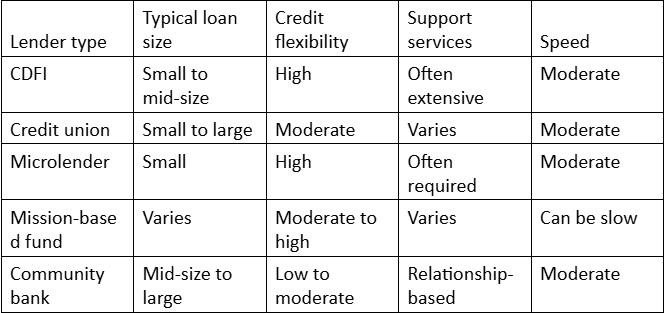
Quick Comparison
How to Find and Evaluate Community Lenders
Community lenders rarely advertise as heavily as national online platforms, so finding them takes a little effort. Start with your local small business development center, chamber of commerce, or economic development office. Ask other local business owners where they borrowed. Search for CDFIs and microlenders serving your city or state. Libraries, community colleges, and local business associations frequently host workshops where these lenders present their programs, which is an easy way to meet loan officers and ask questions informally before you commit to anything.
Broaden your understanding of how these lenders compare with other options, too. Comparison resources like Compare Small Business Loans and Compare Business Loans Online help you place community lending alongside traditional and online products. If your need is short-term operating cash, Best Working Capital Loans explains the structures commonly used for that purpose, and Business Loans Blog covers practical topics owners encounter throughout the process.
When evaluating a specific lender, ask:
- What loan sizes and purposes do you typically fund?
- What are your eligibility requirements for credit, time in business, and location?
- Do you provide coaching or technical assistance?
- How long does the process usually take?
- What collateral or guarantees do you require?
- Are there fees beyond the interest rate?
Choose One and Apply Thoughtfully
After your research, select the single lender whose mission, loan sizes, and requirements best match your business, and apply there first. This is especially important with community lenders, which often have small teams that invest real time in each applicant. Submitting duplicate applications to several lenders at once can trigger multiple credit inquiries, lowering your score. It can also strain relationships in a close-knit local lending community, where staff at different organizations sometimes collaborate or refer borrowers to one another.
A single, sincere application allows the lender to work with you fully. If the answer is not yes, many community lenders will explain why and suggest steps to strengthen your application, or refer you to a better-fitting partner. That guidance is valuable, and it is far more likely when you approach lenders one at a time.
Make the Most of the Relationship
Community lenders often want to see you succeed long after funding. Take advantage of any training or advising they offer. Share updates on your progress. Pay on time, and communicate early if challenges arise. A strong track record with a community lender can become a stepping stone to larger bank financing as your business grows. Ask whether the lender reports your payments to business credit agencies, since that history can help you build a profile other lenders will recognize.
The Bottom Line
The big banks and the fast online lenders are not your only options. CDFIs, credit unions, microlenders, mission-based funds, and community banks offer capital and, often, guidance designed for businesses that need a fair chance. Research them carefully, pick the one that fits, and apply with focus. You may find not just a lender, but a partner genuinely invested in your success and in the health of the community your business serves.