
By: Marcus J. Reed
Here’s the problem with Christian hip-hop: when you know the answer before you ask the question, where’s the tension? Here’s DPB’s solution: forget the question. Turn the answer into a hook, crank the beat, and repeat it until conviction becomes rhythm.
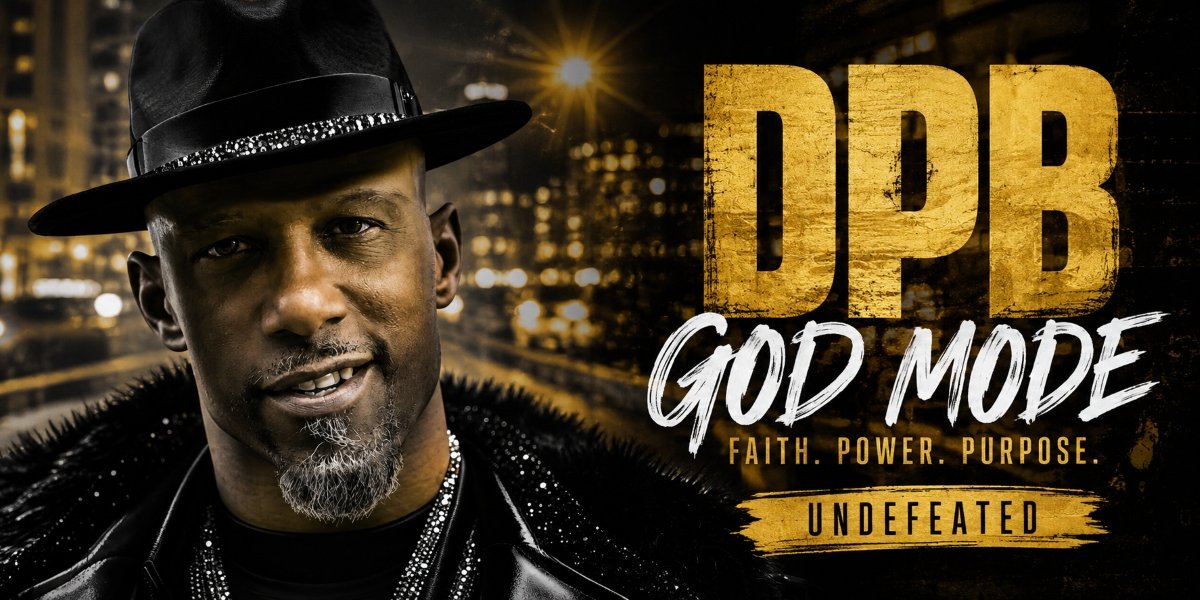
“God Mode,” from DPB’s Undefeated, has one big idea and absolutely no intention of hiding it. In gaming, God Mode makes you invincible. In DPB’s theology, believers already possess something better, not immunity from trouble, but divine authority within it. Thus the hook: “I’m in God Mode,” followed by the even more audacious “Jesus Christ is the God Code.” Subtle? No. Memorable? Try getting it out of your head.
That matters because DPB has never been an abstraction guy. He doesn’t construct theological labyrinths and invite you to admire the architecture. He puts EXIT signs everywhere. Jesus saves. Faith works. Healing happens. Get moving.
The song reportedly emerged from a dream in which DPB received the message that Christians spend too much time praying about tomorrow instead of using the spiritual authority they’ve already been given today. It’s exactly the sort of origin story that could sink a lesser record beneath its own self-importance. DPB escapes because he understands that pop music doesn’t require a systematic theology. It requires a premise you can feel before you finish explaining it.
So he gives you one.
“God Mode” is Christianity translated into the vocabulary of somebody who knows what a controller looks like. The trick is that DPB isn’t trivializing faith by turning it into a video-game metaphor. He’s using a secular expression of fantasy power to make a distinction about spiritual power. The gamer becomes invincible by entering a code; DPB’s believer becomes powerful by surrendering control.
There’s your paradox.
And paradox is more interesting than preaching.
Musically, the track charges ahead somewhere between hip-hop anthem and storefront revival. The beat hits hard enough to keep the sermon from becoming a lecture, while DPB performs with the kind of exuberance available mainly to people who aren’t embarrassed by enthusiasm. Earlier reviews have correctly noted the track’s high-energy production and revival-like character.
That enthusiasm is essential because these lyrics would collapse under a cooler performance. Imagine somebody murmuring “Deliverance is here / Freedom is here / Healing is here” with tasteful restraint. Disaster. DPB understands that proclamation requires volume.
His writing can be wonderfully blunt. Where another rapper might spend sixteen bars constructing an elaborate metaphor for redemption, DPB basically kicks open the sanctuary door and announces that Jesus has arrived. He piles healing upon deliverance upon miracles upon revival. There are body parts getting healed, streets getting spiritually transformed, and enough divine intervention to make realism file a formal complaint.
Good.
Faith music should occasionally sound as though the singer actually expects something supernatural to happen.
What saves “God Mode” from inspirational wallpaper is DPB’s personality. He has been making Christian hip-hop for more than three decades, and you hear that history not as sophistication but as freedom. He isn’t auditioning for anybody. He isn’t trying to prove he knows what younger rappers are doing. He isn’t sanding Christianity off the record in pursuit of crossover credibility.
He believes this stuff.
That sounds obvious until you consider how much supposedly spiritual popular music seems terrified of saying anything spiritually specific.
“God Mode” has the opposite problem. Specificity comes at you with a megaphone.
Coming after “Back in the Day,” the contrast is especially effective. That National Radio Hits No. 1 looked backward toward DPB’s childhood, praying mother, church upbringing, neighborhood block parties, and the values that formed him. “God Mode” looks nowhere but now. The former asks what happened to the foundations; the latter asks what you’re going to do with them. “God Mode” subsequently climbed to No. 2 on Christian Music Weekly’s Rhythmic Airplay chart.
There’s also something pleasingly old-fashioned about DPB’s understanding of hip-hop. Not sonically, conceptually. Rap began partly as the art of declaring yourself into existence. The MC grabbed a microphone and told the room who he was, how strong he was, and why nobody could stop him. DPB preserves that boast but changes its source.
The conventional rapper says: I’m unstoppable because I’m me.
DPB says: I’m unstoppable because God is God.
That alteration turns braggadocio into testimony without eliminating the swagger that makes braggadocio fun in the first place.
Does “God Mode” overstate its case? Of course. That’s what anthems do. Does the repetition occasionally threaten to become redundancy? Certainly. But criticizing a revival chant for repetition is like complaining that “Louie Louie” could use another bridge. The repetition is the mechanism.
DPB has made a record about certainty in a culture addicted to ambiguity. You don’t have to share that certainty to recognize the force of it. “God Mode” is loud, literal, exuberant, slightly outrageous, occasionally corny, thoroughly sincere, and considerably more alive than music that mistakes tasteful vagueness for profundity.
Turns out the cheat code isn’t much of a secret.
DPB has been typing it in for decades.