
By Adrian Keller
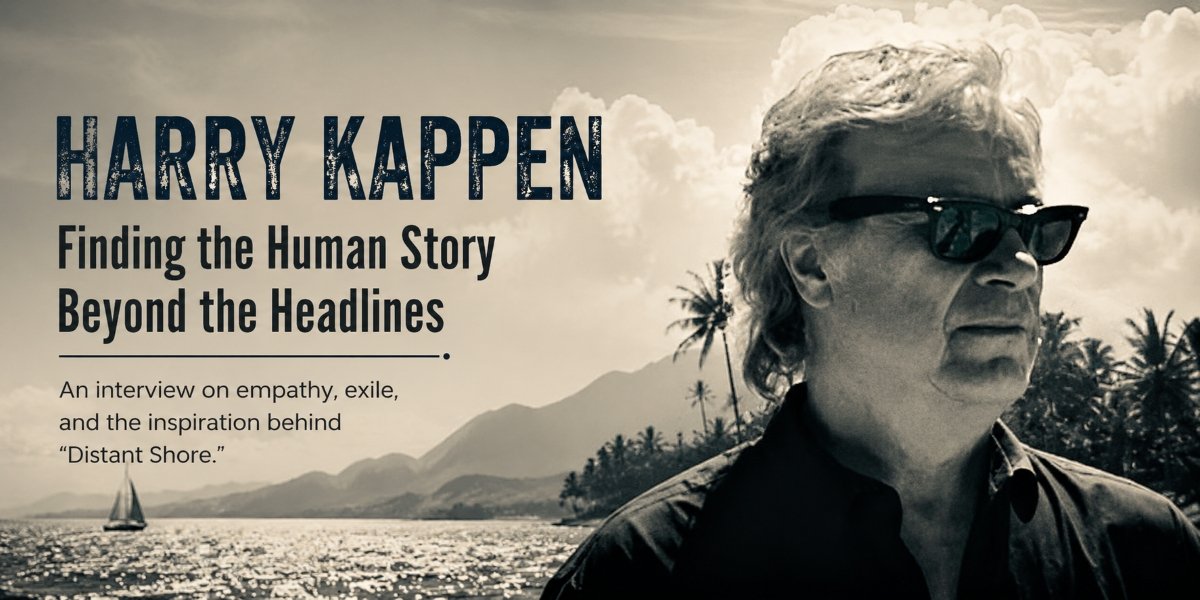
For Harry Kappen, crossing an ocean was never meant to become a political statement. When the Dutch singer-songwriter, producer, and music therapist relocated from the Netherlands to Mexico, he expected paperwork, shipping delays, and the inevitable frustrations that accompany an international move. What he didn’t expect was that those inconveniences would become the emotional spark behind one of the most affecting songs on his latest album, After the Crossing.
The result is “Distant Shore,” a reflective, deeply compassionate song that explores the refugee experience not through statistics or political slogans, but through empathy. It is a perspective that feels increasingly rare in an era dominated by polarization.
“My journey was a luxury trip,” Kappen says without hesitation. Compared to those fleeing war, persecution, or poverty, his own challenges were minor. Waiting months for residency documents and delayed household shipments became a lesson in perspective rather than hardship.
That realization transformed into songwriting.
Instead of framing refugees as a political issue, Kappen chose to focus on the emotional reality of people forced to abandon everything familiar in search of safety.
“Headlines lose their meaning,” he explains. “The human story has to be at the center.”
It is a philosophy that extends beyond music. Kappen believes modern politics often feels disconnected from ordinary people, creating space for division and misunderstanding. Personal stories, he argues, are what reconnect audiences to issues that otherwise become abstract debates.
That outlook feels particularly authentic because compassion has always been central to Kappen’s career.
Long before releasing albums, he built a professional life as a music therapist. Listening deeply, understanding emotional experiences, and walking beside people through difficult moments became daily practice. Those same instincts naturally shaped “Distant Shore.”
“As a therapist, you align yourself with whatever your client brings,” he explains. “You speak their language and stand beside them.”
That mindset allowed him to imagine the fears, uncertainty, and fragile hope of someone risking everything for the possibility of a better life. Rather than writing from a distance, he attempted to write from within that emotional landscape.
The song’s power also comes from its musical construction.
Kappen has an unusual songwriting process: melodies always arrive first.
“I write the music first and the lyrics later,” he says.
“Distant Shore” began with a slow, contemplative melody that immediately suggested a more serious subject. Having recently completed his move across the Atlantic, the theme seemed almost inevitable.
Once the lyrics found their home within the music, the song became something far more personal than he initially expected.
Today, he considers it one of his favorite tracks on After the Crossing.
Musically, listeners may notice subtle echoes of David Bowie’s “Space Oddity,” particularly through Kappen’s use of the Mellotron. Rather than imitation, however, Kappen views the instrument as an emotional texture.
“I love the Mellotron sound,” he says. “It always gives me a dreamy feeling.”
The rest, he believes, comes naturally through his own voice, guitar playing, and production style. Inspiration becomes influence rather than imitation.
His relocation has also offered a fascinating perspective on cultural identity.
Living in Mexico has exposed him to a society with a profound sense of historical pride and a musical culture deeply woven into everyday life. Unlike much of Europe, where English-language popular music dominates, Mexican audiences maintain an extraordinary connection to their own musical traditions.
“Everyone—young and old—can sing along to Mexican songs,” Kappen observes.
Yet despite immersing himself in a dramatically different environment, he says those influences have not yet altered his songwriting. His creative voice remains firmly established, allowing him to appreciate Mexican culture without abandoning the artistic identity he spent decades developing.
That may eventually change as he continues building a life there.
Kappen is currently assembling a new band in Mexico while already looking toward performances beyond its borders next year. It represents another chapter in a career built on evolution rather than reinvention.
Perhaps the interview’s most revealing moment comes when the conversation turns to the idea of home.
Having left one continent for another, what does home mean now?
His answer is remarkably simple.
“Home is where the heart is.”
For Kappen, home is no longer defined by geography. It exists in his marriage, his music, his family in the Netherlands, and the life he is creating in Mexico. More importantly, it exists within himself.
Feeling at home, he says, requires self-confidence, trust, vulnerability, and faith in one’s own creative path.
Those qualities are evident throughout After the Crossing and nowhere more than on “Distant Shore.” In an age when migration is too often reduced to political talking points, Harry Kappen offers something far more enduring: a reminder that every journey begins with a human being searching for a place to belong.
That may ultimately be the album’s greatest achievement. It doesn’t ask listeners to choose sides.
It simply asks them to care.