

By: Tally Daniels
Marc J. Straus’s play in verse turns an intensely complicated mother-son relationship into an act of memory, imagination, and reckoning.
When Marc J. Straus found his mother in the hospital, she had been admitted as a Jane Doe.
Dora Straus had collapsed on the street without identification after suffering a massive stroke. The damage left her paralyzed on her right side and with aphasia, unable to speak or make herself understood. Hospital workers assumed that she understood little of what was happening around her.
Her son believed otherwise.
“I knew instantly that she understood everything,” Straus recalled. He watched for the smallest signals: a change in her eyes, a movement of her face, a gesture from her left hand. He told her that he knew she was still there.
“One could see how important that was to her,” he said.
That encounter lies at the emotional center of Aphasia, Straus’s 85-minute play in verse, which comes to the Chain Theatre in Manhattan for three performances, Oct. 9 through 11. Written and performed by Straus and directed by Mara Mills, the play imagines what Dora might have been thinking during the long hours when a woman renowned for the force of her personality could no longer express herself.
The irony is almost theatrical in its precision. Dora was, by her son’s description, a “consummate wordsmith,” hypercritical, enormously well-read, opinionated, and formidable in an argument. She graduated from college as valedictorian at 76. Then, late in life, language, one of her greatest weapons, disappeared.
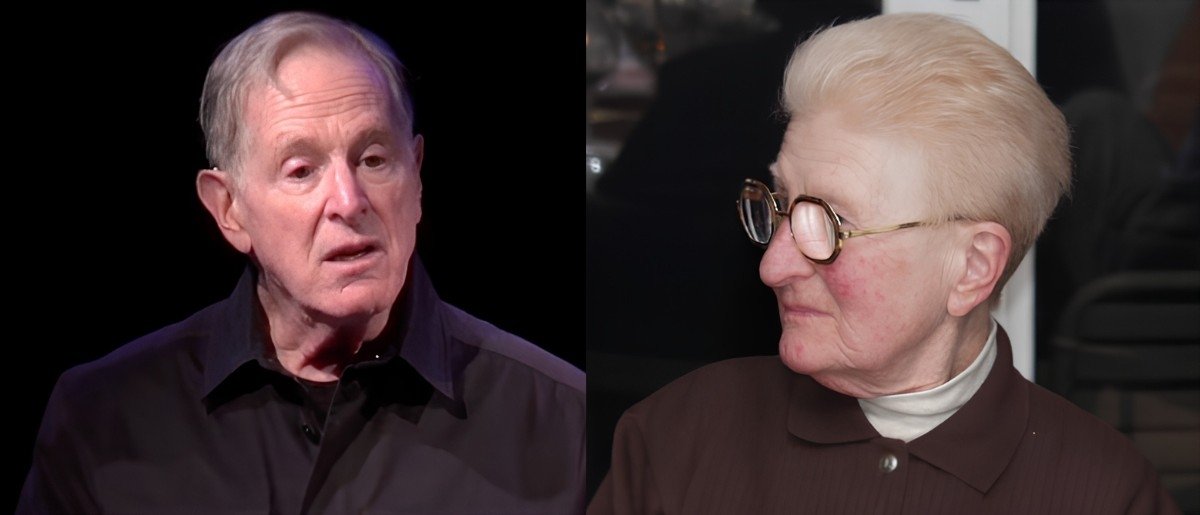
So Straus gave it back to her.
In the play, he becomes Dora, allowing his mother to tell her own story through a sequence of lyrical soliloquies. She determines what is remembered, what is confessed, and what remains unresolved.
Straus said the writing arrived less like invention than dictation.
“It came to me as though I was transcribing exactly as it was told to me,” he said.
That assertion creates one of the fascinating tensions in Aphasia. Straus is not merely a playwright constructing a character. He is a son imagining his mother’s interior life, a witness interpreting gestures, and now an actor stepping into her body and speaking words she never actually spoke.
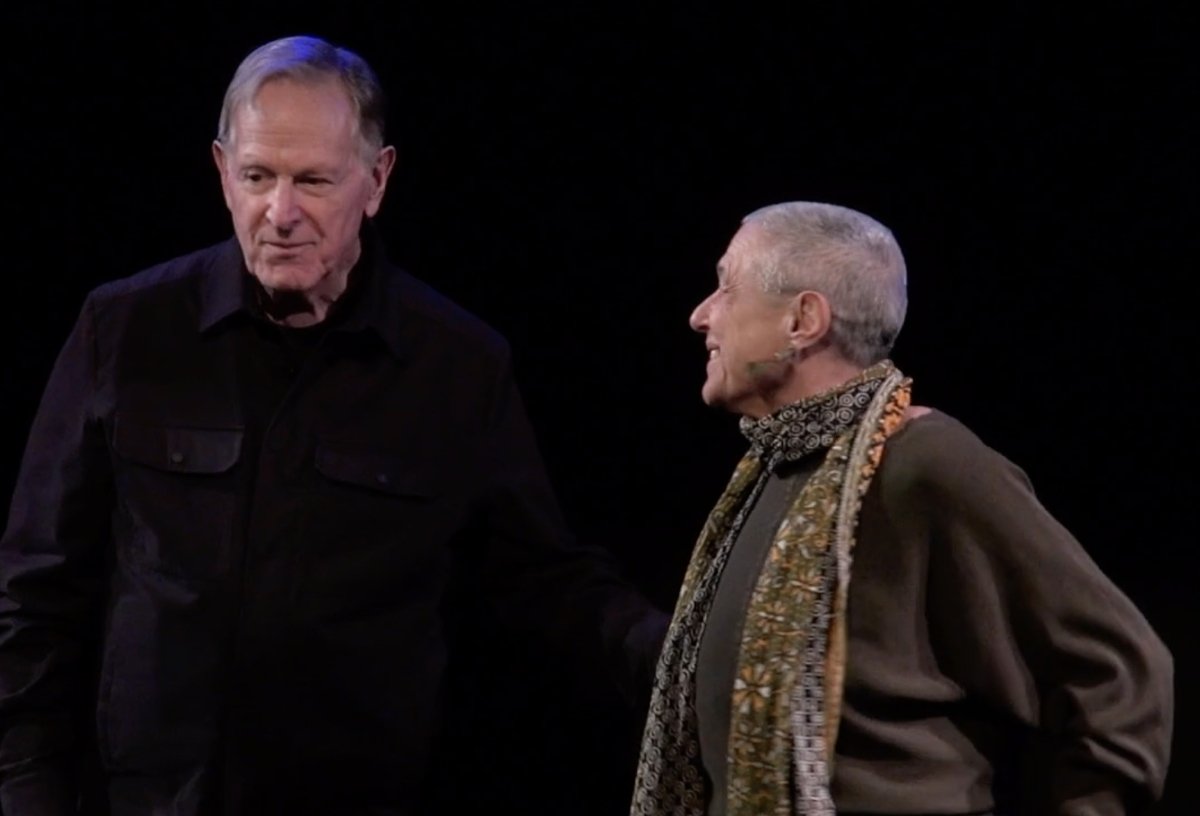
For Mills, that ambiguity is not a problem to solve. It is part of the play.
“How does one know what a parent would have been if she had made other choices?” she asked. “What secrets does a parent keep about themselves? What does a child do with both the myth and reality of a parent?”
What audiences encounter, Mills suggested, is simultaneously Dora’s imagined version of herself and Marc’s portrait of the woman he spent a lifetime observing.
And it was not an uncomplicated life together.
Straus describes his mother as “combative, competitive, critical and smart as hell.” He also speaks openly about physical abuse and about the effort required to resist her control.
“The hardest part of being her son was staying independent of her criticisms and opinions,” he said.
Other family members often stopped challenging Dora, he recalled, because doing so was exhausting. Straus did not. He pursued the subjects he wanted to study, married whom he wanted to marry, and became a poet despite the consequences.
Those memories make Aphasia something more difficult, and potentially more interesting, than a sentimental tribute to a dying parent.
There is affection in the work, but also anger. Admiration exists alongside injury. Straus is attempting to preserve his mother without sanitizing her.
“I wrestled with her all the years our lives overlapped,” he said.
The word “wrestled” feels important. Aphasia is not simply an attempt to recover Dora’s voice. It is another round in a lifelong conversation between two strong-willed people, except this time the son controls the page.
In rehearsal, Mills had to negotiate another unusual relationship: Straus was simultaneously playwright, actor and subject.
Once rehearsals began, she said, she largely ignored “Marc the playwright.” Instead, she worked with “Marc the performer” and “Marc the son,” treating individual poems as dramatic scenes and digging into the family history beneath them.
They traded family stories. They examined motivation and subtext. They established physical spaces that helped distinguish Marc from Dora until, Mills said, the two eventually emerged as separate characters who could exist anywhere onstage.
The goal was not impersonation.
Straus is not pretending to be his mother so much as navigating the shifting relationship between a voiceless woman, the son trying to understand her, and the writer who eventually translates that understanding into art.
That distinction also complicates the title.
For a play named Aphasia, Mills does not necessarily consider it a work primarily about language.
“Perhaps the play is not so much about language and more about communication,” she said.
Communication happens through memory, gesture and imagination: between a woman unable to speak and a son who learns to read minute movements; between the mother who survives in his memory and the poet who transforms those memories; and finally between performer and audience.
Mills said audience members have approached her after performances to tell stories about their own parents, suggesting that the specificity of Dora’s story can open onto something more universal.
Despite the medical condition at its center, Mills resists describing the play primarily as a work about disability, aging or even the structures surrounding long-term care.
Ultimately, she said, it is “a play of a family,” sons and daughters, spouses and parents, histories and stories filtered through the person who listens, watches and interprets.
For Straus, now a poet, physician, art collector and gallery owner, that act of interpretation also raises a question that may be impossible to answer: What would Dora herself have made of the play?
He can imagine the review.
She would shake her head, he said, and pronounce it “Not Bad.”
Then, naturally, she would have notes.
She would particularly like the poem about Scrabble, he imagined, and another about her husband’s maddening habit of driving in the middle of the road.
She might even become tearful.
But she would accept its honesty.
For a mother who had spent a lifetime speaking her mind, that may be the closest thing to a rave.
Aphasia: A Play in Verse
Written and performed by: Marc J. Straus. Directed by: Mara Mills.
Performances: Friday, October 9 at 7 PM; Saturday, October 10 at 7 PM; and Sunday, October 11 at 3 PM.
Location: The Chain Theatre, 312 W. 36th Street, 3rd floor.
Running Time: 85 minutes.
Tickets begin at $40. For tickets, visit aphasia2026.eventbrite.com