By: Kahyun Lee
Freud introduces the concept of the ‘Tummelplatz’, which translates to “playground”. The playground is considered an in-between space between “illness” and “real life”. The emotional transference and the compulsion to repeat as a way of remembering may unfold in this intermediate region. In this space and time, one can unpack past events and process the present through imaginative play.
Ke Qin’s moving image, Through the Fissures of Perception, presents a version of “Tummelplatz,” loosening the regime of logic that constructs conscious perception and inviting imagination to play freely. In this playground, the moving image seems to maneuver deftly between memories, slipping in and out of consciousness. Its shifting perspective may disorient the viewers; the camera zooms out to a wide angle spanning the playground, dives underwater to look up through the surface, rises into the sky for a bird’s-eye view, and drops into the first-person perspective of a child gliding down a slide.
The motif of water repeatedly emerges in the film–submergence, surface ripples, raindrops bursting against the ground, roaring ocean waves, and storms with thunder, and together these elements further blur the vision and muffle the sound. The artist introduces overlapping moments where imagination and reality seem to bleed into each other. A goldfish crossing the sky, a blue elephant strolling by the pond–these surrealistic figures inserted into peaceful scenery of a playground can serve as reminders of permeable boundaries.

Photo Courtesy: Jinming Liu
The Installation view of ‘Swaying Within’, 2024, at the Espacio Gallery, UK.
Swaying Within is another iteration of the in-between space. It depicts how the consciousness of the patient and the therapist might collapse into a swirling chaos. The piece appears to lure the audience. “Hypnotises” could be more accurate. Set in a clinical space with flickering fluorescent lighting and furnished with dull office furniture, a patient and therapist sit facing one another. They seem to appear as doppelgängers, one mirroring the other. An oscillating pendulum gradually hypnotises the patient as the steady beep of the cardiac event monitor accelerates. Upon entering the subconscious, the therapist waves her hand, inviting the patient to step closer and deeper into the abyss. At the climax, time and space seem to crumble into fragments, and the fine line distinguishing patient from doctor disappears.
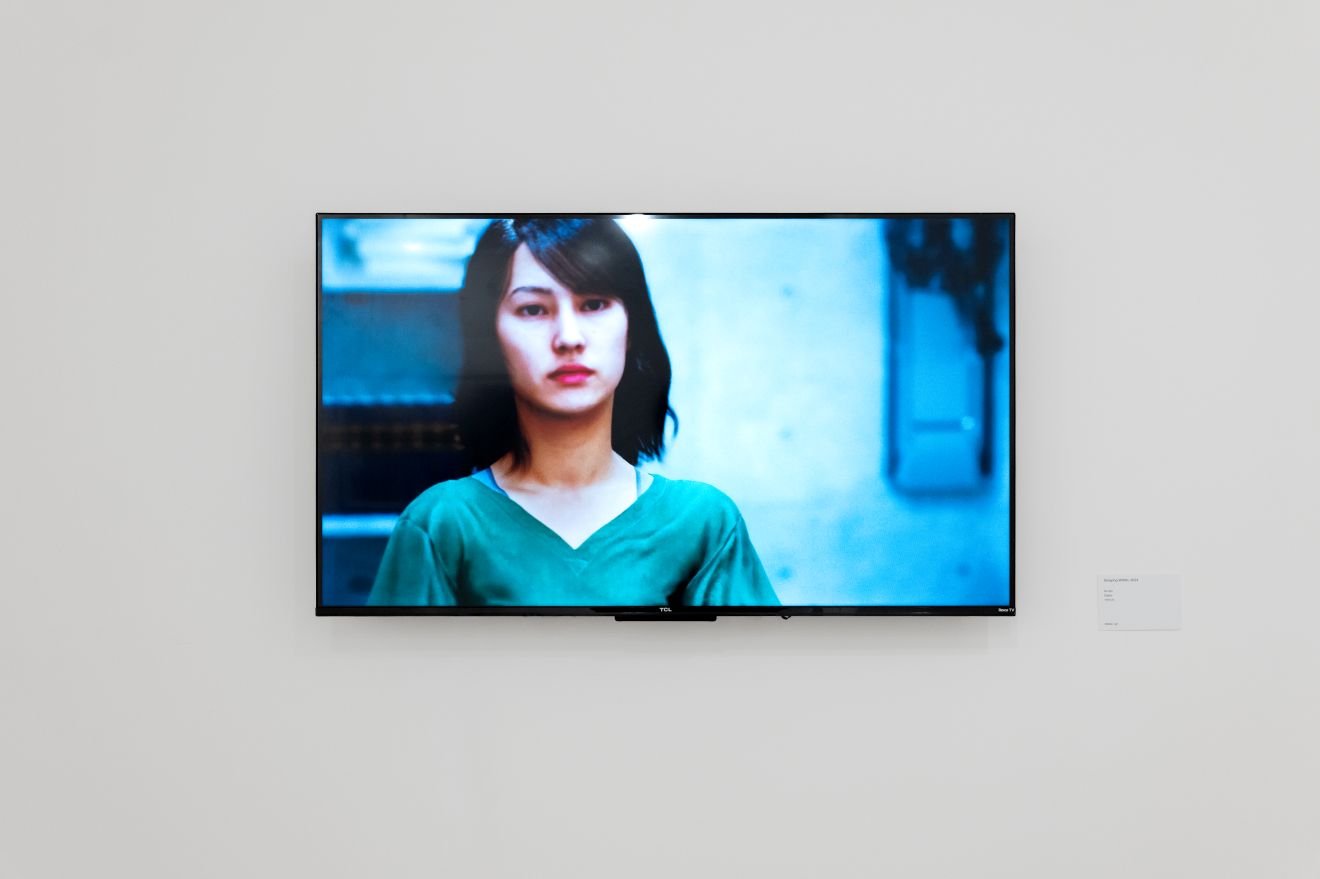
Photo Courtesy: Jinming Liu
The Installation view of ‘Swaying Within’, 2024, at the Espacio Gallery, UK.
By creating an intermediate field, a playground or a battlefield of sorts, Ke Qin invites the audience to question the vague division between the individual and the institution, the disease and the medicine, the illness and the real life, the imagined and the perceived. Ostensibly binary worlds tend to seep into one another and fold over each other in Ke Qin’s playgrounds.
Swaying Within is shown as a part of the exhibition Noctilucent at Espacio Gallery in London.
About the Author
Kahyun Lee is a curator, researcher, and writer based in London and Seoul. Her practice traces how modern and contemporary art reflects on the present and imagines alternative futures. Engaged with the formation of dominant narratives, Lee questions the structural frameworks such as institutions, national borders, and identities that shape art and its histories. She has contributed to Monthly Art, Qilu, Daejeon Museum of Art, and Seoripul Gallery as a writer. Currently a doctoral researcher at the Royal College of Art and Tate, supported by the Arts and Humanities Research Council’s Collaborative Doctoral Partnership, her research explores transnational curatorial practices and narratives of East Asian modern and contemporary art at Tate Modern. Lee has curated exhibitions and programmes at it’s a local collective, Museum of Contemporary Art Busan, and the Design Museum.