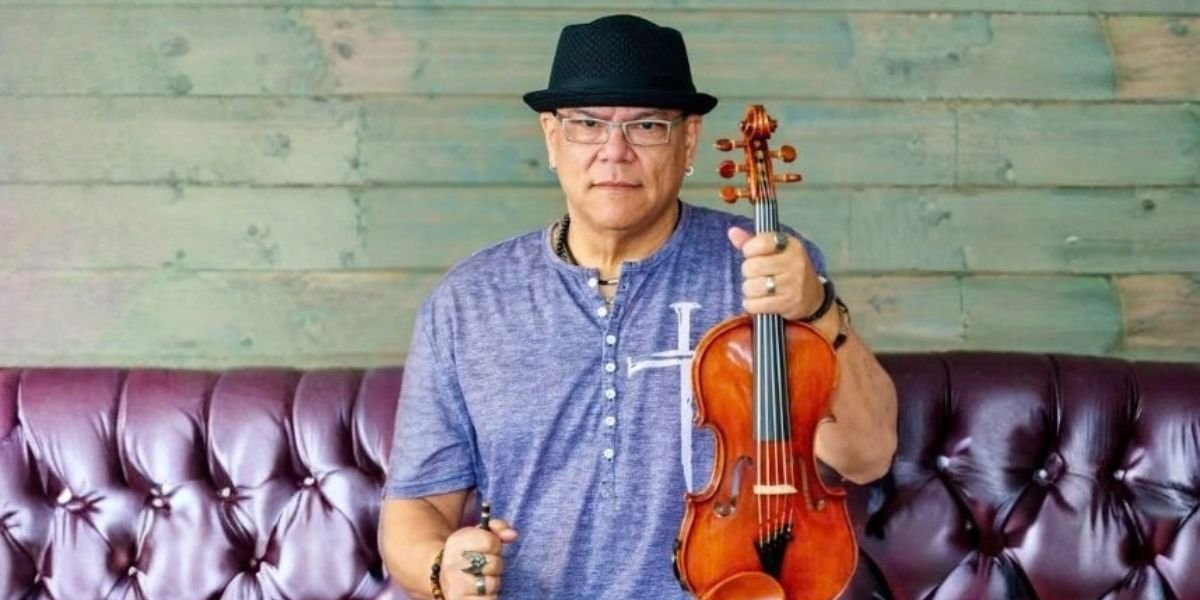

There is something unexpected about the way Jesús Florido thinks about the violin. Ask him about classical music, and the conversation might lead to Puccini. Ask him about phrasing, and he may talk about an old jazz singer. Ask him about the violin itself, and before long he is discussing six strings, seven strings, electric instruments, guitar pedals, Latin rhythms, improvisation, and sounds the violin was never traditionally expected to make.
For Florido, these are not contradictions. They are all part of the same musical language.
Throughout a career that has moved between concert halls, recording studios, classrooms, touring stages, composition, and music production, Florido has resisted one of the music world’s most persistent impulses: the need to put artists into categories. Classical violinist. Latin musician. Fiddler. Composer. Producer. Educator. He has been all of them, but perhaps the simplest description is the most accurate: musician.
At the center of his philosophy is an uncomplicated idea: good music is good music.
Florido has also never thought of the violin merely as a string instrument. To him, its closest relative may be the human voice. He approaches a phrase with the emotional instinct of a singer, the vulnerability of an old jazz vocalist, the dramatic sweep of a soprano singing Puccini, the rhythmic urgency of Latin music, or the freedom of an improviser discovering where a melody wants to go.
The technique may come from the classical tradition, but for Florido, technique is only the beginning. The real question is what a musician has to say.
Born in Venezuela in 1966 to a family of Italian ancestry, Florido grew up in a cultural environment where European and Latin American influences naturally overlapped. Piano and violin entered his life early, and he eventually became involved with Venezuela’s National System of Youth and Children’s Orchestras, the movement the world would later know as El Sistema.
Classical music gave him discipline, technique, repertoire, and a profound respect for tradition. What it did not give him were boundaries.
After moving to the United States in 1989, Florido continued studying violin performance and composition, including studies at Indiana University and Butler University. Composition opened another door, particularly toward film music and the possibilities of creating music beyond the conventional recital stage.
Meanwhile, another education was happening outside the practice room.
Jazz, rock, Cuban music, Latin American traditions, African influences, fiddle music, and improvisation increasingly entered his musical vocabulary. Florido listened, studied, played, and absorbed, gradually developing an artistic language that could move between those worlds without treating any of them as a temporary excursion.
A pivotal moment came through his relationship with celebrated American fiddler and composer Mark O’Connor. O’Connor recognized something in Florido that Florido himself had not yet completely embraced: his Latin American musical identity. He encouraged him to explore it.
The suggestion proved transformative. Florido was eventually invited to teach at O’Connor’s camp in Nashville, bringing together his classical foundation, Latin musical vocabulary, and growing fascination with improvisation. Somewhere along that journey, “Latinfiddler” was born.
What began as a name became something closer to an artistic declaration. A fiddler did not have to sound only one way. A Latin musician did not have to inhabit only one tradition. And a classically trained violinist did not have to leave classical music behind in order to explore everything beyond it.
Florido began treating musical traditions not as competing identities, but as different languages available to the same storyteller.
That philosophy found one of its clearest expressions in his debut solo album, Heading North. The recording refuses to remain comfortably inside a single genre. Jazz, rock, classical influences, Latin grooves, funk, and progressive elements move through the music without asking permission from traditional categories.
But Heading North was not intended simply as a collection of stylistic experiments. Florido was searching for something more integrated: an instrumental language in which those influences could coexist naturally. The violin could sing, groove, improvise, become aggressive or intimate, and move between lyrical and rhythmic roles. It could belong almost anywhere.
That same openness has shaped Florido’s collaborations. His career has placed him in musical environments associated with artists ranging from Yo-Yo Ma and Whitney Houston to Robert Plant and Jimmy Page, the Moody Blues, and guitarist Gary Hoey.
The significance of those experiences goes beyond a collection of recognizable names. Each musical environment requires a different instinct. A musician must understand not merely the notes but the language surrounding them.
That idea became particularly important in Florido’s collaboration with violinist Rachel Barton Pine on the 2011 recording Capricho Latino. His work included serving as a style director and coach as well as contributing arrangements. The objective was not simply to perform Latin American repertoire accurately, but to understand the stylistic vocabulary underneath the notation.
It is an important distinction in Florido’s musical world: the notes tell a musician what to play; culture helps explain how those notes live.
Throughout his career, Florido has increasingly occupied the space between performer and creator, working variously as violinist, arranger, composer, producer, stylistic coach, and educator. His teaching follows much the same philosophy as his performing. Rather than presenting classical technique and improvisation as competing ideas, he has worked to demonstrate how discipline, groove, stylistic authenticity, and creative freedom can strengthen one another.
Along the way, even the instrument in his hands began to change.
In the early 1990s, Florido encountered a violinist playing a handmade five-string violin. Traditional violins have four strings; this instrument added a lower string, extending its range into territory normally associated with the viola. Florido immediately understood the possibilities. Why carry a violin and a viola when one instrument could speak with both voices?
The five-string violin soon became an important part of his musical identity. At roughly the same time, he was experimenting with electric violins, amplification, and guitar effects pedals. Electric guitarists had spent decades manipulating their instruments through distortion, delay, modulation, and amplification. Florido wondered why violinists could not approach sound with the same freedom.
So he began experimenting.
The violin became an electronic sound source capable of being reshaped, expanded, layered, and transformed. Five strings eventually became six and seven, dramatically extending the range of a single instrument downward through viola and cello territory while retaining the brilliance and agility of the violin above.
For a musician already moving among classical music, Latin traditions, jazz, rock, improvisation, and contemporary production, the extended-range violin was not simply a novelty. It became a tool for a musical world that had grown larger than the traditional instrument.
Today, Florido continues working with violin makers and instrument designers to explore what future electric and extended-range violins might become. Importantly, he does not see this exploration as a rejection of the traditional violin. Quite the opposite. Centuries of violin making produced one of humanity’s most expressive musical instruments. Florido’s question is not how to replace it, but what else it can become.
That question may also describe Florido himself.
His career has been built around apparent contradictions that, in his hands, stop being contradictions: tradition and experimentation, discipline and improvisation, acoustic and electric, Europe and Latin America, concert hall and recording studio, performer and producer, teacher and student.
For Florido, respecting tradition does not mean freezing it in time. It means understanding it deeply enough to know how to carry it forward.
What Comes Next
That philosophy is now moving into a considerably larger arena.
In Los Angeles, Florido’s work has increasingly shifted from crossing musical borders himself to creating platforms where other musicians, traditions, and audiences can cross them together. Among the most ambitious expressions of that idea is Sonoro Latino, a large-scale concert production created by Florido that reimagines familiar classical works through the musical languages and rhythms of Latin America.
The concept grows naturally from the questions that have followed him throughout his career. What happens when music inherited from one tradition encounters another? Can a masterpiece be respected without being treated as untouchable? And can orchestral music reach audiences who may never have imagined that the world was meant for them?
For Florido, the objective is not to place Latin rhythms on top of classical music as decoration. It is to create a genuine musical conversation, one in which orchestral tradition, contemporary production, improvisation, technology, and Latin American culture can inhabit the same stage.
That vision also extends beyond performance.
Education has remained a constant thread throughout Florido’s career, and his current work increasingly focuses on what the profession will look like for the musicians who come after him. He envisions a generation of string players who do not have to choose between orchestral technique and improvisation, acoustic tradition and technology, performing and producing, or artistic excellence and entrepreneurship.
The modern musician, in Florido’s view, may need to be fluent in all of them.
It is perhaps the natural destination for an artist who has spent decades refusing to accept the walls between musical worlds. The young violinist who once moved between his Venezuelan upbringing and European classical tradition eventually became the “Latinfiddler,” then a performer, collaborator, teacher, producer, and advocate for expanding the physical possibilities of the violin itself.
Now the scale of the question has changed.
It is no longer simply: What else can the violin become?
It is also: What else can the concert experience become? What can a modern musician become? And who might discover this music if we are willing to open the doors wider?
After decades of playing the violin, perhaps the most revealing thing about Jesús Florido is that he still seems unwilling to accept that anyone, including himself, already knows everything the instrument, or the musician holding it, can do.
There is always another sound to discover, another rhythm to understand, another collaboration waiting to happen, another audience to reach.
And for Jesús Florido, there is another border to cross.