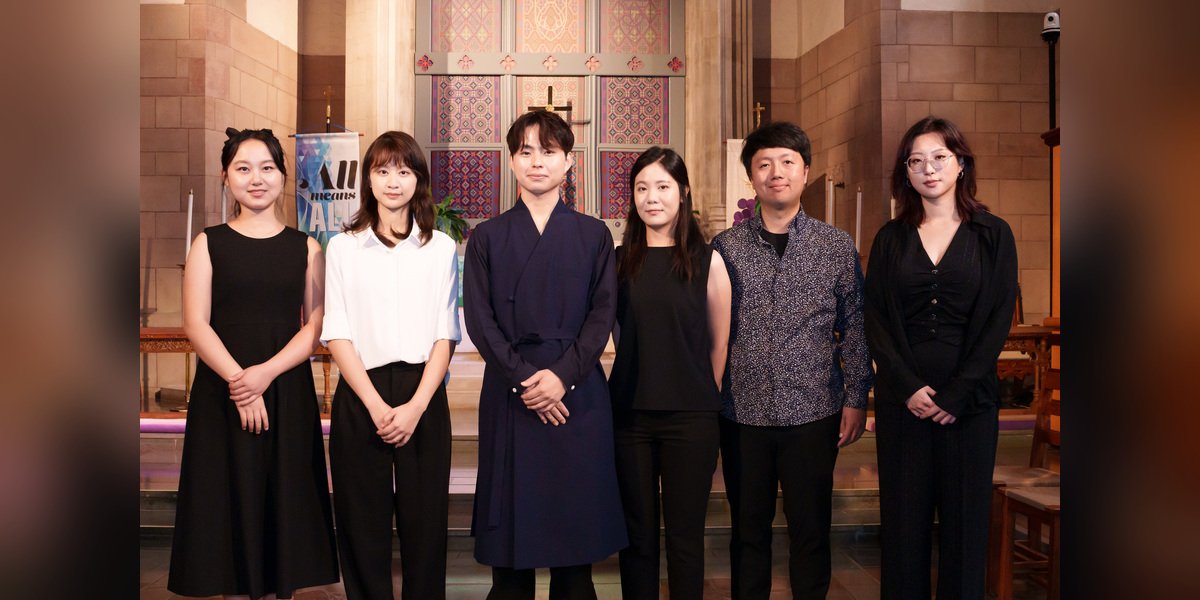

WASHINGTON, D.C. – The Washington International Young Artists Music Series brought a broad mix of instruments, repertoire, and artistic backgrounds to National United Methodist Church on Sept. 13 with MOSAIC, a concert whose title reflected the variety heard throughout the program.
Presented by the International Art Development and Promotion Association, the concert brought together pianists, string players, clarinetists, percussionists, and chamber musicians from across the United States. The program moved from J. S. Bach and Franz Liszt to André Messager, William Walton, Guillaume Connesson, and Casey Cangelosi.
Among the performers were six WIYAMS Artists whose contrasting roles reflected the program’s range: pianists Bella Xiangcao Shi and Ruoyang Xiang, clarinetist Li-Jie Yu, violist Chang-Ping Gu, and percussionists David Chungin Lee and Ruyun Irene Yang. Several appeared in more than one setting, creating connections between the concert’s solo and chamber performances.
“We wanted the program to feel varied,” said Dr. Jinwei Zhang, Co-founder and artistic director of WIYAMS. “These artists come from different places and work in different areas of music. What connects them is the seriousness and individuality they bring to the stage.”
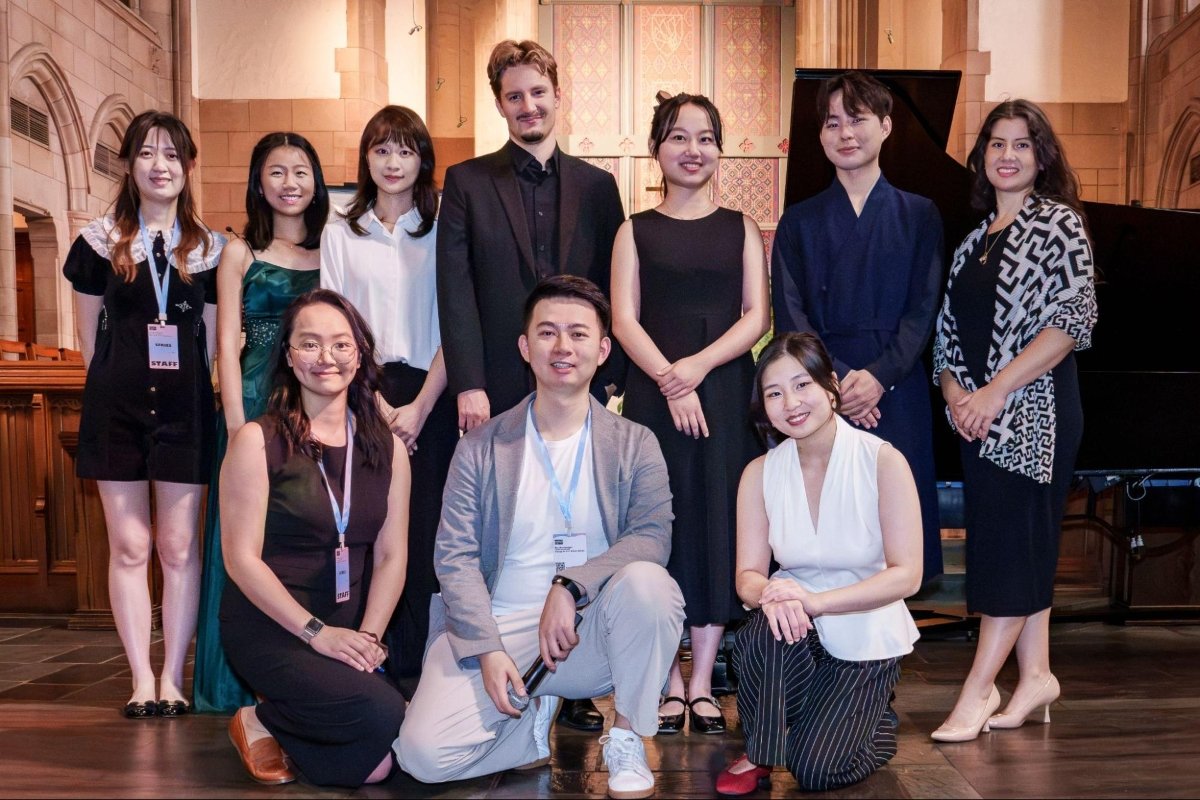
Photo Courtesy: Baiying Zhang (WIYAMS artists and members of the organizing team following the MOSAIC concert at National United Methodist Church. Pictured with the group are WIYAMS Founder and Artistic Director Dr. Jinwei Zhang and Operations Director Yingjun Amy Chen.)
Chinese pianist Bella Xiangcao Shi brought the Romantic piano tradition into the program with Liszt’s Transcendental Étude No. 10 in F Minor, S. 139/10. Urgent passagework and powerful chords repeatedly give way to broad lyrical gestures, requiring both technical command and a sustained sense of musical direction.
Active as a soloist, chamber musician, and collaborative pianist, Shi has performed across Asia, Europe, and the United States. She earned her Bachelor of Music from Ewha Womans University and is pursuing a Master of Music in Piano Performance at the Peabody Institute under Benjamin Pasternack. Her honors include First Prize at the Sviatoslav Richter International Piano Competition, Absolute First Prize at the Fanny Mendelssohn International Competition, and First Prize at the Seoul Art Concours.
Pianist Ruoyang Xiang provided one of the afternoon’s clearest connecting threads. She appeared in three different musical relationships: as pianist of the Vinola Trio, as Li-Jie Yu’s partner in Messager’s Solo de concours, and alongside Chang-Ping Gu in the first movement of Walton’s Viola Concerto. Moving between chamber musician and collaborative pianist, Xiang linked several otherwise contrasting parts of the program.
Xiang is Coordinator of Collaborative Piano at Truman State University and a co-founder of Vinola Trio, which also includes violinist Laurel Gagnon and clarinetist Li-Jie Yu. The ensemble performed Connesson’s Techno-Parade, a 2002 work for violin, clarinet, and piano driven by insistent rhythms, sharply defined instrumental colors, and quick exchanges among the three musicians.
Formed in 2021 with early support from the Verdehr Trio Commission Project at the Indiana University Jacobs School of Music, Vinola Trio is dedicated to expanding the repertoire for its distinctive instrumentation. The ensemble won the Grand Prize at the 2025 Plowman Chamber Music Competition and the Grand Prize at the 2026 NOLA Chamber Music Competition.
For Yu, Techno-Parade was only part of the assignment. She also appeared as soloist in Messager’s Solo de concours, with Xiang at the piano. Written to test both musical line and technical control, the piece shifts between elegant French lyricism and agile, extroverted passagework.
Yu joined the University of Wisconsin–Stevens Point as a tenure-track Assistant Professor of Clarinet in August 2026. The Taiwanese clarinetist previously served as Clarinet Associate Instructor at Indiana University, where she earned a Doctor of Music, an Artist Diploma, and a Master of Music. She also received Third Prize at the 2018 National Society of Arts and Letters Woodwind Solo Competition.
Gu and Xiang turned to a different musical language in the first movement, Andante comodo, of Walton’s Viola Concerto. With the orchestral part presented at the piano, the movement begins with a searching, melancholy viola line before expanding into music of greater urgency and weight. The writing allows the viola to move between introspection and a more assertive concerto voice.
Based in Bloomington, Indiana, Gu is a Taiwanese violinist and violist completing a Doctor of Music in Violin Performance at Indiana University, with minors in Music Theory and Viola. His work combines performance, pedagogy, and analysis; his doctoral research applies Schenkerian analysis to violin practice. He has performed with the Owensboro Symphony, Queensboro Symphony, Taipei Camerata, and Taipei Philharmonic Orchestra.
The concert’s two percussionists approached their instruments from markedly different directions.
Los Angeles–based David Chungin Lee performed his own arrangement of the Chaconne from Bach’s Partita No. 2 in D Minor, BWV 1004. Although composed for solo violin, the Chaconne has long attracted arrangers because its architecture remains recognizable across changes in instrumentation. Lee recast that structure through the resonance and physical vocabulary of percussion.
A Korean American percussionist, composer, and educator, Lee has appeared at Carnegie Hall and David Geffen Hall. In 2026, he joined the World Percussion Group for a European tour of concerts and masterclasses. He is completing a Doctor of Musical Arts at the University of Southern California, where he serves as Assistant Lecturer of Percussion and a graduate teaching assistant.
New York–based percussionist and interdisciplinary artist Ruyun Irene Yang performed Casey Cangelosi’s Meditation No. 1, a work in which gesture, repetition, resonance, and silence become part of the musical argument.
Yang has performed at Lincoln Center, The Midwest Clinic, the Percussive Arts Society International Convention, Mozarteum University Salzburg, and Cadillac Shanghai Concert Hall. Her honors include First Prize at the Singapore International Percussion Competition and silver medals at the PAS China International Percussion Festival. She is pursuing a master’s degree at Columbia University after graduating from the Eastman School of Music.
Across the larger program, solo performances and chamber collaborations placed Romantic virtuosity beside contemporary rhythm, a concerto movement beside a French competition showpiece, and historic repertoire beside newer approaches to instrumental sound. The connections emerged through contrast, with each artist retaining an individual musical identity while contributing to the larger design of MOSAIC.
WIYAMS expressed its appreciation to National United Methodist Church for welcoming the series and supporting its 2026 concert season. The organization also recognized Dr. Mary Voutsas, whose efforts helped establish the collaboration and bring MOSAIC to the church’s historic Washington space.