
By: Jeremy Cline
Some choreographers use technology because the moment seems to demand it. And then there are dance artists like Wang Zhaotian, for whom technology appears less as a tool and more as a quiet ecological condition—something that surrounds the body the way air or memory does. Watching his work, I’m struck not by the novelty of the devices he uses, but by the patience with which he listens to what the machines refuse to do. That resistance becomes part of the choreography.
Wang grew up within the rigorous discipline of Chinese traditional dance, and you can still see that lineage in the way his dancers carry their torsos, in the subtle tilt of the sternum, in a certain restraint that feels inherited rather than learned. But he places this inherited body in environments that seem to move according to their own logic—glitchy, delicate, sometimes uncooperative. The dialogue between the two creates a tension that feels his: a tradition that knows where it comes from and a digital environment that has no idea where anything begins.
One of his recent works, The Things I Don’t Speak Of, unsettles quietly. It opens with a single performer, almost still, their breath mic’d so softly that you’re not sure whether you’re hearing it or imagining it. The projections that surround the body don’t behave like stage visuals; they behave like thought—fragmentary, inconsistent, arriving half a second too late. Wang uses breath as the trigger for the projections, which sounds like a clever technical idea but plays out more like an externalized nervous system than an effect. When the performer inhales too sharply, a cluster of words appears overhead and dissolves before you can parse it; when the breathing settles, the space thins out, like the mind deciding not to reveal something after all.
There’s something almost uncomfortable about watching it, as if you’re intruding on the backstage of someone’s interior life. What stays with me is not the technology, but the way Wang positions silence—not as emptiness but as pressure, a kind of emotional static. The piece edges toward confession but never commits. It hovers. It refuses closure. It feels, in the best way, unfinished, like a thought that keeps circling back to itself.
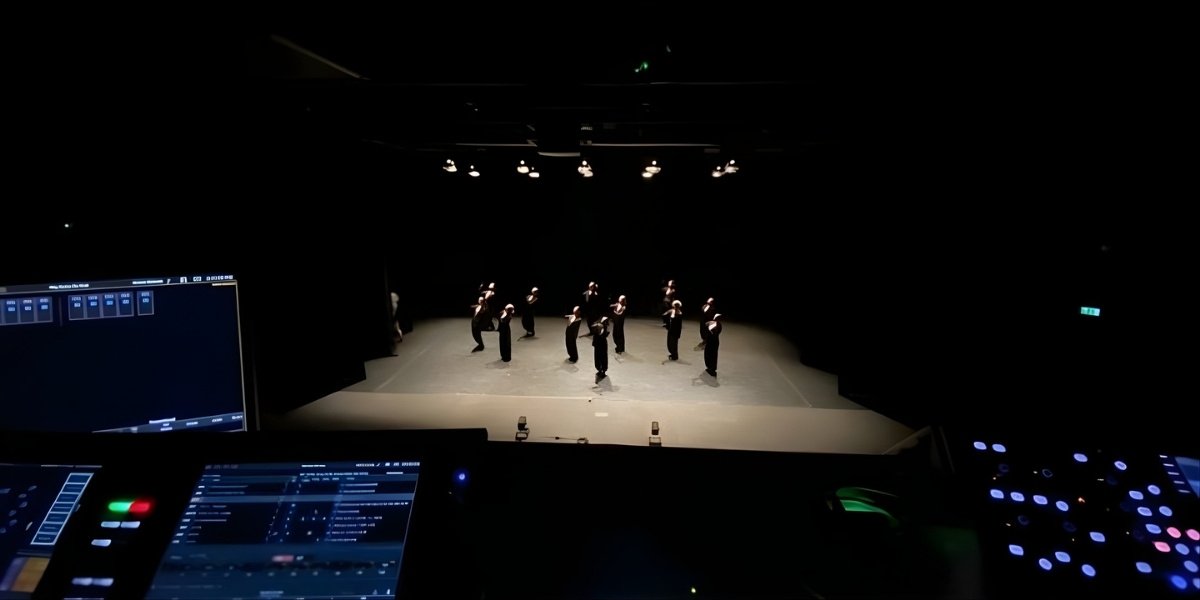
A very different atmosphere emerges in Ashes Fold Into Light, although the works seem to speak to each other in a way Wang doesn’t explicitly acknowledge. Here, two dancers move through a slow storm of projected particles—dust, ash, things that look like they’re falling but never quite reach the ground. The projections react to shifts in the dancers’ weight, but the reaction is intentionally delayed, as if the space were tired or reluctant. I found myself watching the pauses more than the steps. When a dancer hesitates, the particles accumulate around the body, suggesting both erosion and attention—the environment waiting for the human to decide.
There is an understated melancholy running through the piece, not because it is sad, but because Wang seems fascinated by the traces movement leaves behind, the residue of choices that don’t announce themselves. At one point, the dancers cross in near silence, and for a moment the particle field generates a faint echo of a third figure—just long enough for the audience to wonder whether movement has a memory independent of the mover. It’s the kind of moment most choreographers would try to repeat or highlight; Wang lets it slip away.

Photo Courtesy: Zhaotian WANG
If there is something distinctive about his process, it might be his willingness to let chaos remain chaos. Most technologically driven choreography I see in the U.S. leans toward polish—clean cues, crisp interactivity, a sense that the machine should behave correctly. Wang, in contrast, seems to treat error as a form of texture. In rehearsal, he reportedly spends as much time watching systems misfire as he does refining movement. The dancers learn to work with whatever the system is doing that day. In a world obsessed with optimization, this feels oddly radical.
I don’t think Wang is trying to make a point about technology. His work feels too subtle, too non-didactic for that. What he’s doing instead is paying attention to how bodies respond when the environment around them—digital or otherwise—refuses to settle. There is a gentle philosophical undertow to everything he makes, as if he’s less concerned with showing something than with holding open a question: how much of what we call choreography is actually negotiation?
You leave his performances not with answers but with a faint sense of being recalibrated. Something about the way his dancers move—alert, exposed, improvisationally honest—makes the digital effects feel strangely human, as though the technology has absorbed a bit of their vulnerability. I don’t know whether that’s what Wang intends, and I’m not sure he does either. But perhaps that uncertainty is part of the point. His work seems to belong to that small category of performances that don’t illustrate an idea so much as make space for one to appear.