
By: Gina Kurtz
Listening to Patti Spadaro’s “Mystic Misfit” feels less like following a conventional rock song than watching a carefully unfolding piece of movement theater. Nothing arrives abruptly. The music stretches, breathes, contracts, and opens again, tracing an emotional landscape where every guitar phrase, vocal inflection, and rhythmic pulse seems connected to the body as much as the ear.
That physical awareness is no accident.
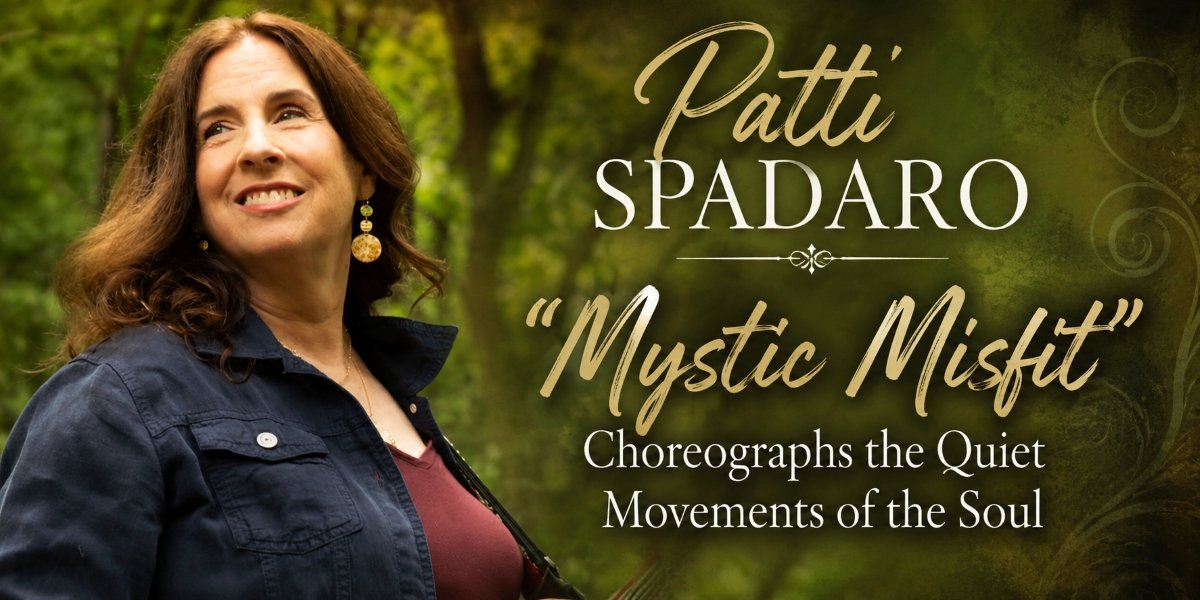
Spadaro occupies a rare creative intersection. She is not only a guitarist and songwriter but also a yoga instructor, meditation teacher, and educator whose work explores mindfulness through music. Rather than existing as separate identities, those disciplines converge naturally in “Mystic Misfit,” producing a song that values presence over spectacle and intention over excess.
The title immediately suggests tension. A mystic reaches inward; a misfit exists outside accepted boundaries. Those ideas become complementary rather than contradictory as the song unfolds. Spadaro isn’t interested in rebellion for its own sake. Instead, she explores what happens when someone accepts the discomfort of being different while continuing to seek connection with others.
The song’s opening establishes this emotional terrain with remarkable restraint. Eric Kurtzrock’s drumming resists the temptation to dominate, creating instead a spacious rhythm that allows the music to breathe. Ryan Black’s bass moves with quiet assurance, providing both momentum and stability. Cherylann Hawk’s harmony vocals arrive almost like shifting light, softening the edges without distracting from the song’s emotional center.
That center belongs unmistakably to Patti Spadaro.
Her voice carries none of the theatrical flourishes common to contemporary rock. Instead, it feels conversational, reflective, almost observational. She sings as though discovering each line as she performs it, allowing vulnerability to become part of the composition rather than merely its subject.
The recurring refrain, “Meet me in the middle,” functions almost like choreography.
Repeated throughout the song, the phrase changes meaning depending on its emotional surroundings. At first, it feels deeply personal, a reminder to return to one’s own center. Later, it becomes relational, inviting understanding rather than agreement. By the conclusion, it has evolved into something broader still: a philosophy rooted in balance rather than certainty.
That progression gives “Mystic Misfit” an unusual dramatic shape.
Spadaro understands that movement is rarely linear. Personal growth rarely follows a straight path. Like breath itself, it expands and contracts. The arrangement mirrors that rhythm beautifully, never forcing emotional climaxes but allowing them to emerge organically.
The bridge becomes the song’s emotional turning point. References to breathing among trees, sensing energy, synchronicity, and higher frequencies might appear abstract in isolation, yet Spadaro delivers them with such quiet conviction that they feel grounded rather than ornamental. Nature is presented not as escape but as a teacher. Awareness becomes less an achievement than a practice.
Then comes the guitar solo.
It doesn’t interrupt the narrative; it completes it.
Spadaro approaches the instrument almost as a dancer approaches space, not filling every available moment but understanding that silence, sustain, and restraint possess their own expressive power. Each phrase unfolds with patience. Notes bend toward one another with graceful inevitability, never rushing to resolution. The solo feels less like a demonstration of skill than an emotional conversation unfolding without words.
That may be the song’s greatest accomplishment.
“Mystic Misfit” consistently resists performance in favor of presence. It rejects the urgency that often dominates contemporary rock recordings, instead trusting the listener’s willingness to inhabit stillness. In doing so, it creates a rare experience: music that invites reflection without sacrificing momentum.
Spadaro’s background in mindfulness informs the work, but never confines it. She isn’t offering instruction or self-help. She is documenting an ongoing process of paying attention to oneself, to other people, and to the natural world. The song acknowledges uncertainty without becoming fragile and embraces hope without becoming sentimental.
There is also something quietly radical about its optimism. In a cultural moment often defined by polarization, speed, and constant distraction, “Mystic Misfit” suggests another possibility. It proposes that strength may reside not in certainty but in openness, not in louder voices but in deeper listening.
By the time the final notes fade, the listener has experienced more than a song. The music has become an act of attentive movement, carrying emotional weight through rhythm, breath, and space. Patti Spadaro reminds us that transformation does not always announce itself dramatically. Sometimes it arrives gently, asking only that we slow down long enough to notice.
“Mystic Misfit” understands that the most meaningful journeys are often measured not by how far we travel, but by how fully we inhabit each step along the way.