By Jim Manley
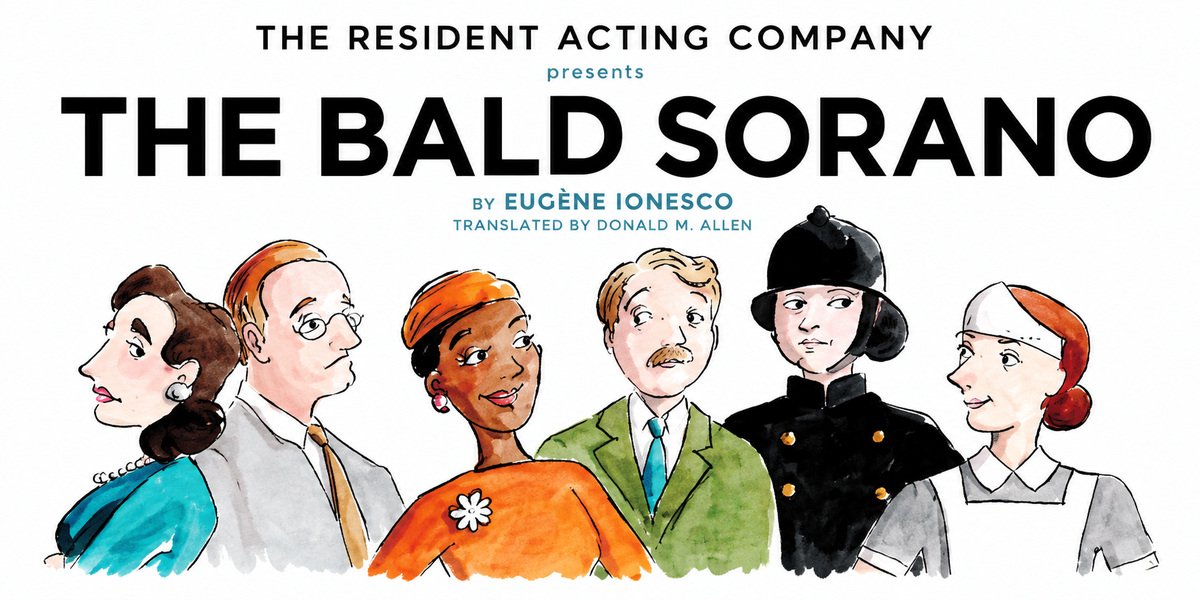
Fifteen years ago, Bradford Cover stood onstage in Eugène Ionesco’s The Bald Soprano. Now, returning to the same absurdist classic, this time from the director’s chair, he finds that the play has changed.
Or perhaps the world has.
“I am seeing so many things that I missed 15 years ago,” Cover said recently. “The older I get, the more this play makes sense to me, and the more comfortable I am with its seemingly wild language.”
That is a slightly alarming endorsement for a comedy in which polite conversation steadily disintegrates into clichés, contradictions, non sequiturs and verbal chaos. But beginning Oct. 11, Cover and The Resident Acting Company will invite New York audiences to decide for themselves just how strange Ionesco’s world feels in 2026.
The production opens Oct. 15 at the Frank Shiner Theater at The Sheen Center for Thought & Culture and runs through Nov. 1.
Written more than 75 years ago, The Bald Soprano is one of the foundational works of the Theatre of the Absurd. Ionesco found inspiration while studying English from a language manual, becoming fascinated by the mechanical, supposedly self-evident phrases used to teach conversation. In his hands, those orderly sentences began to unravel. Domestic small talk became existential comedy.
Today, Cover hears something surprisingly recognizable in the wreckage.
“The conversations in this play sound to me like real life,” he said.
The play begins conventionally enough, with the Smiths at home and the Martins arriving for a visit. But conversation soon ceases to function as communication. People speak past one another. Statements contradict what came before them. Language becomes performance rather than connection.
For Cover, that aspect of the play has taken on new urgency.
He said one reason he wanted to revisit the work was that its sound reminded him of the increasingly fractured nature of contemporary public conversation, particularly political discourse and social media.
“The play sounds and feels exactly like the ridiculous and cacophonous national conversations that we are currently having,” he said. “Listening is gone.”
Cover also sees a more serious current beneath the comedy. He views Ionesco’s absurdism partly through the playwright’s experience of political instability and authoritarianism in Europe and sees the Smiths and Martins as people trying desperately to preserve familiar social rules while the world beneath them shifts.
“The Smiths and the Martins represent the parts of society that play by the rules and don’t want to rock the boat,” Cover said. “Unfortunately for them, the boat is rocking them.”
The observation is Cover’s, and it is one reason he believes the play feels newly immediate. But The Bald Soprano has survived precisely because its targets are broader than any single political moment: conformity, complacency, failed communication and the human talent for saying a great deal while communicating almost nothing.
And, importantly, it is very funny.
That comedy will be entrusted to a six-member ensemble: Rachel Botchan, Anique Clements, Dan Daily, Dominic Cuskern, Andy Paterson and Carine Montbertrand. Their collective résumés stretch across Broadway, Off Broadway and regional theater, but their value to this particular production may lie just as much in the nature of the company itself.
The Resident Acting Company grew out of the artistic tradition of The Pearl Theatre Company, the respected Off Broadway classical repertory troupe that closed in 2017 after 33 seasons. The Pearl maintained a resident ensemble, actors who worked together repeatedly, developing a shared theatrical vocabulary over time.
Cover, Botchan and Daily were all part of The Pearl’s 2011 production of The Bald Soprano, directed by Hal Brooks.
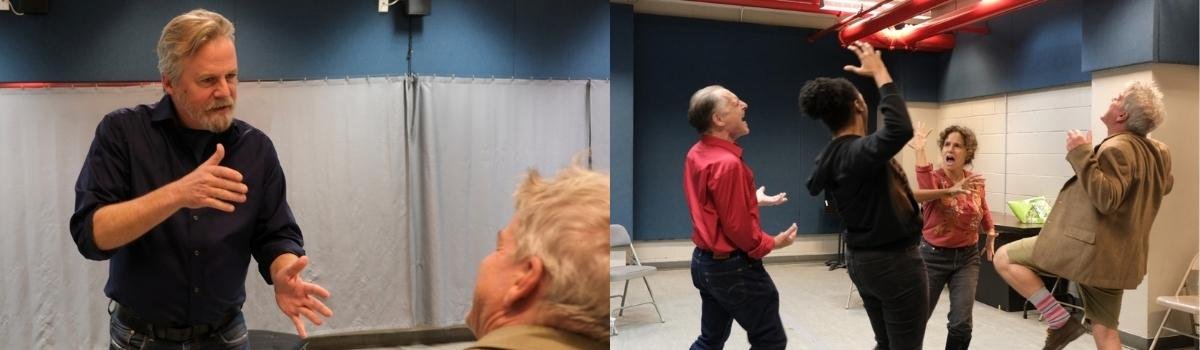
For Cover, returning with some of the same artists does not mean trying to reproduce the earlier staging.
“We can take what we learned 15 years ago and enrich it,” he said. “We take what we like, and also look for new answers to the challenges that the play presents.”
Then he added another advantage that only time can supply: “We are older and wiser.”
That familiarity among performers is particularly valuable in a play whose comedy depends on rhythm. Cover describes The Bald Soprano almost as chamber music for actors, although another musical comparison quickly comes to mind.
“We know each other’s rhythms and we can play off each other with great ease,” he said. “Like a jazz band.”
His job as director, he added, is to get everybody “playing together.”
“And listening to each other,” he said. “That is when the magic happens.”
There is an appealing irony in that goal. A play about people who cannot truly hear one another requires actors who listen with extraordinary precision.
That may also help explain why The Bald Soprano makes such sense for The Resident Acting Company. RAC was formed around the belief that an ensemble that works together repeatedly can dig more deeply into classical texts, finding not only their language but their contemporary pulse.
For Cover, choosing the play was therefore not simply an exercise in nostalgia for The Pearl.
“It felt right for this moment in our trajectory as a company,” he said. “Above all, it is inherently an ensemble piece.”
It also happens to be a work with almost absurd staying power of its own. The Bald Soprano has been performed continuously at Paris’s Théâtre de la Huchette since 1957, where it is identified with one of the longest theatrical runs in the world.
Now RAC is giving New York another encounter with the Smiths, the Martins and their rapidly collapsing universe of civilized conversation.
Cover hopes audiences will recognize something in that collapse, and laugh.
Because perhaps the strangest thing about The Bald Soprano in 2026 is not how absurd it sounds.
It is how little explanation it seems to require.
PERFORMANCE INFORMATION
The Resident Acting Company presents Eugène Ionesco’s The Bald Soprano, directed by Bradford Cover, beginning Oct. 11, 2026, with an official opening Oct. 15, and continuing through Nov. 1 at the Frank Shiner Theater at The Sheen Center for Thought & Culture, 18 Bleecker Street, New York City.
The cast features Rachel Botchan, Anique Clements, Dan Daily, Dominic Cuskern, Andy Paterson and Carine Montbertrand.
From Oct. 11–17, performances are Sunday at 2 p.m. and Tuesday through Saturday at 7 p.m. From Oct. 18–Nov. 1, performances are Tuesday and Wednesday at 2 p.m.; Thursday through Saturday at 7 p.m.; and Saturday and Sunday at 2 p.m.
Tickets are $33.85 for previews and $65.87 thereafter, inclusive of fees, and are available through Eventbrite. Additional information is available at RACNYC.org.