
By Melissa Morris
There are country songs that announce themselves with a bang, and then there are songs like Richard Lynch’s “Wait For Me,” which arrive quietly, take a seat at the kitchen table, and remind you that the most important stories are often the ones that never make the evening news.
The thing about country music, and particularly the traditional strain that Lynch has spent his career preserving, is that it has always understood the value of ordinary lives. Long before arenas, streaming numbers, and social media algorithms entered the picture, country songs were telling stories about the people who held families together, worked until their hands ached, and considered sacrifice less a burden than a responsibility. “Wait For Me” exists squarely within that tradition.
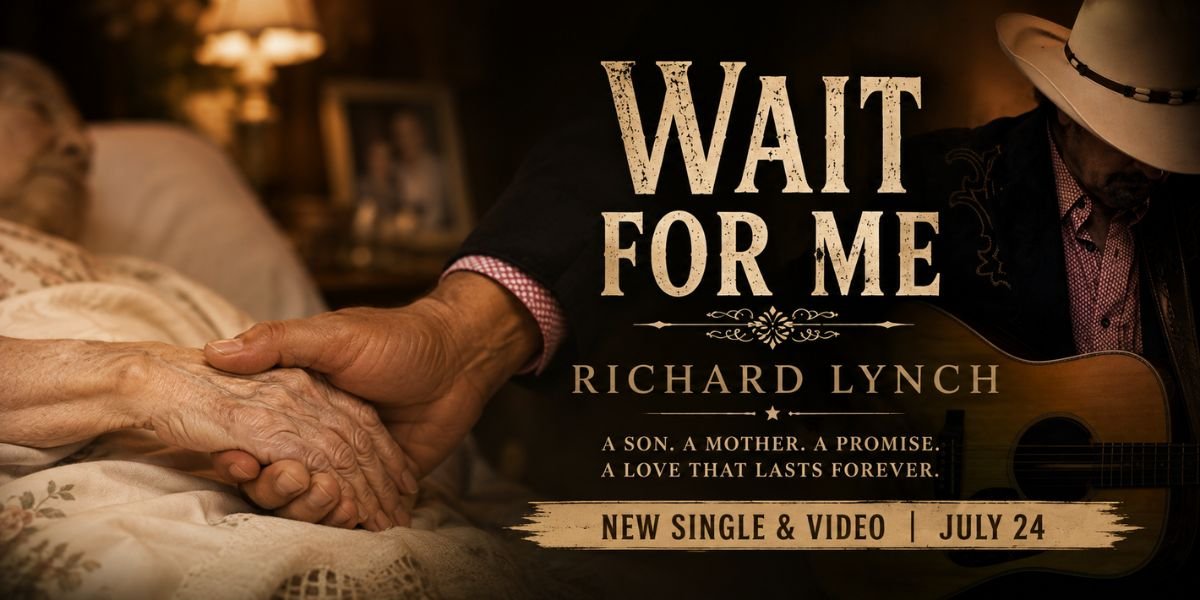
The song opens with a devastatingly simple image: a son sitting beside his sleeping mother, holding her hand while memories begin to flood his mind. From there, Lynch and co-writer John Lee build an entire world from details so familiar that listeners immediately recognize pieces of their own lives inside them.
The central image, of course, is a mother’s hands.
In lesser hands, no pun intended, that kind of symbolism could become unbearably sentimental. Instead, Lynch treats the idea with remarkable restraint. These are the hands that comforted frightened children, mended clothing, wiped away tears, soothed pain, prepared meals, and somehow managed to hold an entire family together along the way. The brilliance of the song lies in the realization that these acts, so seemingly small in the moment, eventually become the defining monuments of a person’s life.
That tension between the ordinary and the monumental has always been one of country music’s greatest strengths. Dolly Parton understood it. Merle Haggard understood it. Loretta Lynn built an entire career around it. Lynch understands it, too.
There’s an unhurried quality to the performance that feels increasingly rare. The arrangement doesn’t rush toward some grand emotional payoff because the song itself already carries enough weight. Acoustic guitar provides the foundation while steel guitar rises and falls around the melody like old memories drifting in and out of focus. Every instrument serves the story. Nothing distracts from it.
Lynch’s vocal performance is equally understated. His voice bears the marks of experience, which turns out to be exactly what this song requires. When he sings, “Momma, I’m on my way, I want you to see just how much I love you,” the line lands with a kind of quiet force that polished perfection could never achieve. It feels less like a performance than a confession.
That authenticity extends to the song’s spiritual undercurrent. Faith has always occupied an important place in Lynch’s music, but here it never feels performative or obligatory. References to God, peace, and eternal rest emerge naturally from the story itself. They’re expressions of belief rather than attempts at persuasion, and the distinction matters.
What’s especially striking about “Wait For Me” is the way it refuses to become consumed by grief. For all of its sadness, this isn’t really a song about death. It’s a song about gratitude. The narrator isn’t mourning the things he lost nearly as much as he’s celebrating the gifts he was given. By the time the final verse arrives, the listener understands that the plea to “wait for me” is about more than one last goodbye. It’s an acknowledgment that love has a way of lingering, of continuing to shape us long after the people who gave it to us have gone.
At a time when so much contemporary music seems determined to be louder, faster, bigger, and more immediate, Richard Lynch has done something quietly radical. He’s slowed things down. He’s trusted the story. He’s trusted the listener.
Most importantly, he’s trusted that the simple truth still matters.
And it does.
“Wait For Me” isn’t just another traditional country ballad. It’s a tribute to mothers, to memory, to faith, and to the thousands of small kindnesses that become the measure of a life. In the end, Richard Lynch reminds us of something country music has always known: the people who leave the deepest marks on our lives are often the ones who never ask for credit at all.