

Qualifying for a merchant cash advance is less like taking an exam and more like passing through a series of gates. Each one asks a yes-or-no question. Clear them all and a funder can often make an offer the same day. Get stopped at one, and you’ll need to fix something, wait, or choose a different product.
Here are the seven gates most funders use, along with what to do if a gate stays closed. Standards vary from one company to the next, so treat these as typical patterns rather than fixed rules.
Gate 1: Does Your Business Have Enough History?
Typical standard: Several months of operation at minimum, and often six months to a year.
Pass if: Your statements show continuous sales for the period the funder requires.
If the gate is closed: Newer companies can sometimes find funders willing to take less history in exchange for a smaller amount and a higher price. But a business with only a few months of receipts gives a funder little to assess, and you should expect limited choices. A microloan or a secured credit card may be a better starting point.
A sensible first step is to learn how the product is structured and described. A page such as Fundivi cash advance eligibility can help you see what kinds of details you’ll be asked about before you begin.
Gate 2: Are Your Receipts Large Enough?
Typical standard: A monthly minimum, frequently somewhere between $5,000 and $15,000 in receipts or deposits. Higher offers need higher volume.
Pass if: Your average monthly receipts, after removing transfers and loan proceeds, clear the minimum.
Funders commonly size an advance around one month’s receipts, sometimes less and occasionally more. Here’s how that might look:
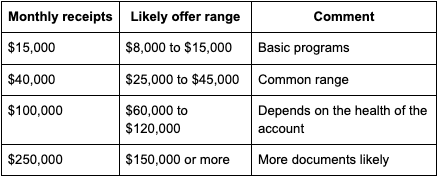
These are illustrative ranges, not quotes. Treat any offer far above your monthly revenue as a warning sign rather than a compliment, since larger holdbacks can cripple daily cash flow.
If the gate is closed: Consider asking for less, or look at other products meant for smaller operators.
Gate 3: Are Sales Frequent and Steady?
Typical standard: Regular deposits across the month, often several per week, with no steep recent decline.
Pass if: Your statements show a dependable rhythm.
A funder is buying a piece of your future sales, so it wants to see sales that repeat. A restaurant with hundreds of small daily transactions tends to fare better than a consultant with two large checks a month.
If the gate is closed: Supply an explanation for unusual months. Seasonal businesses should include prior-year statements for the comparable period. If deposits are truly irregular, invoice factoring or a term loan may be more appropriate.
Gate 4: Is the Account in Good Condition?
Typical standard: Few negative days and returned items, along with an adequate average daily balance.
Pass if: Recent statements show your account staying positive in most periods.
This gate catches many applicants by surprise. Lots of overdrafts tell a funder that daily remittances are likely to bounce. Funders differ on how many negative days they accept, but fewer is always better, and the most recent month counts the most.
If the gate is closed: A month or two of careful cash management can reopen it. Set low-balance alerts, schedule bills after deposits, and stop any payments you don’t need.
Gate 5: How Many Advances Do You Already Have?
Typical standard: No more than a limited number of existing “positions,” with some funders refusing anything beyond the first position.
Pass if: You have none, or your deposits comfortably carry what you’ve got.
Calculate your existing burden exactly. If your current advances collect $600 per business day and your average daily receipts are $4,000, you’re already giving up 15% of your sales. Adding another 12% leaves you with 73 cents of every dollar to run your whole operation. Many businesses can’t survive on that.
Be honest here. Funders see those debits, and most contracts prohibit undisclosed stacking. Reading about flexible funders for firms at every stage may help you locate alternatives if your existing positions have closed this gate.
If the gate is closed: Wait until a current position is paid down, ask your funder about reconciliation, or get independent financial advice. Taking on one more advance to make payments on the last one usually speeds up the decline.
Gate 6: Are There Legal or Tax Barriers?
Typical standard: No active bankruptcy, no significant unresolved tax liens, no large judgments.
Pass if: Public records come up clean, or any issues are being addressed under a documented arrangement.
Some funders accept tax liens with an approved payment plan. Few will proceed during an open bankruptcy. Personal credit gets checked here as well, though a low score is more likely to affect your price than to stop the deal altogether.
If the gate is closed: Gather your IRS or state payment plan letters and proof that you’ve kept up with payments. Request lien releases for any debts you’ve already satisfied. Coverage of fast term products, such as this NewsBreak article on term loans after SBA data, can also point you toward fixed-payment alternatives to explore.
Gate 7: Can You Move Fast Enough?
This is the only gate that’s entirely under your control.
Pass if you can do all of the following:
☐ Provide three to four months of complete bank statements
☐ Provide processor statements if you take cards
☐ Supply a legible photo ID for each owner
☐ Provide a voided check or bank letter
☐ Confirm that your name and EIN match across your records
☐ Take a verification call within minutes
☐ Apply early on a business day
Many funders can make a decision within hours when these items are ready. Funds may arrive the same day or the following business day, depending on the transfer method. A Friday afternoon signature might not settle until Monday.
After the Gates: Is It Wise?
Passing doesn’t mean you should go ahead. An MCA is frequently among the most expensive forms of business financing, so spend a few minutes on this last check.
Figure the holdback in dollars. Multiply your average daily receipts by the percentage, then subtract it from what you need to run the business each day.
Figure the true cost. Subtract net proceeds from total purchased amount. A $25,000 advance at a 1.35 factor with a $500 fee costs $9,250 on $24,500 received. If that’s repaid over five months, your annualized cost could well reach triple digits.
Compare it with the return. If $25,000 of inventory brings $40,000 in gross profit, the deal could be sensible. If it simply covers rent, you’ve made next month harder.
Independent comparison resources can help you evaluate your choices, though you should always verify what you read and check how any site is paid.
Common Reasons Otherwise Qualified Applicants Get Rejected
Even applicants who pass all seven gates can stumble over avoidable problems:
- Sending statements with missing pages
- Applying under a trade name that doesn’t match the bank account
- Failing to disclose an existing advance
- Submitting edited or altered statements, which is potentially fraud
- Providing a phone number that goes unanswered
- Asking for far more than monthly receipts can support
Each of those issues is within your power to prevent. The last one is especially common, because owners tend to request what they want rather than what their numbers support.
Frequently Asked Questions
What credit score is needed for an MCA?
Many funders have no strict minimum or accept low scores, focusing more on sales. Weak credit generally leads to a higher factor rate.
Can a home-based business qualify?
Yes, if it has a business bank account and steady receipts. Some funders ask for additional proof of operations.
Do I have to be taking credit cards?
Not always. Many programs now use total bank deposits and fixed ACH debits instead of card splits.
How long does an MCA offer last?
Often just days. Bank statements get stale quickly, and funders may request updated records after a short time.
Will applying affect my credit?
Some funders use a soft inquiry at first, while others run a hard inquiry. Ask before you give consent.
Can I qualify after a recent default on another advance?
It’s difficult, as funders share information and see UCC filings. Disclosure and a documented resolution improve your chances.
Is there an application fee?
Reputable funders usually don’t charge a fee just to apply. Be wary of anyone demanding payment before funding.
Can a business in any industry qualify?
No. Funders maintain restricted lists, which often include certain financial services, adult businesses, and other sectors they consider high risk.
Disclaimer: This article is for informational purposes only and does not constitute financial or legal advice. Merchant cash advance terms, eligibility requirements, costs, and funding timelines vary by provider. Funding within 24 hours is not guaranteed. Business owners should carefully review all agreements and consult a qualified financial professional before making financing decisions.